
FAA clears SpaceX to launch Starshp/Superheavy; 13th test flight set for July 16th
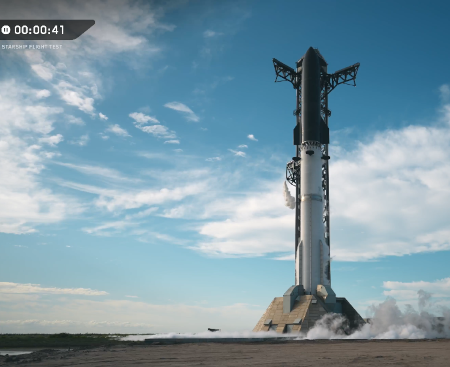
Starship/Superheavy on the launchpad prior to 12th test flight in May
The Federal Aviation Administration (FAA) today closed out its investigation of the 12th orbital test flight of Starship/Superheavy and cleared SpaceX to go ahead with the 13th test flight.
In truth what the FAA did was rubberstamp SpaceX’s own investigation into that flight, almost immediately after the company announced on July 11, 2026 that it was targeting July 16, 2026 for launch. The company has now posted a complete description of that investigation and the flight plan for the 13th flight.
First the cause of the failure of Superheavy to successfully return as planned:
At stage separation on Flight 12, slight differences in engine startup on the ship [Starship] caused the directional flip of the booster to be off by approximately 90 degrees. The startup sequence has been modified to be more robust to timing variability and more reliably flip in the desired direction, which is done to increase overall performance.
After stage separation and the flip, the Super Heavy booster attempted its boostback burn. Five of its 33 engines experienced issues when attempting to re-light causing the boostback burn to end early. The Super Heavy on this upcoming flight has hardware modifications to improve re-light reliability along with updates to engine alarms and aborts to match the conditions seen in the multi-engine flight environment.
In addition, hardware changes were made to the engines on Starship, addressing the failure of several to light during flight 12.
The 13th test flight will once again follow the low orbital path used in the past few flights that will bring it down in the Indian Ocean. A relight of a Raptor-3 engine in orbit will once again be on the schedule. Starship will also deploy for the first time 20 actual Starlink satellites, rather than dummy prototypes. Six will be outfitted with cameras to observe Starship’s heat shield as it and the satellites de-orbit.
Finally, the ship will do more tests of its heat shield and tiles during re-entry.
If all goes well, this will lay the groundwork for the first full orbital flight on the next launch, likely to occur about a month or so later.

On Christmas Eve 1968 three Americans became the first humans to visit another world. What they did to celebrate was unexpected and profound, and will be remembered throughout all human history. Genesis: the Story of Apollo 8, Robert Zimmerman's classic history of humanity's first journey to another world, tells that story, and it is now available as both an ebook and an audiobook, both with a foreword by Valerie Anders and a new introduction by Robert Zimmerman.
The print edition can be purchased at Amazon or from any other book seller. If you want an autographed copy the price is $60 for the hardback and $45 for the paperback, plus $8 shipping for each. Go here for purchasing details. The ebook is available everywhere for $5.99 (before discount) at amazon, or direct from my ebook publisher, ebookit. If you buy it from ebookit you don't support the big tech companies and the author gets a bigger cut much sooner.
The audiobook is also available at all these vendors, and is also free with a 30-day trial membership to Audible.
"Not simply about one mission, [Genesis] is also the history of America's quest for the moon... Zimmerman has done a masterful job of tying disparate events together into a solid account of one of America's greatest human triumphs."--San Antonio Express-News
I have a question for those who might know better than me.
I have found out that Space X is using phased array antennas on all its satellites and ground links. Yes their flat sat link is actually ,essentially, a phased array radar panel.
Could the Satellite antenna be turned into down look radar systems?
Could the flat panel uplinks be turned into cheap short range radar panels?
Maybe just a hardware addition and some nifty programing?