
Could Japan’s Hayabusa-2 next target asteroid be instead a failed Soviet Mars probe?
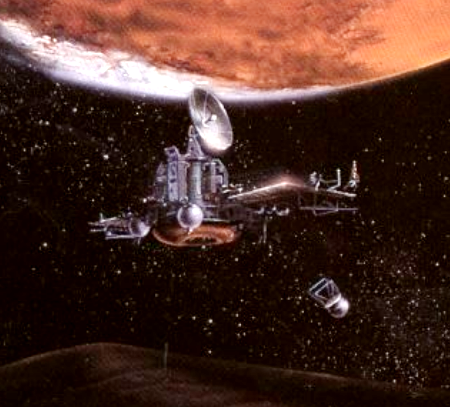
Artist rendering of Phobos-1 in orbit around Mars
Scientists reviewing the data known about the asteroid 1998 KY26, the next goal of Japan’s Hayabusa-2 asteroid probe, now speculate that it might not be an asteroid at all but could instead be the failed Soviet Mars probe, Phobos-1.
The researchers came up with this possibility due to 1998 KY26 small size, its inexplicable orbital shifts, and the fact that its solar orbit closely matches that of Phobos-1 after it failed to enter Mars orbit when a mistyped command shut down its systems.
Hibberd points out that the 10-metre (32.8ft) span of its solar panels matches the estimated size of 1998 KY26 and that the craft would be expected to have a high albedo. The non-gravitational acceleration of the object would be explained by solar radiation pressure as sunlight reflects off the probe’s shiny metallic surfaces.
For the interplanetary trajectory of Phobos 1 to fit the measured orbit of 1998 KY26, the probe would need to have subsequently fired its rocket twice, say the team: once on 2 September 1988 (shortly after contact was lost) and then again on 19 May 1996. This isn’t impossible for a malfunctioning spacecraft and there is some evidence that Phobos 1 did indeed fire its rocket without being commanded.
The last supposition, that the spacecraft fired its engines on its own, is the most implausible part of this theory, but not impossible.
Hayabusa-2 is scheduled to arrive at 1998 KY26 in 2031, assuming its last ion thruster does not fail. We shall then find out if this wild theory is right. If so, the probe will have an entirely different job. Rather than studying a very small asteroid, it will be studying a piece of human space history.

On Christmas Eve 1968 three Americans became the first humans to visit another world. What they did to celebrate was unexpected and profound, and will be remembered throughout all human history. Genesis: the Story of Apollo 8, Robert Zimmerman's classic history of humanity's first journey to another world, tells that story, and it is now available as both an ebook and an audiobook, both with a foreword by Valerie Anders and a new introduction by Robert Zimmerman.
The print edition can be purchased at Amazon or from any other book seller. If you want an autographed copy the price is $60 for the hardback and $45 for the paperback, plus $8 shipping for each. Go here for purchasing details. The ebook is available everywhere for $5.99 (before discount) at amazon, or direct from my ebook publisher, ebookit. If you buy it from ebookit you don't support the big tech companies and the author gets a bigger cut much sooner.
The audiobook is also available at all these vendors, and is also free with a 30-day trial membership to Audible.
"Not simply about one mission, [Genesis] is also the history of America's quest for the moon... Zimmerman has done a masterful job of tying disparate events together into a solid account of one of America's greatest human triumphs."--San Antonio Express-News