
Scientists rally to observe the Falcon 9 that will hit the Moon on August 5, 2026
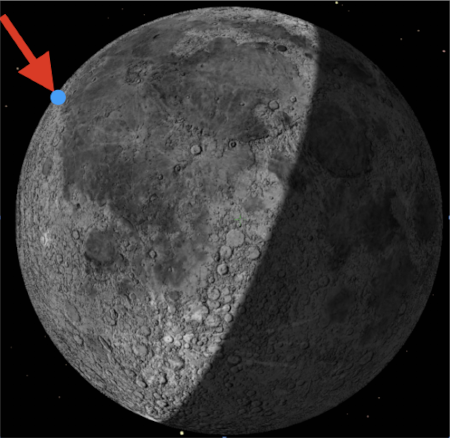
On August 5, 2026 at precisely 11:35 pm (Pacific), the upper stage used by the Falcon 9 rocket that launched in 2025 the Blue Ghost and Hakuto-R lunar landers will impact the Moon.
Scientists have now published a paper [pdf], outlining the details of that impact and calling on the astronomical community, both professional and amateur, to conduct observations. The image to the right, showing the location on the Moon where the impact will occur, comes from Figure 1 of the paper. From the paper’s conclusion:
The upcoming Falcon 9 upper stage impact on the Moon on 2026 August 5, presents an ideal opportunity for observers in the Americas and space-based assets to study a significant lunar impact in real time. Potential observables from this event include the flash at the time of impact (likely lasting less than a second) and the ejecta plume (lasting minutes to tens of minutes) Although some specifics of the impact (such as its precise visual magnitude) remain unclear due to the complexity of the physical processes involved, this event is an ideal opportunity to calibrate measurements of flash brightness and plume dynamics against a known event, should either be detected.
This event also provides an opportunity to test pipelines for measuring flash properties to locate impact events seismically, and to better understand the multi-modal hazards posed to future lunar infrastructure and astronauts from space debris impacting the Moon. It also provides an opportunity to test our capability to monitor the cislunar environment. Given the renewed interest in the lunar exploration, the impact of artificial bodies on the Moon could is almost certain to become more frequent. To avoid uncontrolled increases in the amount of space debris in lunar orbit (as is the case now in low Earth orbit), advancing monitoring of cislunar space from ground- and space-based facilities will be key.
The scientists note that the impact will occur at night when the Moon is visible in South America and in the low and mid-latitudes of North America. Though the impact flash could be as bright as magnitude 3 (thus visible to the naked eye), its location during the lunar day will likely make it too faint for ordinary observers. They say that a telescope will be needed, that binoculars will not be sufficient.
The paper is also very enlightening in that it provides a detailed history of past observed lunar impacts, both natural and artificial.

On Christmas Eve 1968 three Americans became the first humans to visit another world. What they did to celebrate was unexpected and profound, and will be remembered throughout all human history. Genesis: the Story of Apollo 8, Robert Zimmerman's classic history of humanity's first journey to another world, tells that story, and it is now available as both an ebook and an audiobook, both with a foreword by Valerie Anders and a new introduction by Robert Zimmerman.
The print edition can be purchased at Amazon or from any other book seller. If you want an autographed copy the price is $60 for the hardback and $45 for the paperback, plus $8 shipping for each. Go here for purchasing details. The ebook is available everywhere for $5.99 (before discount) at amazon, or direct from my ebook publisher, ebookit. If you buy it from ebookit you don't support the big tech companies and the author gets a bigger cut much sooner.
The audiobook is also available at all these vendors, and is also free with a 30-day trial membership to Audible.
"Not simply about one mission, [Genesis] is also the history of America's quest for the moon... Zimmerman has done a masterful job of tying disparate events together into a solid account of one of America's greatest human triumphs."--San Antonio Express-News