
Astronomers photograph baby stars in Orion
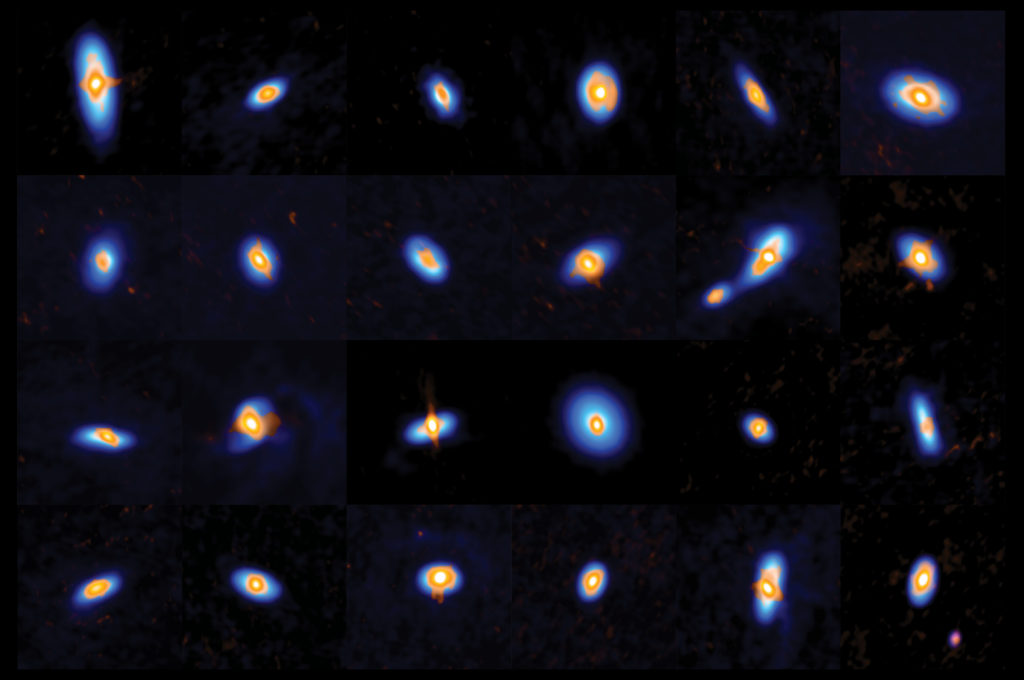
Click for full image.
Astronomers using two radio telescopes have created multi-wavelength radio images of 300 protoplanetary disks, or proplyds, found in the star forming region in the constellation Orion. The image to the right shows only a small sampling of the proplyds imaged.
“This survey revealed the average mass and size of these very young protoplanetary disks,” said John Tobin of the National Radio Astronomy Observatory (NRAO) in Charlottesville, Virginia, and leader of the survey team. “We can now compare them to older disks that have been studied intensively with [the radio telescope] ALMA as well.”
What Tobin and his team found, is that very young disks can be similar in size, but are on average much more massive than older disks. “When a star grows, it eats away more and more material from the disk. This means that younger disks have a lot more raw material from which planets could form. Possibly bigger planets already start to form around very young stars.”
Of the disks photographed, four appear to be extremely young, probably less than ten thousand years, because of their very blobby and irregular shape.

On Christmas Eve 1968 three Americans became the first humans to visit another world. What they did to celebrate was unexpected and profound, and will be remembered throughout all human history. Genesis: the Story of Apollo 8, Robert Zimmerman's classic history of humanity's first journey to another world, tells that story, and it is now available as both an ebook and an audiobook, both with a foreword by Valerie Anders and a new introduction by Robert Zimmerman.
The print edition can be purchased at Amazon or from any other book seller. If you want an autographed copy the price is $60 for the hardback and $45 for the paperback, plus $8 shipping for each. Go here for purchasing details. The ebook is available everywhere for $5.99 (before discount) at amazon, or direct from my ebook publisher, ebookit. If you buy it from ebookit you don't support the big tech companies and the author gets a bigger cut much sooner.
The audiobook is also available at all these vendors, and is also free with a 30-day trial membership to Audible.
"Not simply about one mission, [Genesis] is also the history of America's quest for the moon... Zimmerman has done a masterful job of tying disparate events together into a solid account of one of America's greatest human triumphs."--San Antonio Express-News