
Criss-crossing Martian ridges hit by new impacts
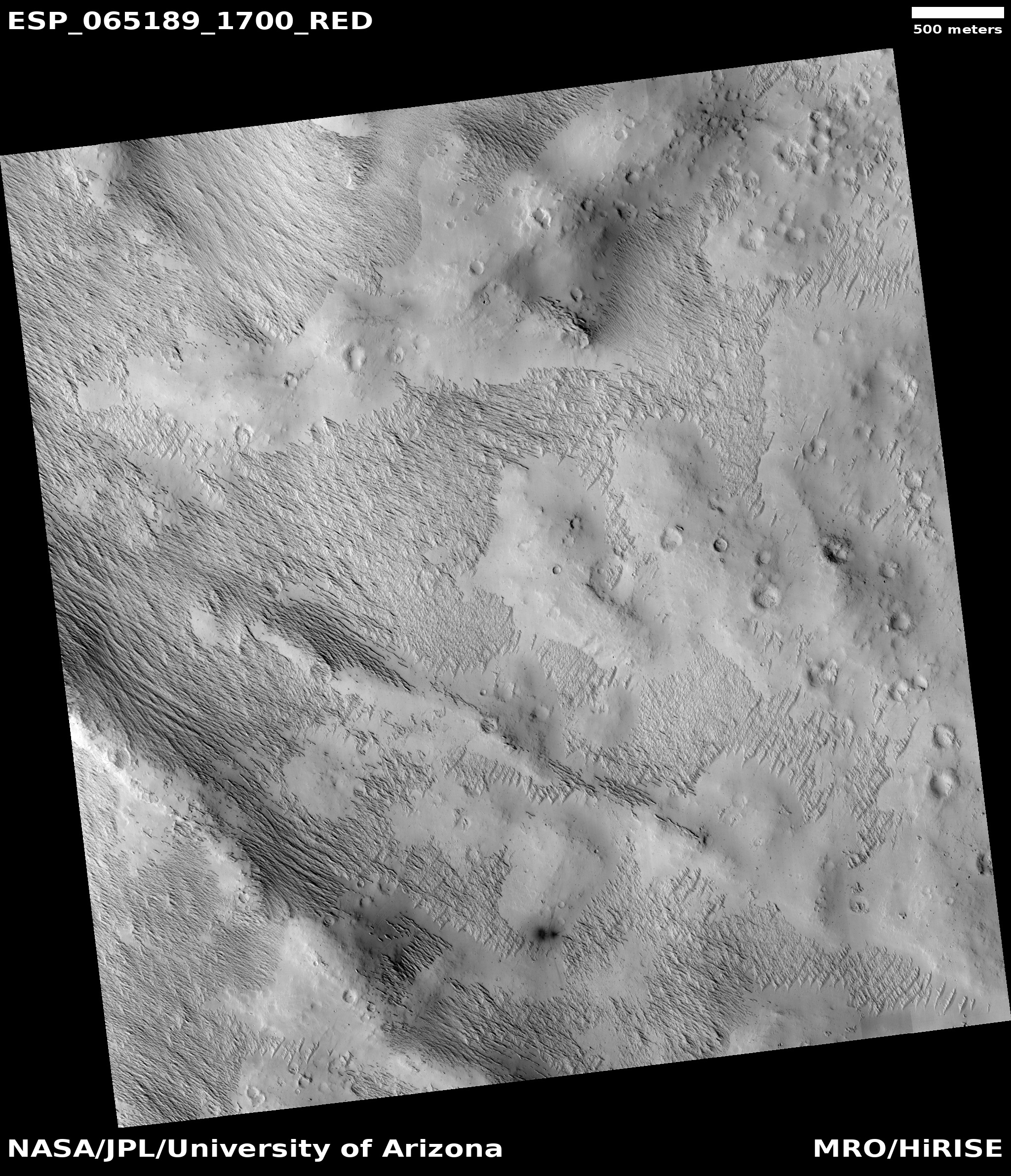
Click for full image.
The image to the right, cropped to post here, is a captioned photo from the high resolution camera on Mars Reconnaissance orbiter and released today. From the caption:
The black spots [recent impacts] form because the craters exposed cleaner materials in the subsurface beneath the bright, dusty surface.
Our image is also interesting because the surface has a criss-cross pattern formed by wind activity. Bright ripples that are oriented from the upper right to the lower left are perpendicular to the wind flow. In contrast, outcrops that have been eroded by the wind are oriented perpendicular to the ripples to produce the criss-cross pattern we now observe.
The overview map below might also help explain this criss-cross pattern.
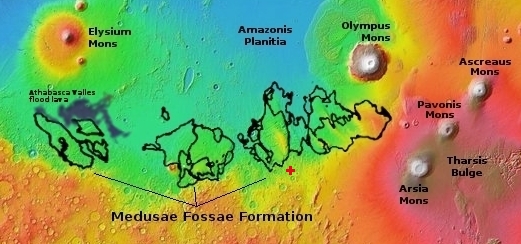
The caption notes that this image, indicated by the red cross, is located near the large meandering canyon dubbed Mangala Valles. What must also be realized is its proximity to both Mars’ giant volcanoes as well as the planet’s largest volcanic ash deposit, dubbed the Medusae Fossae Formation.
The darker northwest-to-southeast ridges appear to be ash deposits that are being eroded away by the wind, thus explaining their orientation parallel to the prevailing wind direction. If you go the Medusae Fossae link above, you will see from the cool image there the resemblance these ridges have to that eroding ash deposit.
The lighter northeast-to-southwest ridges appear to be the underlying bedrock, their orientation caused not by wind but by a more fundamental geological process related to the complex formation of Mangala Valles itself, as discussed in this paper [pdf]

On Christmas Eve 1968 three Americans became the first humans to visit another world. What they did to celebrate was unexpected and profound, and will be remembered throughout all human history. Genesis: the Story of Apollo 8, Robert Zimmerman's classic history of humanity's first journey to another world, tells that story, and it is now available as both an ebook and an audiobook, both with a foreword by Valerie Anders and a new introduction by Robert Zimmerman.
The print edition can be purchased at Amazon or from any other book seller. If you want an autographed copy the price is $60 for the hardback and $45 for the paperback, plus $8 shipping for each. Go here for purchasing details. The ebook is available everywhere for $5.99 (before discount) at amazon, or direct from my ebook publisher, ebookit. If you buy it from ebookit you don't support the big tech companies and the author gets a bigger cut much sooner.
The audiobook is also available at all these vendors, and is also free with a 30-day trial membership to Audible.
"Not simply about one mission, [Genesis] is also the history of America's quest for the moon... Zimmerman has done a masterful job of tying disparate events together into a solid account of one of America's greatest human triumphs."--San Antonio Express-News
What is with the parabolic looking line at the foci?
pawn: That’s a great question. I hadn’t noticed it until you pointed it out.
I suspect that this double impact occurred at the same moment, probably because the asteroid broke in two as it barreled though Mars’ atmosphere. That line is probably the result of the collision of the blast waves from the two impacts, laying down a line on the ground. If the left impact was slightly larger it would explain the slight push towards the right.
Parabola could indicate direction of impact? This looks like a double impact (meteor brought a friend?) and possible interference between impact shock waves?
Is there possibly an earlier photo of the same spot? Occasionally they have caught really recent impacts, proven by earlier photos without impact scars. This looks very recent.
Robert, I agree. They might have been additive and disturbed the lighter shaded soil to a higher degree where they met. The additive condition of the shocks was at a single location (considering a hemisphere) that moved outwards as time went on resulting in a continuous “curve”.
Kinda weird (but Mars……)