
InSight fails to respond during scheduled communications session
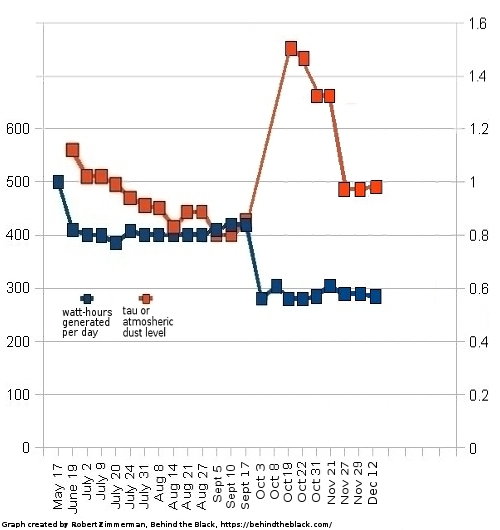
Since December 15, 2022 engineers have been unable to contact the Mars InSight lander, which likely means its power levels have finally fallen so low that the spacecraft is no longer functioning.
On Dec. 18, 2022, NASA’s InSight did not respond to communications from Earth. The lander’s power has been declining for months, as expected, and it’s assumed InSight may have reached its end of operations. It’s unknown what prompted the change in its energy; the last time the mission contacted the spacecraft was on Dec. 15, 2022.
The graph to the right shows the decline in InSight’s power levels since May. The atmosphere has been clearing following the dust storm in October, indicated by the drop in the tau level. Normal tau levels outside of dust storm season are around 0.6-0.7. It is therefore likely that as this dust cleared, it also settled on InSight’s solar panels, and reduced their ability to generate power to the point the spacecraft ceased functioning.
This is very much the same thing that put the rover Opportunity out of business in 2019.
According to this update, engineers are going to continue to try to contact the lander, but it is likely that this effort will end in about a week, should no contact be successful.

On Christmas Eve 1968 three Americans became the first humans to visit another world. What they did to celebrate was unexpected and profound, and will be remembered throughout all human history. Genesis: the Story of Apollo 8, Robert Zimmerman's classic history of humanity's first journey to another world, tells that story, and it is now available as both an ebook and an audiobook, both with a foreword by Valerie Anders and a new introduction by Robert Zimmerman.
The print edition can be purchased at Amazon or from any other book seller. If you want an autographed copy the price is $60 for the hardback and $45 for the paperback, plus $8 shipping for each. Go here for purchasing details. The ebook is available everywhere for $5.99 (before discount) at amazon, or direct from my ebook publisher, ebookit. If you buy it from ebookit you don't support the big tech companies and the author gets a bigger cut much sooner.
The audiobook is also available at all these vendors, and is also free with a 30-day trial membership to Audible.
"Not simply about one mission, [Genesis] is also the history of America's quest for the moon... Zimmerman has done a masterful job of tying disparate events together into a solid account of one of America's greatest human triumphs."--San Antonio Express-News
Since this seems to be such a frequently reoccurring problem, maybe they need to devise a simple windshield wiper system for their solar panels…
Ryan Lawson,
NASA may not consider it the problem that you do. These missions have limited expected lifespans, but they do seem to routinely exceed these mission timelines. Generally, the landers and rovers are not built to last much longer and the extra time is considered a bonus. To put a solar cell cleaner on the craft would cost weight that the scientists want to use for instruments and experiments. When budgeting the mission, they don’t really budget for longer missions and must request mission extensions in order to receive additional budget for additional data collection (ground controllers and Deep Space Network time to collect the data, and scientist salaries to write the additional papers explaining the data). For these reasons, it is not really considered cost effective to put solar cell cleaners on these craft at the design phase of the mission. Longer missions, such as Curiosity or Perseverance, tend to be designed with other power sources so that reliability and longevity are assured.
Perhaps one of these years someone will design a solar array cleaner that is lightweight and effective so that these longer missions can use solar arrays rather than the other power sources. It does seem to be a shame that we are losing our only seismometer on Mars.