
Canadian company that makes robot arm might be for sale again
The Canadian company that makes the shuttle robot arm and other space robotics might be for sale. The company has vaguely denied this report, however.
The Canadian company that makes the shuttle robot arm and other space robotics might be for sale. The company has vaguely denied this report, however.
As expected, the satellite company TerreStar has filed for bankruptcy.
Expensive and therefore not as competitive for market share as it could be, Arianespace is now facing a second year of losses and further competition from a variety of other rocket companies.
An evening pause:
Using a deep field image taken by the Hubble Space Telescope, astronomers at the European Southern Observatory have identified one galaxy in that image as the most distant ever seen, with a record-setting redshift of 8.6 and thus an rough distance of about 13 billion light years, only about 600 million years after the Big Bang.
Whoops! Last sentence corrected, thanks to my readers.
A variety of federal government agencies are moving aggressively to shut down human access to all American caves, including those on private property. Key quote:
In Wisconsin, where white nose syndrome has not yet appeared, wildlife managers want to get a jump on the disease by declaring G. destructans [the fungus associated with the syndrome] an invasive species, and declaring four species of bats threatened. Those designations would give wildlife agencies access to new sources of funds. They would also “give police power to the agencies to go onto private land to prevent damage to these newly named threatened species,” said [Peter] Youngbaer, [white nose syndrome liaison for the National Speleological Society]. “We fear that private landowners will be fearful of allowing even inadvertent access to caves, and thus move to seal caves shut. They’ll be causing more damage to the bats that they’re ostensibly trying to protect.” [emphasis mine]
As a caver, I not only have a strong personal interest in this story, I know a lot about bats and caves from personal experience. As a science writer who has also written about white nose syndrome for Science, I am also very familiar with the present state of the science. Based on this background, I find the actions of these government officials unconscionable. As one commenter to this article very correctly noted:
“There is currently *no* evidence that humans have spread this disease, but mountains of evidence for bat-to-bat transmission. The possibility does exist that humans *could* spread it, but even at its worst a human vector would be quite statistically insignificant in comparison to the bat-to-bat transmission.
In other words, closing all caves to human access can accomplish no good, and a great deal of harm. Yet, this is exactly what these government officials and environmental bureaucrats wish to do.
Back in March 2008, soon after white nose syndrome was discovered, I wrote the following:
I am beginning to believe strongly that the situation has worrisome political overtones linked to the unstated desire of some people to limit access to caves. . . . Some people are distorting the situation for their own purposes, either consciously or unconsciously. . . . Some of those people might have an agenda (closing caves to cavers) that is entirely irrelevant to the issue of white nose.
The article above only serves to confirm my opinions from 2008. The government officials who are demanding the indiscriminate closure of caves and the unfettered control over caves on private property are not really interested in protecting or saving the bats. In fact, their actions might actually do great harm to the bats, as the closures, the regulatory restrictions, and the threat to private property will antagonize both cavers and landowners, thus guaranteeing their unwillingness to cooperate with scientists.
So what do these government officials want? As far as I can tell, what they really want is power. And they are using white nose syndrome as a hammer to gain it.
Sadly, I fear that they are going to succeed. Today’s environmental laws are rigged to their advantage. The press is generally on their side. And the opposition to this power grab is diffuse and weak.
Once again, we see the death of freedom. And it dies, not by a single devastating blow, but by the death of a thousand cuts.
Benoit Mandelbrot, the mathematician who discovered fractals, has died at 85.
Unsure of the cause of yesterday’s fuel line leak on the space shuttle Discovery, engineers plan to replace a set of seals this week. Whether this will delay the November 1 launch remains unknown at this time.
The private space station company, Bigelow Aerospace, has signed agreements with six different nations — Japan, the Netherlands, Singapore, Sweden, Australia and the United Kingdom — to provide them space on its next orbiting station.
Because of damage sustained during the railroad trip from Russia to Kazakhstan, the Russians are flying in a replacement descent module for the Soyuz capsule scheduled for launch to ISS on December 13.
China is expanding its embargo on exporting rare earth minerals, blocking shipments to Japan, Europe and the United States. Key quote:
China mines 95 percent of the world’s rare earth elements, which have broad commercial and military applications, and are vital to the manufacture of products as diverse as cellphones, large wind turbines and guided missiles. Any curtailment of Chinese supplies of rare earths is likely to be greeted with alarm in Western capitals, particularly because Western companies are believed to keep much smaller stockpiles of rare earths than Japanese companies.
An evening pause:
Despite its age (20 plus years), the Hubble Space Telescope continues to produce amazing images. The mosiac below shows the beautiful pinwheel galaxy NGC 3982. From the caption:
NGC 3982 is located about 68 million light-years away in the constellation Ursa Major. The galaxy spans about 30,000 light-years, one-third of the size of our Milky Way galaxy. . . .The arms are lined with pink star-forming regions of glowing hydrogen, newborn blue star clusters, and obscuring dust lanes that provide the raw material for future generations of stars. The bright nucleus is home to an older population of stars, which grow ever more densely packed toward the center.

It appears that the fuel leak on the space shuttle Discovery has stopped.
Watch this so-called panel of expects on MSNBC as they desperately try to figure out why why women play such a large part in the tea party movement. Totally baffled, the best these out-of-touch “gurus” can come up with is “taxes” and “women pay the family bills.”
Putting aside their blatent bigotry (“Women as we all know are smarter than men.”) and childishly shallow generalizations (“Something about finding a voice.”), these empty headed fools, emblematic of most modern elite intellectuals, can’t see the obvious elephant in the room.
It’s the out-of-control government spending, stupid! On Monday the Treasury Department released numbers showing that since Barack Obama took office just two years ago, the debt of the federal government rose by $3 trillion.
This graph, courtesy of Gateway Pundit, gives some context to the increase in the debt:
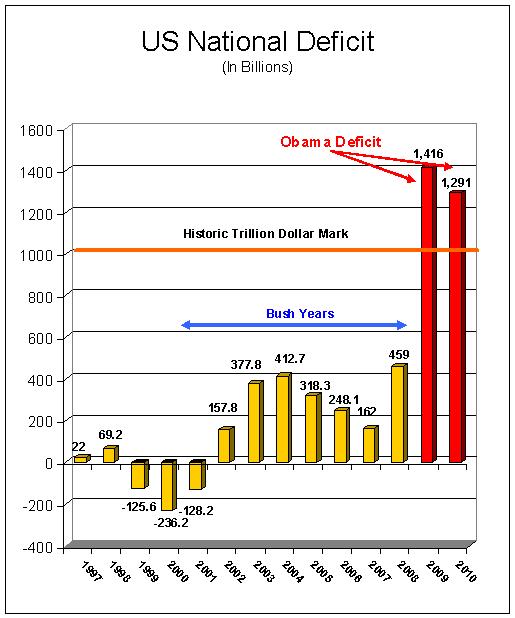
Spending was horrible under George Bush. The public was worried about it. Now spending has gone insane under President Obama, and the public is more than worried, the public is outraged and spitting nails. That these elites don’t see this either means they are incredibly stupid, or they want the country to collapse in a sea of debt. In either case, they shouldn’t have the jobs they do.
The custodian of the Dead Sea Scrolls is working with Google to put them on line for all to view.
The private space station company Bigelow is beginning the testing of its station life support systems, using human subjects.
Republican senator Judd Gregg (R-New Hampshire) suggested Monday that it would be better to restructure the healthcare bill than repeal or defund it.
Idiot. I think he and the rest of the Republican Party are being as clueless as the Democrats if they think this strategy will work. They should instead pay very close attention to what Sarah Palin said on the same day about a third party threat:
“Some in the GOP, it’s their last shot,” Palin said Monday evening on Fox News. “It’s their last chance, and we will lose faith and we will be disappointed and disenchanted from them if they start straying from the bedrock principles that can grow our economy.”
I am also reminded of this prescience Iowahawk post. As he says so eloquently, “Retards.”
It ain’t just the government in financial trouble: With $1 billion in debt, the satellite wireless company TerreStar is rumored to be considering bankruptcy.