
Testing of Orion capsule proceeds
Pressure testing NASA’s Orion capsule is about to begin, despite the space war about its future.
Pressure testing NASA’s Orion capsule is about to begin, despite the space war about its future.
On May 18, 1980, Mt. St. Helens erupted, the blast throwing the north slope of the mountain out and downward in a terribly hot wave of ash, rock, and magma. All life in its path was destroyed. Forests were ripped to the ground, then buried. The force of the wave tore into Spirit Lake, pushing the water sideways so that it sent its own wave 500 feet up the side of the opposite mountain. The mountain then dumped so much material into the lake that it actually doubled in size, its shores raised 200 feet.
It is now thirty years later. After years of slowly oozing out two large lava domes into its shattered crater, Mt. St. Helens had finally quieted down enough for the National Park Service to permit hikers to once again return. Not only do trails now criss-cross the blast zone below the crater, if you make arrangements in advance you can actually hike up the mountain’s south face and look down into the crater.
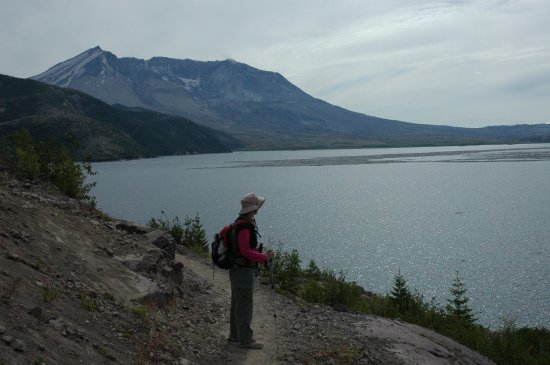
Our hike yesterday at Mt. St. Helens consisted of two parts. The first took us down onto the Loowit Trail, the closest the National Park Service permits hikers to get to the volcano’s lava domes. The second part was a short hike down to the shoreline of Spirit Lake.
Two things stood out in both these hikes. First, I was astonished how much of the surrounding landscape remains devastated, barren, and desert-like, decades after the eruption. I come from the East, where you expect a barren field to quickly become overgrown with life. Yet, even in the rainy climate of the northwest the destruction left by the volcano is so profound it is going to take many more decades for the forest to reclaim its former glory.
Thus, the land between the mountain and Spirit Lake more resembles the deserts of the American southwest than the lush, wet forests of the Cascade mountains. At one point I even noted to Diane how the Loowit trail reminded me of the Tonto Plateau trail in the Grand Canyon — a wide shadeless terrain crossing periodic dry gullys.
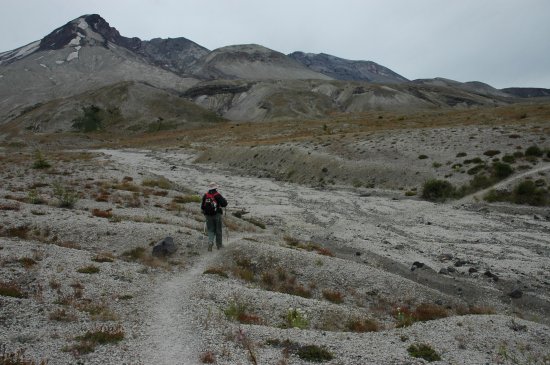
Still, in what had been a dead zone thirty years ago, small life has reappeared, from chipmunks to a variety of scrubs and grasses. There are even a scattering a small young evergreens, signaling the eventual return of the forest.
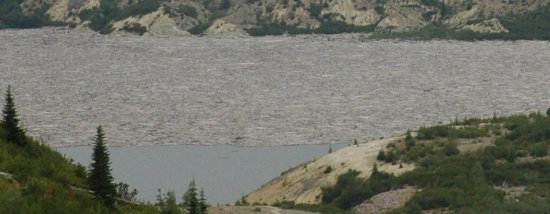
At Spirit Lake, farther from the volcano, the landscape showed even more life. Yet, the lake was still half covered with a mat of dead logs, left over from the blast. And the hillsides were littered with the blown-down logs. Though many have rotted away in the ensuing decades, many remain, scattered about like giant toothpicks.
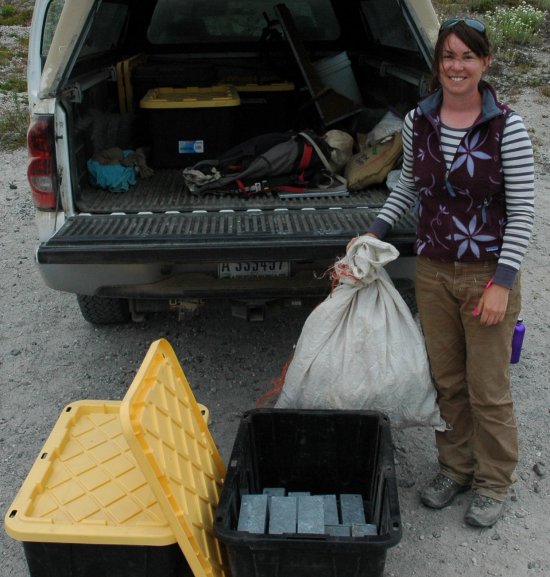
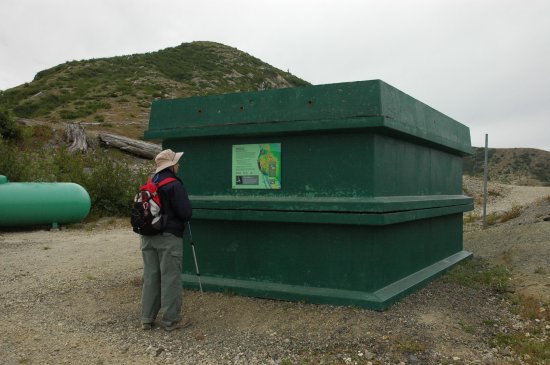
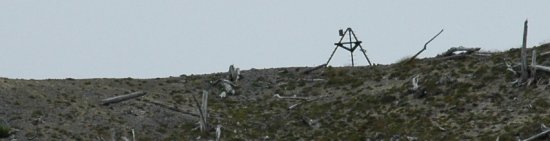
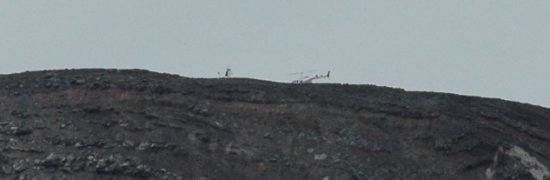
The second thing notable was how much the barren landscape of Mt. St. Helens was dominated by the research work of scientists. Wherever we looked we saw evidence of it. Instruments and sensors could be spotted everywhere. Helicopters transporting scientists flew over repeatedly. We even met a young researcher gathering animal traps, part of the continuing census of life in the blast zone. As she explained to me, they are tracking the changing species as life re-enters and repopulates the dead zone.
From a human perspective, this research is profound. Though natural disasters such as the Mt. St. Helens eruption are not unusual things in the history of our planet, humans have never had an opportunity to study the aftermath of one in such detail. The knowledge gained will be priceless beyond measure. And that we as a society are willing to dedicate the funds to do this work will speak very well of us to future generations.
The thirty-three Chilean miners presently trapped underground face a months-long effort before a new tunnel can reach them.
An evening pause: The Muppets, again!
Why bother with research when all we need to do is ask our politicians? Scientist Hillary Clinton studies the floods in Pakistan and the forest fires in Russia and declares them both proof that global warming is happening!
Oh boy! Doesn’t this sound exciting! The FAA is teaming up with seven universities to lay out the regulation of private space travel.
Today we hiked almost ten miles around Mt. St. Helens, walking down to the shore of Spirit Lake (see below) as well as tromping about on the debris field just below the crater. I will have a long post on the experience tomorrow.
According to this AP report, the massacre at Fort Hood last November 9, where 13 people were killed by Major Nidal Hasan in the name of Islam, has been designated by the Pentagon as a case of “workplace violence.” If this is true, it is another sad example of the incredible disconnect between fantasy and reality among our society’s leadership.
An evening pause: A concert performance of Ennio Morricone’s theme from Cinema Paradiso (1988), one of the best films ever made. Even if you don’t speak Italian, see it in Italian with subtitles, rather than the dubbed version.
Another scientific scandal, this time in the field of animal and human cognitive research: Harvard scientist Marc Hauser has admitted to eight instances of misconduct. Three key quotes:
The university said in a statement last week that Dr. Hauser or a co-author had been directed to correct three published papers for which the original data could not be found. [emphasis mine]
Harvard itself had faced growing criticism for not releasing more details of the inquiry since The Boston Globe reported on Aug. 10 that the university had found evidence of scientific misconduct in Dr. Hauser’s lab. On Friday, Michael D. Smith, dean of the Harvard faculty of arts and sciences, issued a letter to the faculty confirming the inquiry and saying the eight instances of scientific misconduct involved problems of “data acquisition, data analysis, data retention, and the reporting of research methodologies and results.” No further details were given.
Harvard’s findings against him, if sustained, may cast a shadow over the broad field of scientific research that depended on the particular research technique often used in his experiments.
Gee, this sure sounds a lot like the Phil Jones/East Anglia University climategate scandal, where both the researcher and his university provided cover for each other, thereby leaving a cloud over a vast amount of climate research that depends on Jones’s data.
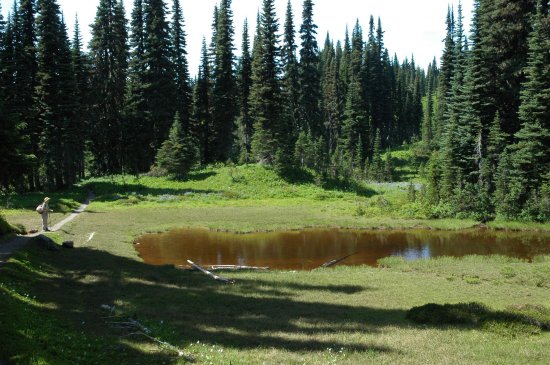
The sun was out, the sky was clear, and so today we did a short 6.5 circuit hike below Mt. Rainier, following the Lakes trail.
More details about the drop test by SpaceX of its Dragon capsule.
Is the space war over NASA’s future ending? I wonder, reading this report in which NASA Deputy Administrator Lori Garver confidently announces that a compromise between Congress and the administration is pending. More importantly, she said the following:
Many things are still uncertain, but one thing is not uncertain. Marshall [Space Flight Center] will lead the heavy-lift launch program.
Considering Garver’s previously strong opposition to Constellation, this statement indicates that she and the administration have backed down, and are willing to accept the heavy-lift part of Constellation, once called Ares V, as long as no one uses those Bush-era names.
An evening pause: Daffy-the Commando. From World War II.
Why I drive rather than fly, as much as possible: TSA guards rummage through woman’s purse, inspect her receipts, commandeer her checkbook, and call her husband. Key quote:
“I understand that TSA is tasked with strengthening national security but [it] surely does not need to know what I purchased at Kohl’s or Wal-Mart.”
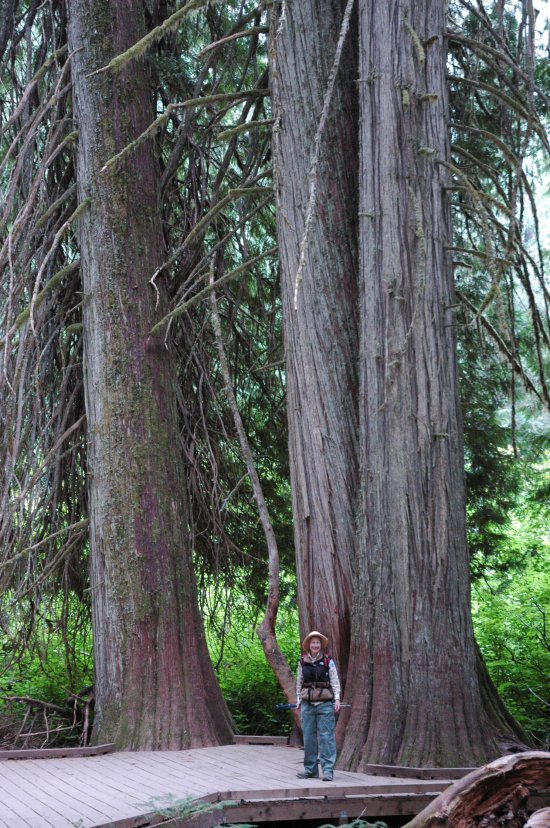
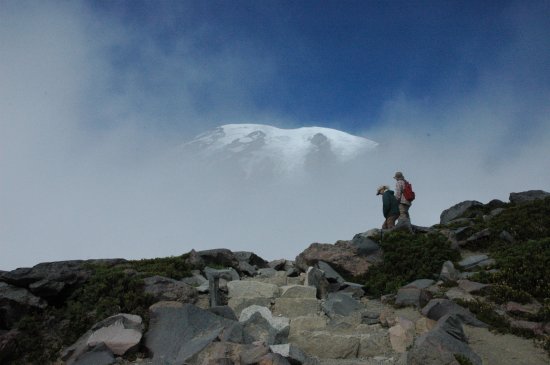
We were back at Mt. Rainier today, this time doing one short hike and one long one, totaling 8.6 miles. The short hike took us to the Grove of the Patriarchs, a small grove of thousand year old trees. The long hike took us up to 7200 feet elevation on the flanks of Mt. Rainier. Unfortunately, the mountain was shy today, keeping itself hidden behind clouds for most of the day. Near the top of the climb the clouds parted for about 30 seconds, and I was able to get a signal snapshot of it. Otherwise, we spent most of the hike in the mist, which was beautiful in its own way.
Want to see what the Earth-Moon double planet looks like from 114 million miles away? Take a look at this image taken recently by the Messenger spacecraft on its long journey to Mercury.
Bad news for space tourism! One of WhiteKnightTwo’s landing gears collapsed as the plane landed at the end of a test flight yesterday. Here’s a statement from Scaled Composites, the builder of the suborbital rocket system.
Images from Lunar Reconnaissance Orbiter have proven that as the Moon cooled and solidified, it shrunk, leaving behind a network of cliffs, called thrust faults, across its entire face.