ULA launches Amazon’s first 27 Kuiper constellation satellites; SpaceX launches more Starlinks

Two more launches today. First, SpaceX completed another Starlink launch, placing 27 satellites into orbit, its Falcon 9 rocket lifting off from Vandenberg in California, with its first stage completing its 25th flight, landing on a drone ship in the Pacific.

Next, ULA successfully launched the first 27 Kuiper internet constellation satellites for Amazon, its Atlas-5 rocket lifting off from Cape Canaveral in Florida.

As of posting the Kuiper satellites have not yet been deployed. As this was ULA’s first launch this year, the company is not included in the leader board for the 2025 launch race.

49 SpaceX
22 China
5 Rocket Lab
5 Russia

SpaceX now leads the rest of the world in successful launches, 49 to 38. Two more launches are still scheduled for today, one by SpaceX placing more Starlinks into orbit, and a second a classified Angara launch out of its Plesetsk spaceport in northeastern Russia.

5 comments

Watch Atlas-5 launch of Amazon’s first 27 Kuiper satellties

I have embedded below the live stream of the launch today of ULA’s Atlas-5 rocket, carrying the first 27 satellites for Amazon’s planned 3,200 satellite Kuiper internet constellation designed to compete directly against SpaceX’s Starlink.

The first launch attempt several weeks ago was scrubbed due to weather. This is one of fifteen Atlas-5’s still in ULA’s inventory, eight of which are reserved for Kuiper launches, six of which are reserved for future missions of Boeing’s manned Starliner capsule, and one of which will place into geosynchronous orbit a communications satellite for Viasat.

After these launches ULA will rely entirely on its new Vulcan rocket.

» Read more

0 comments

April 27, 2025 Quick space links

Courtesy of BtB’s stringer Jay. This post is also an open thread. I welcome my readers to post any comments or additional links relating to any space issues, even if unrelated to the links below.

2 comments

Hubble snaps picture of barred spiral galaxy

A barred spiral galaxy as seen by Hubble
Click for original image.

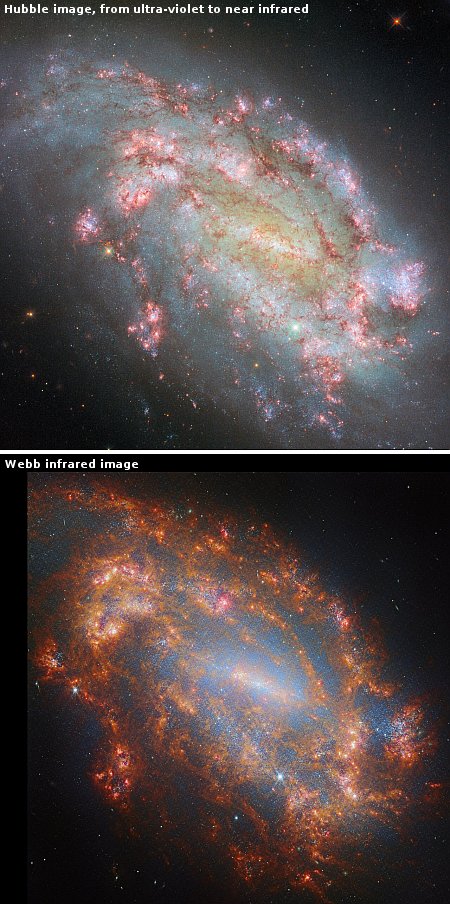
Cool image time! While NASA celebrates the 35th anniversary of the Hubble Space Telescope with photos from its past, astronomers continue to use it to produce new wonders. The picture to the right, cropped, reduced, and sharpened to post here, was taken by Hubble recently and released today.

NGC 5335 is categorized as a flocculent spiral galaxy with patchy streamers of star formation across its disk. There is a striking lack of well-defined spiral arms that are commonly found among galaxies, including our Milky Way. A notable bar structure slices across the center of the galaxy. The bar channels gas inwards toward the galactic center, fueling star formation. Such bars are dynamic in galaxies and may come and go over two-billion-year intervals. They appear in about 30 percent of observed galaxies, including our Milky Way.

The theorized formation process of that bar is based on computer modeling using the limited data we presently have, and thus carries a great deal of uncertainty.

2 comments

NASA re-releases a slew of Hubble images to celebrate its 35th anniversary

Eta Carina, in focus, after 1993 repair mission

As part of its celebration of the telescope’s 35th anniversary, NASA on April 25, 2025 re-released what it called 27 key images from the history of the Hubble Space Telescope.

More than half the images are historical, showing the telescope’s conception by astrophysicist Lyman Spitzer, its construction, its launch in 1990, and its repair in 1993 of its faulty optics. The subsequent sharp astronomical images include only a few of Hubble’s most famous and significant later photographs, including the first Hubble Deep Field, the Hourglass planetary nebula, and the Pillars of Creation snapshot.

What NASA did not include in this collection however was without doubt to those alive at the time after Hubble was finally repaired its most historically significant photo. That picture is to the right. It shows the exploding star Eta Carina as taken by Hubble in 1993 right after its repair.

For the very first time, we had a telescope above the Earth’s fuzzy atmosphere capable of taking sharp in-focus images of the mysteries of the heavens. And for the first time, we could see in this star its actual nature. It wasn’t simply surrounded by a pretty cloud — as all previous ground-based images had suggested — that cloud was formed by eruptions from the star itself. Those earlier eruptions, which had occurred in the previous century, had spewed from the star’s poles, forming two bi-polar clouds that were expanding away from the star most dramatically.

In the three decades since astronomers have used Hubble and its later upgraded cameras to track those expanding clouds, with the most recent photo taken in 2019. Hubble has shown that such massive heavenly objects are not static, but evolving, and with the right high resolution telescopes in space we can track that evolution, in real time.

At the moment no comparable replacement of Hubble is planned, or even on the drawing board. The Einstein space telescope, just launched, will provide magnificent optical images at a slight lower resolution. So will China’s planned Xuntian space telescope, set for launch in 2027. Neither however matches Hubble’s capabilities.

And Hubble is now long past its original lifespan of fifteen years. Though engineers say it is in good shape, this is not true. It presently has only two trustworthy working gyroscopes. To extend its lift, the telescope is operated on only one gyroscope, with a second held back in reserve. When these go, however, so will Hubble.

Meanwhile, the astronomy community continues to put most of its energy in building giant ground-based telescopes that not only cannot match Hubble but are threatened by the coming wave of new communication constellations. Do they rethink their approach and shift to orbital astronomy?

Nah. Instead, the astronomical community demands new powers to to ban those constellations!

Of all people, one would think astronomers more than anyone else would not put their head in the sand. But that’s what they continue to do.

1 comment

China and SpaceX complete launches

Both China and SpaceX completed launches yesterday. First, China placed what its state-run press called “a data relay” satellite into orbit, its Long March 3B rocket lifting off from its Xichang spaceport in southwest China.

No word on where there rocket’s lower stages and four strap-on boosters crashed inside China. All use very toxic hypergolic fuels.

Next SpaceX launched 23 more Starlink satellites, including 13 configured for cell-to-satellite service, its Falcon 9 rocket lifting off from Cape Canaveral in Florida. The first stage completed its 20th flight, landing on a drone ship in the Atlantic.

The leaders in the 2025 launch race:

48 SpaceX
22 China
5 Rocket Lab
5 Russia

SpaceX now leads the rest of the world in successful launches, 48 to 37, with three more launches scheduled for later today. China will use its Long March 5B, its largest rocket, to launch a set of communications satellites, SpaceX will launch another set of Starlink satellites, and ULA will make its second attempt to launch Amazon’s first set of Kuiper internet satellites, the first launch scrubbed due to weather.

0 comments

Axiom replaces its CEO

In a move that apparently promotes one of its most productive managers, space station startup Axiom has now picked Tejpaul Bhatia, its chief financial officer for the past four years, to take over as the company’s CEO.

The choice seems sound, considering what Bhatia has done already for the company.

Ghaffarian cited Bhatiaโ€™s work as chief revenue officer at Axiom as a key reason to make him CEO. Axiom noted in a statement that Bhatia secured more than $1 billion in contracts since joining Axiom, including overseeing the companyโ€™s series of private astronaut missions to the International Space Station.

…Bhatia came to Axiom from Google, where he was involved in its cloud computing business. He earlier founded and led several startups and worked on ESPNโ€™s video streaming business.

Considering other rumors that suggest the company has been experiencing cash flow issues, this pick might be aimed at alleviating those issues.

0 comments

April 25, 2025 Quick space links

Courtesy of BtB’s stringer Jay. This post is also an open thread. I welcome my readers to post any comments or additional links relating to any space issues, even if unrelated to the links below.

17 comments

Axiom signs deal with medical company to do diabetes monitor research on its next manned mission to ISS

Axiom today announced it has signed a deal with the medical company Burjeel Holdings to fly and test a glucose monitor during its May 2025 AX-4 manned mission to ISS.

The Ax-4 mission will utilize Continuous Glucose Monitors (CGMs), which have become the standard for glucose monitoring in individuals with diabetes. These devices will be tested to ensure their accuracy in microgravity, providing real-time data that will ultimately support the health of astronauts with insulin-dependent diabetes.The comprehensive preflight, inflight, and post flight protocols will employ various testing methods to validate these technologies. The Ax-4 mission also plans to look at insulin exposure in microgravity to assess the potency and stability of the drug product upon its return to Earth.

Testing the behavior of CGMs and insulin delivery technologies in microgravity and with circadian rhythm disruption is expected to advance the understanding of how such innovations can improve diabetes monitoring and care in remote or under served areas on Earth. Experts say this research will lay the groundwork for managing diabetes in isolated locations, such as oil rigs, deserts, or rural regions.

These tests will also make it possible for people who have diabetes to go into space. For Axiom, this will help widen its customer base. For Burjeel it proves its monitors can work in many remote and hostile environments, also widening its customer base.

Hat tip BtB’s stringer Jay, who adds that “This is cool since this is two companies and no NASA/government involvement.”

0 comments

Curiosity’s recent travels as seen from orbit

The view of Curiosity from orbit
Click for original image.

Oveview map
Click for interactive map.

Cool image time! Using Mars Reconnaissance Orbiter (MRO), scientists have captured a very cool image of Curiosity in its recent travels on Mars. That picture is above, reduced and sharpened to post here.

Taken by the HiRISE (High-Resolution Imaging Science Experiment) camera aboard NASAโ€™s Mars Reconnaissance Orbiter, the image shows Curiosity as a dark speck at the front of a long trail of rover tracks. Likely to last for months before being erased by wind, the tracks span about 1,050 feet (320 meters). They represent roughly 11 drives starting on Feb. 2 as Curiosity trucked along at a top speed of 0.1 mph (0.16 kph) from Gediz Vallis channel on the journey to its next science stop: a region with potential boxwork formations, possibly made by groundwater billions of years ago.

The overview map to the right provides some context. Curiosity’s present position is indicated by the blue dot. The yellow lines indicate the approximate section of its past travels photographed by the picture above.

According to the press release at the link, the science team is now estimating the rover will arrive at the boxwork geology in about a month.

0 comments
1 198 199 200 201 202 2,929