NASA/Boeing: More Starliner ground engine tests throughout 2025; Next flight likely in 2026

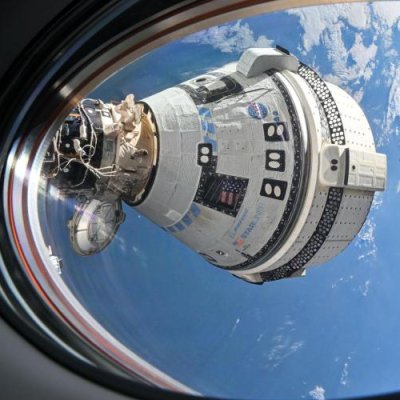
Starliner docked to ISS
Starliner docked to ISS.

According to a press release from NASA late yesterday, both the agency and Boeing will spend most of the rest of this year doing additional Starliner static fire engine tests of thruster redesigns before considering another flight of the capsule to ISS.

NASA and Boeing are working to finalize the scope and timelines for various propulsion system test campaigns and analysis that is targeted throughout the spring and summer. Testing at White Sands Test Facility in New Mexico will include integrated firing of key Starliner thrusters within a single service module doghouse to validate detailed thermal models and inform potential propulsion and spacecraft thermal protection system upgrades, as well as operational solutions for future flights. These solutions include adding thermal barriers within the doghouse to better regulate temperatures and changing the thruster pulse profiles in flight to prevent overheating. Meanwhile, teams are continuing testing of new helium system seal options to mitigate the risk of future leaks.

“Once we get through these planned test campaigns, we will have a better idea of when we can go fly the next Boeing flight,” said Steve Stich, manager, NASA’s Commercial Crew Program at the agency’s Kennedy Space Center in Florida. “We’ll continue to work through certification toward the end of this year and then go figure out where Starliner fits best in the schedule for the International Space Station and its crew and cargo missions. It is likely to be in the timeframe of late this calendar year or early next year for the next Starliner flight.”

The release indicated that the goal is to get the capsule certified prior to the next flight so that it can carry a crew on a fully operational mission. The release however left open the option that this next ISS flight might instead be an unmanned cargo mission. The announcement said nothing about who will pay for this flight. Under Boeing’s fixed-priced contract, it should foot the bill, but no one should be surprised if NASA works a deal to funnel money Boeing’s way.

Meanwhile, the agency has changed some of the crew assignments for that first and long-delayed operational Starliner flight, switching astronaut Mike Fincke from that mission to the next Dragon mission to launch later this year. (I suspect Fincke wanted to fly again, and was tired of sitting on his hands waiting for Boeing to get Starliner working.)

9 comments

NASA experiment on Blue Ghost demonstrates the ability to repel the Moon’s abrasive dust

Before and after
Click for original blink movie.

In a press release yesterday, NASA revealed that one of its technology experiments on Firefly’s Blue Ghost lunar lander successfully demonstrated the ability to repel the Moon’s abrasive dust from the surfaces of various materials.

Lunar dust is extremely abrasive and electrostatic, which means it clings to anything that carries a charge. It can damage everything from spacesuits and hardware to human lungs, making lunar dust one of the most challenging features of living and working on the lunar surface. The EDS technology uses electrodynamic forces to lift and remove the lunar dust from its surfaces. The “before” image highlights the glass and thermal radiator surfaces covered in a layer of regolith, while the “after” image reveals the results following EDS activation. Dust was removed from both surfaces, proving the technology’s effectiveness in mitigating dust accumulation.

The images to the right, taken from a blink movie showing the change after the EDS technology was used, suggest that though this technology does work, it is not yet wholly successful in some cases. The thermal radiator was not cleared entirely of dust. More engineering research will be necessary, both on the Moon and here on Earth.

Nonetheless, this success is important and a major step forward for future exploration of the Moon, Mars, and the asteroids. In all these places dust is going to pose a major problem for equipment and spacesuits. New techniques must be developed to clean the dust away, since traditional Earth-based cleaning methods using water will not be available.

7 comments

Boeing now faces criminal trial for two 737-Max crashes that killed 346

Boeing Logo

In a criminal case against Boeing that has been going on since two Boeing 737-Max planes crashed in 2018 and 2019, the company now faces a criminal trial scheduled to begin in June over its admitted lies to the FAA about the airplane’s technical flaws that led directly to those crashes.

[T]he criminal charge pending against Boeing arises out of two deadly crashes of Boeing 737 MAX aircraft in 2018 and 2019. A Justice Department investigation uncovered the fact that Boeing had lied to the FAA about the safety of the aircraft—lies that led directly and proximately to the crashes killing 346 passengers and crew. On January 7, 2021, the Justice Department filed a criminal information with a one-count conspiracy charge against Boeing, alleging that “From at least in or around November 2016 through at least in or around December 2018, in the Northern District of Texas and elsewhere, the Defendant, The Boeing Company, knowingly and willfully, and with the intent to defraud, conspired and agreed together with others to defraud the United States by impairing, obstructing, defeating, and interfering with, by dishonest means, the lawful function of a United States government agency.”

In 2021 Boeing admitted to these charges as part of a plea deal with Justice, whereby prosecution would be deferred for three years if Boeing took certain actions to clean up its act. When that deal expired in 2024, Justice determined that Boeing had failed to live up to its agreement. Rather than go to criminal trial however government lawyers instead attempted twice to settle the case by having Boeing pay a big fine, first $243 million and then $455 million. In both cases the deals fell through when lawyers for the victims’ families objected.

After many further delays, the judge in the case has now taken action and set a trial date of June 23, 2025.

The article at the link is written by one of the lawyers for the victims, so it of course has a very decidedly anti-Boeing slant. Nonetheless, the situation for the company is very dire. It has already admitted guilt in the 2021 plea deal. It will be practically impossible for it to avoid a guilty sentence at that trial, resulting in gigantic payouts that could very well bankrupt the company.

I wonder however if instead of charging just the company, a corporation, the Justice Department should also have indicted the specific individuals at Boeing who committed the fraud itself. Those people are the ones responsible, not the entire company. Leaving them out of the case allows them to literally get away with the equivalent of second degree murder for “depraved indifference.”

For example, the CEO of Boeing at the time of those 737-Max crashes, Dennis Muilenburg, was fired in 2019 shortly after the crashes, suggesting the company was aware of his culpability in the situation. And what about the specific managers who filed false reports with the FAA? Do they all get off scot free?

As it stands now, the case is likely to destroy Boeing itself, harming thousands of innocent employees who had nothing to do with this fraud or the 737-Max. It will also do great harm to Boeing’s many other contracts with the government, NASA, and other private airline companies.

Then again, maybe it is time for this company to go. It surely hasn’t demonstrated in the past decade any ability to build anything reliably.

6 comments

March 27, 2025 Quick space links

Courtesy of BtB’s stringer Jay. This post is also an open thread. I welcome my readers to post any comments or additional links relating to any space issues, even if unrelated to the links below.

3 comments

Webb finds more elements not possible so soon after the Big Bang

A galaxy that shouldn't be there
Click for original image.

The uncertainty of science: Using the Webb Space Telescope, astronomers have now detected emissions of hydrogen from a galaxy that exists only 330 million years after the Big Bang that simply shouldn’t be possible, based on present cosmological theory.

The false-color infrared image of that galaxy is to the right, cropped to post here. At that distance, 13.5 billion light years away, all Webb can really see is this blurry spot. From the press release:

In the resulting spectrum, the redshift was confirmed to be 13.0. This equates to a galaxy seen just 330 million years after the big bang, a small fraction of the universe’s present age of 13.8 billion years old. But an unexpected feature stood out as well: one specific, distinctly bright wavelength of light, known as Lyman-alpha emission, radiated by hydrogen atoms. This emission was far stronger than astronomers thought possible at this early stage in the universe’s development.

“The early universe was bathed in a thick fog of neutral hydrogen,” explained Roberto Maiolino, a team member from the University of Cambridge and University College London. “Most of this haze was lifted in a process called reionization, which was completed about one billion years after the big bang. GS-z13-1 is seen when the universe was only 330 million years old, yet it shows a surprisingly clear, telltale signature of Lyman-alpha emission that can only be seen once the surrounding fog has fully lifted. This result was totally unexpected by theories of early galaxy formation and has caught astronomers by surprise.”

In more blunt terms, the theory that the haze would clear only one billion years after the Big Bang appears very wrong. This result is also similar to the story earlier this week about the detection of oxygen in a similarly early galaxy, oxygen that could not possibly be there only a few hundred million years after the Big Bang. Not enough time had passed for the number of star generations needed to produce it.

You can read the peer-reviewed paper here. While the Big Bang theory is hardly dead, the data from Webb continues to suggest it either needs a major rethinking, or there is something fundamentally wrong with it.

13 comments

UK government continues to dither about fixing its serious red tape issues relating to space

Proposed spaceports surrounding Norwegian Sea

Three different news articles from three different British news sources in the past 24 hours strongly suggest that the factions within the government of the United Kingdom are still unfocused about fixing the serious regulatory red tape that not only bankrupted the rocket startup Virgin Orbit but has delayed for years the first launches from either of its two proposed spaceports in Scotland. The headlines might sound positive, but the details are far less encouraging:

The first article describes the comments of industry officials at a House of Lords committee hearing, where they pleaded with the government to help foster a British launch capability. Sounds good, eh? The problem is that such hearings have been held now repeatedly for the last several years, and Britain’s parliament has done nothing to reform its very cumbersome, complex, and byzantine launch licensing process. Getting approvals still takes months if not years.

It appears that this particular hearing is no different. While it provided government officials the chance to express sympathy for industry in front of news cameras, there is no indication parliament will do anything to fix anything.

The second article describes comments by the Labor government’s technology secretary Peter Kyle before the House of Commons. » Read more

10 comments

NASA: Cygnus capsule damaged in transit to launchpad is too damaged to launch

According to this Ars Technica article today, the Cygnus cargo capsule that was reported to be damaged several weeks ago while being transported in a shipping container to its launchpad has now been found too damaged for launch, according to NASA.

On Wednesday, after a query from Ars Technica, the space agency acknowledged that the Cygnus spacecraft designated for NG-22 is too damaged to fly, at least in the nearterm. “Following initial evaluation, there also is damage to the cargo module,” the agency said in a statement. “The International Space Station Program will continue working with Northrop Grumman to assess whether the Cygnus cargo module is able to safely fly to the space station on a future flight.” That future flight, NG-23, will launch no earlier than this fall.

As a result, NASA is modifying the cargo on its next cargo flight to the space station, the 32nd SpaceX Cargo Dragon mission, due to launch in April. The agency says it will “add more consumable supplies and food to help ensure sufficient reserves of supplies aboard the station” to the Dragon vehicle.

It will be at least half a year before the next Cygnus will be ready for launch.

As the article notes (and immediately occurred to me also), this incident creates an opportunity to help Boeing and Starliner. Last year there were rumors that NASA might pay Boeing to fly Starliner as an unmanned cargo flight to ISS. This would allow the company to test its fixes to the capsule without having to pay for another test flight. These rumors however have faded since Trump took power, suggesting the new administration did not want to pay that extra money.

The loss however of this Cygnus cargo mission not only frees up NASA cash that could be transferred to a Starliner cargo mission, it frees up a slot in the cargo schedule. It actually makes a lot of sense to give Boeing the job.

Unfortunately, unless someone higher up in the Trump administration (possibly Trump himself) makes the decision, we should not expect any action on this idea until NASA’s new administrator is confirmed by the Senate and takes office. And that event remains in limbo at this point.

In the meantime, NASA has no redundancy for getting cargo to ISS, and must rely entirely on SpaceX and its Dragon cargo capsules. A third option, Sierra Nevada’s Tenacity Dream Chaser reusable cargo mini-shuttle, is still not ready to launch. It was supposed to do its first test flight to ISS a year ago, but could not because ground testing had to be done first, and for reasons that are very unclear, it appears that testing has not yet been completed.

8 comments

Two more launches today

Since this morning’s launch by Rocket Lab, there have been two more launches. First, SpaceX placed another 27 Starlink satellites into orbit, its Falcon 9 rocket lifting off from Vandenberg in California.

The first stage completed its 24th flight, landing on a drone ship in the Pacific. This is presently SpaceX’s second most used booster, exceeded only by one that has flown 26 times.

Next China launched a communications satellite for use by its space station and other government space missions, its Long March 3B rocket lifting off from Xichang spaceport in southwest China. No word on where the rocket’s core stage and four side boosters, all using very toxic hypergolic fuel crashed inside China.

The leaders in the 2025 launch race:

35 SpaceX
15 China
5 Rocket Lab
4 Russia

SpaceX still leads the rest of the world in successfully launches, 35 to 27.

0 comments

Space Force finally certifies ULA’s new Vulcan rocket for commercial military launches

After significant delays in developing ULA’s new Vulcan rocket, and then further delays after the rocket’s second test launch (which experienced technical issues), the Space Force today finally announced that it has certified the rocket, thus allowing ULA to proceed with several military launches that have been stalled for months. From ULA’s press release:

In September 2016, ULA entered into an agreement with the U.S. Air Force and outlined the plan to certify Vulcan according to the Air Force’s New Entrant Certification Guide. Over the last few years, the collective ULA and Space Force team have completed 52 certification criteria, including more than 180 discrete tasks, two certification flight demonstrations, 60 payload interface requirement verifications, 18 subsystem design and test reviews, and 114 hardware and software audits.

What was not revealed was the criteria the Space Force used to finally put aside as critical the loss of a nozzle on one of Vulcan’s two side booster’s during the second test launch. While the rocket successfully got its payload into the proper orbit, for a booster to lose a nozzle is not trivial. ULA has recently said it had found the cause and has fixed it, but few details have been revealed. Nor has this new announcement revealed any further details about the fix.

Regardless, this certification is very good news for ULA. Expect it to move as quickly as it can (which will seem slow in comparison to SpaceX) to launch a number of delayed military launches.

6 comments

Restoring a historic racing yacht after buying it for a dollar

An evening pause: The yacht, the Tally Ho, had won an important race in 1927 in Great Britain. The goal is to get this work done so it can compete in 2027 in a similar race in Britain that it won one hundred years previously.

Though after watching the video, it seems this is more like a complete rebuild from scratch rather than a restoration.

Hat tip Cotour.

10 comments
1 212 213 214 215 216 2,929