
China successfully launches and recovers first stage of its new Long March 10B rocket
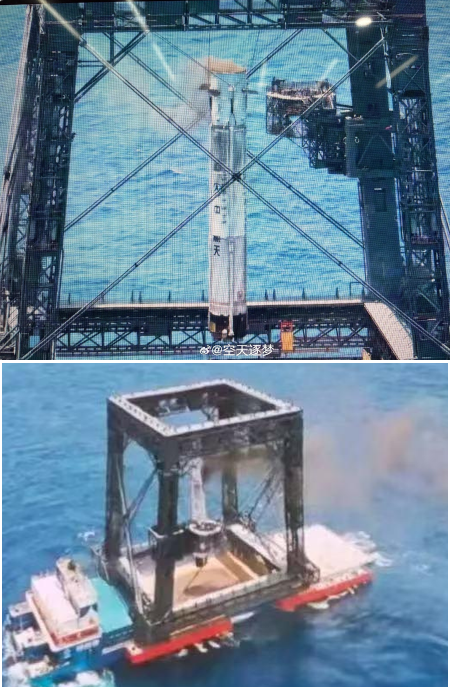
The first stage of Long March 10B after recovery
China’s state run press has now confirmed that today (July 10, 2026 in China) it successfully launched and recovered the first stage of its new Long March 10B rocket on that rocket’s very first launch.
The second link above shows the launch, cued to just before lift-off. The two images to the right come from the third link, a tweet showing the first stage captured on its recovery vessel, using a net catch system. The location of this recovery was in the middle of the South China Sea, about 300 nautical miles west of the Philippines.
Video of the first stage landing is here.
It is not clear if the launch was placing any payloads in orbit, but I will assume so, and add it to my launch count. If this changes I will update.
Either way, China has now joined a very small select group (SpaceX and Blue Origin) capable of landing and recovering a first stage. What is even more impressive about this achievement is that China did it with a completely different recovery technique — a net — that does not require legs (saving weight) that no one else has tried or proposed. Moreover, it demonstrated the ability to bring that stage down precisely and in a controlled manner.
The leaders in the 2026 launch race:
82 SpaceX
45 China
10 Rocket Lab (plus two suborbital HASTE launches)
8 Russia
For the third straight year SpaceX leads the entire world combined in total launches, 82 to 77.
Hat tip to BtB’s stringer Jay for the live stream and landing images and video.

On Christmas Eve 1968 three Americans became the first humans to visit another world. What they did to celebrate was unexpected and profound, and will be remembered throughout all human history. Genesis: the Story of Apollo 8, Robert Zimmerman's classic history of humanity's first journey to another world, tells that story, and it is now available as both an ebook and an audiobook, both with a foreword by Valerie Anders and a new introduction by Robert Zimmerman.
The print edition can be purchased at Amazon or from any other book seller. If you want an autographed copy the price is $60 for the hardback and $45 for the paperback, plus $8 shipping for each. Go here for purchasing details. The ebook is available everywhere for $5.99 (before discount) at amazon, or direct from my ebook publisher, ebookit. If you buy it from ebookit you don't support the big tech companies and the author gets a bigger cut much sooner.
The audiobook is also available at all these vendors, and is also free with a 30-day trial membership to Audible.
"Not simply about one mission, [Genesis] is also the history of America's quest for the moon... Zimmerman has done a masterful job of tying disparate events together into a solid account of one of America's greatest human triumphs."--San Antonio Express-News
It’s not clear to me exactly how the net works, the video isn’t remotely clear enough to show it. I assume it must be drawn in from the sides once the rocket body is at the correct height. I don’t know if it enveloped the rocket from below, or just came in from the sides. You’d think if it came up from below, there would be issues with the rocket plumes intersecting parts of the netting. Although they may just consider the netting itself expendable.
It seems like this method is more forgiving of rocket positioning and possible sea state than landing on legs or trying to grab it with a claw. It will be interesting to see how it works out in terms of any possible damage to the rocket body or engine bells.
Recovering the booster is a big first step, but it’s the re-use that matters. It will be interesting to see how that goes, and if China is forthcoming with that data or not.