
Frost on Mars

Click for original image.
Cool image time! The picture to the right, cropped to post here, was taken on March 23, 2026 by the high resolution camera on Mars Reconnaissance Orbiter (MRO).
It shows the eastern interior rim of a 4.5-mile-wide crater, and was taken to find out if there has been any change to the gullies flowing down that 800 foot slope since the last high resolution image was taken in 2020.
Both pictures were taken in the spring, and both pictures not only don’t appear to show much change, both show the same white frost in exactly the same places. As no pictures have been taken at other times in the year, we do not know yet if this frost disappears as expected in summer.
In fact, until such images are taken and prove this white material disappears in the summer, we don’t even know for sure if it is indeed frost. We could instead be looking a some unusual form of white bedrock, though in my review of many MRO pictures such things are quite rare.
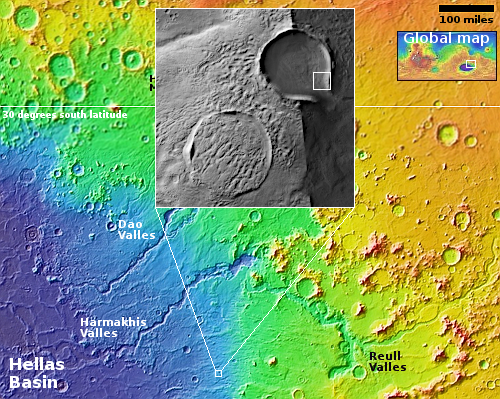
The white rectangle on the overview map to the right marks the location, on the eastern edge of Hellas Basin, the death valley of Mars. Located in the southern mid-latitudes, this is also a region known to have a lot of glacial material, including glaciers flowing down both Dao, Harmakhis, and Reull channels.
The inset suggests that there must be a lot of near-surface ice here. Note the second crater to the southeast, almost buried with glacial debris. Note also how our subject crater with these gullies appears mostly empty of such debris, but also has a break in the southeast quadrant of its rim that could have allowed this debris to drain out at some point in the past.
Overall, this crater and its gullies provides more evidence that Mars is not a dry desert, as so often portrayed in the press. It has plenty of near surface water. You just have to get out of the dry equatorial regions to find it.

On Christmas Eve 1968 three Americans became the first humans to visit another world. What they did to celebrate was unexpected and profound, and will be remembered throughout all human history. Genesis: the Story of Apollo 8, Robert Zimmerman's classic history of humanity's first journey to another world, tells that story, and it is now available as both an ebook and an audiobook, both with a foreword by Valerie Anders and a new introduction by Robert Zimmerman.
The print edition can be purchased at Amazon or from any other book seller. If you want an autographed copy the price is $60 for the hardback and $45 for the paperback, plus $8 shipping for each. Go here for purchasing details. The ebook is available everywhere for $5.99 (before discount) at amazon, or direct from my ebook publisher, ebookit. If you buy it from ebookit you don't support the big tech companies and the author gets a bigger cut much sooner.
The audiobook is also available at all these vendors, and is also free with a 30-day trial membership to Audible.
"Not simply about one mission, [Genesis] is also the history of America's quest for the moon... Zimmerman has done a masterful job of tying disparate events together into a solid account of one of America's greatest human triumphs."--San Antonio Express-News