
A cool crater in Starship’s prime candidate zone on Mars
Click for original image.
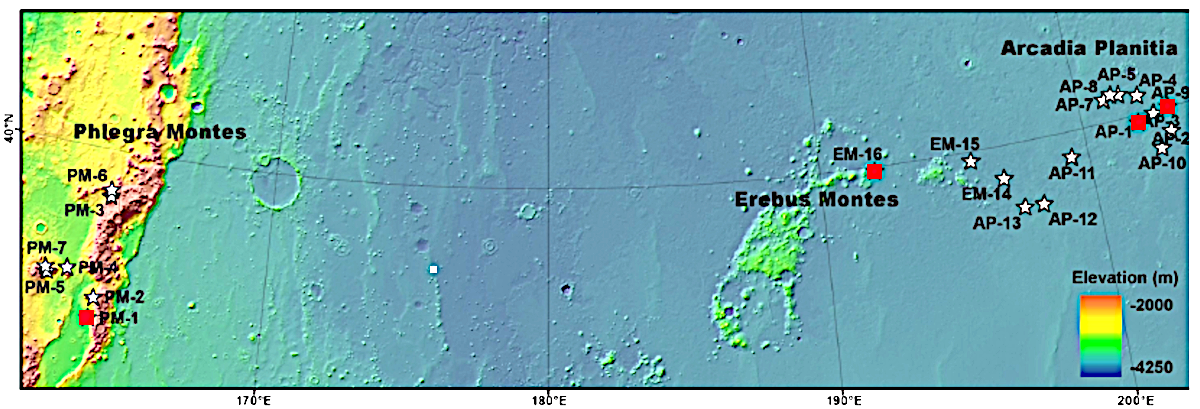
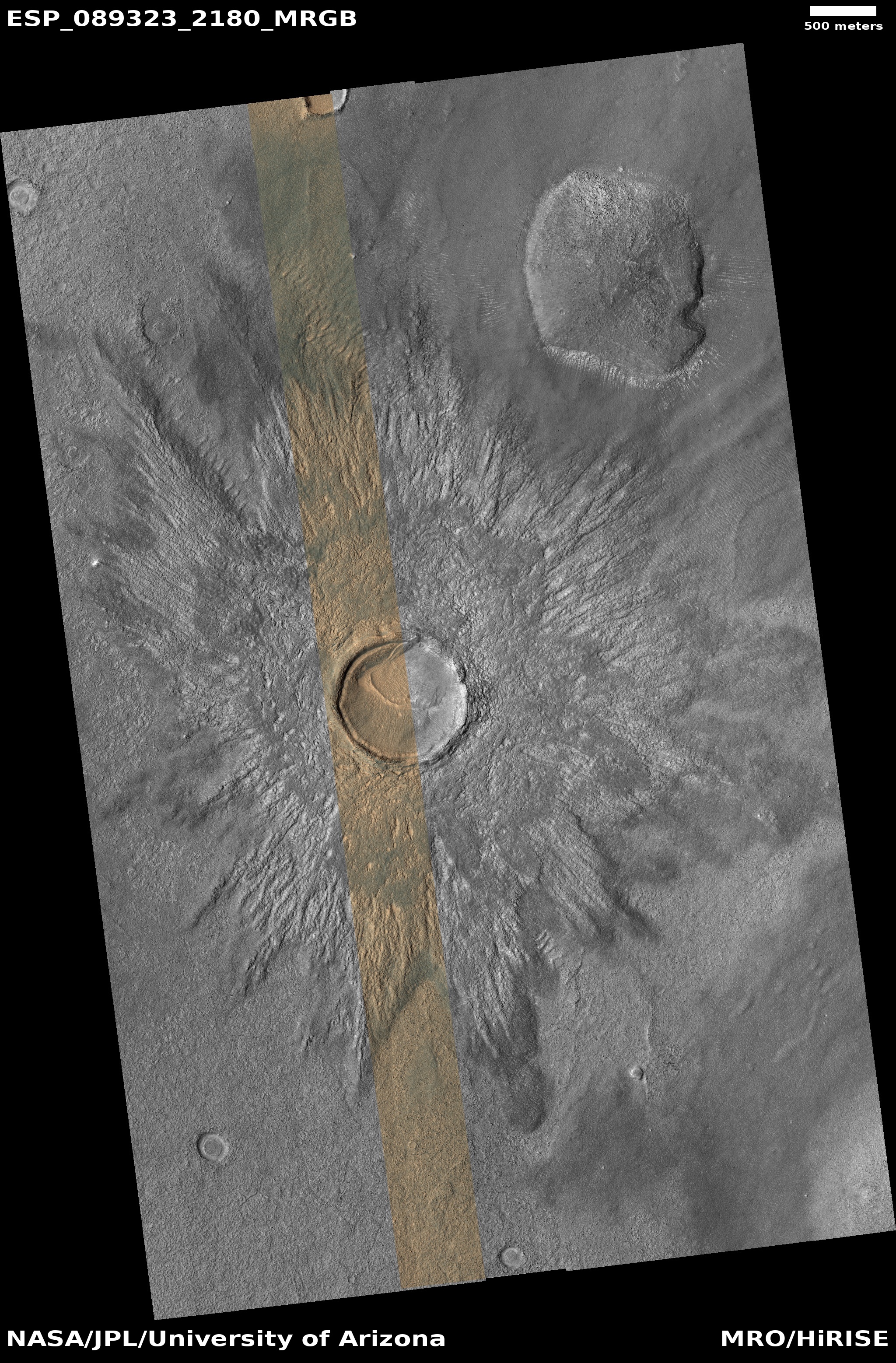
Cool image time! The picture to the right, rotated, cropped, reduced, and enhanced to post here, was taken on August 16, 2025 by the high resolution camera on Mars Reconnaissance Orbiter (MRO). In mid-March it was featured as a captioned image by MRO’s science team. From their caption:
When they form, impact craters dig up material from below the surface and throw it outwards into what geologists call an ejecta blanket. The fastest ejected material travels the furthest so material from different depths can end up at different distances from the crater.
This HiRISE image shows a pedestal crater in Arcadia Planitia that has material of different brightness and color at various distances from the crater. This could tell us more about the material that’s buried below the surface here, but the situation is complex.
The caption however fails to mention the most interesting two aspects of this crater’s ejecta blanket. One, it suggests strongly that there was a lot of near surface ice at impact that melted to produce this splash apron.
Second, and even more intriguing, the 3,100-foot-wide unnamed crater is located smack dab in the middle of the candidate landing zone on Mars for SpaceX’s Starship spacecraft, as shown by the overview map above. The white dot marks the location of this crater, while the red dots mark the four prime landing sites, as suggested by scientists in a 2021 paper [pdf], based on conclusions drawn from two workshops organized by SpaceX and these scientists. The other dots are other MRO images of this region, and include a number of potential secondary landing sites.
This zone is in the northern lowland plains of Mars, in a mid-latitude region where near-surface ice is plentiful. The splash apron of this crater provides further evidence of that near surface ice.

On Christmas Eve 1968 three Americans became the first humans to visit another world. What they did to celebrate was unexpected and profound, and will be remembered throughout all human history. Genesis: the Story of Apollo 8, Robert Zimmerman's classic history of humanity's first journey to another world, tells that story, and it is now available as both an ebook and an audiobook, both with a foreword by Valerie Anders and a new introduction by Robert Zimmerman.
The print edition can be purchased at Amazon or from any other book seller. If you want an autographed copy the price is $60 for the hardback and $45 for the paperback, plus $8 shipping for each. Go here for purchasing details. The ebook is available everywhere for $5.99 (before discount) at amazon, or direct from my ebook publisher, ebookit. If you buy it from ebookit you don't support the big tech companies and the author gets a bigger cut much sooner.
The audiobook is also available at all these vendors, and is also free with a 30-day trial membership to Audible.
"Not simply about one mission, [Genesis] is also the history of America's quest for the moon... Zimmerman has done a masterful job of tying disparate events together into a solid account of one of America's greatest human triumphs."--San Antonio Express-News
Maybe one unmanned Starship dead center of that crater as feed horn.
Inner section has reels that Teslabots descend from in an annular fashion, walking with reels at their backs for power.
Ares-cibo wiring complete…they walk farther down to the plain, wires also serving as zip-lines, mini-magnetosphere, etc.
Second unmanned Starship has annular engines….at center is a pass-thru as on pulse-Orion, but for drilling down….
Human rated Starship last.