
ESA finalizes contract for privately built cubesat lander as part of its Ramses mission to Apophis
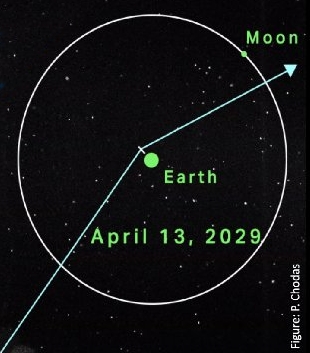
A cartoon (not to scale) showing Apophis’s
path in 2029.
The European Space Agency (ESA) yesterday announced it has issued the full contract with private startup EMXYS to build its Don Quijote cubesat lander for ESA’s Ramses mission to go to the potentially dangerous asteroid Apophis when it flies by the Earth in April 2029.
EMXYS, a Spanish company, previously built a gravity-measuring instrument for the cubesat Juventas, which is flying on ESA’S Hera mission presently on its way to the binary asteroid Didymos/Dimorphos.
Francesca Ingiosi, overseeing Ramses’ CubeSats, notes: “There won’t be time for sustained human oversight: Don Quijote is going to take itself down on a completely autonomous basis, relying on feature tracking to find a safe place to land. It will be running its gravimeter and magnetometer when it flies, but we have high expectations for its scientific work on the surface.
“It will come down quite slowly, but in the ultra-low gravity of Apophis some bouncing along the surface is possible. The CubeSat is therefore designed to operate from any orientation, although the precise nature of the surface remains a question mark: there is even a small possibility that Don Quijote sinks into the ground, which would not be good!
The launch window for Ramses is in the spring 2028, so the schedule to get this cubesat built is very tight.
Below is a list of the missions going to Apophis in 2029:
- Osiris-Apex, already on its way to Apophis after completing its asteroid mission to Bennu.
- Ramses, a European mission scheduled to launch in 2028 on Japan’s H3 rocket, on which will be these additional probes:
- Farinella, built by a partnership of the Italian Space Agency and Terran Orbital
- Don Quijote: a cubesat lander being built by EMXYS
- Destiny+, built by Japan’s space agency JAXA. It will first fly past Apophis, then head to its prime target, the asteroid Phaethon
- A radar cubesat being built Tyvak
- AphophisExL, a private mission being built by the startup Exlabs, which will also deploy two smaller landers built as part of a Japanese university student project.
- START: A Chinese cubesat being built by students at Tsinghua University.

On Christmas Eve 1968 three Americans became the first humans to visit another world. What they did to celebrate was unexpected and profound, and will be remembered throughout all human history. Genesis: the Story of Apollo 8, Robert Zimmerman's classic history of humanity's first journey to another world, tells that story, and it is now available as both an ebook and an audiobook, both with a foreword by Valerie Anders and a new introduction by Robert Zimmerman.
The print edition can be purchased at Amazon or from any other book seller. If you want an autographed copy the price is $60 for the hardback and $45 for the paperback, plus $8 shipping for each. Go here for purchasing details. The ebook is available everywhere for $5.99 (before discount) at amazon, or direct from my ebook publisher, ebookit. If you buy it from ebookit you don't support the big tech companies and the author gets a bigger cut much sooner.
The audiobook is also available at all these vendors, and is also free with a 30-day trial membership to Audible.
"Not simply about one mission, [Genesis] is also the history of America's quest for the moon... Zimmerman has done a masterful job of tying disparate events together into a solid account of one of America's greatest human triumphs."--San Antonio Express-News