
Psyche completes its Mars fly-by
Click for original image.
The asteroid probe Psyche on May 15, 2026 successfully completed its last fly-by of Mars, sending the spacecraft on its way to the asteroid Psyche, with a planned arrival in 2029.
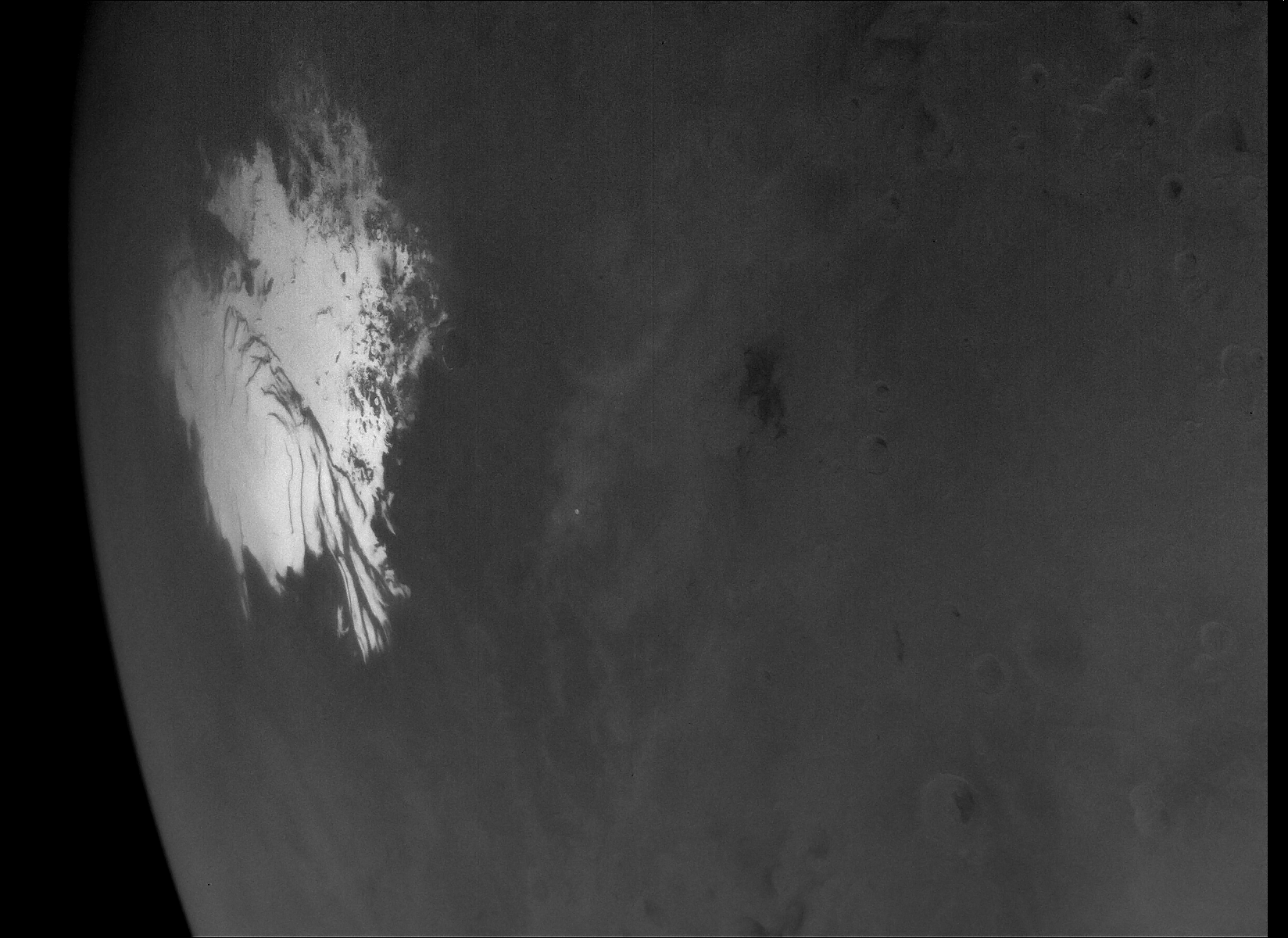
The image to the right, cropped, rotated, and, reduced to post here, was the highest resolution image released by the science team of the Martian south polar icecap.
The image scale is around 0.7 miles per pixel (1.14 kilometers per pixel). The cap itself extends across more than 430 miles (700 kilometers). The image was acquired with Imager A on May 15, 2026, at about 1:53 p.m. PDT.
The white material is the perennial dry ice cap overlaying a water ice cap of larger size.
NASA also released several other images taken during the fly-by, including a close-up of the 290-mile-wide Huygens Crater, located in the Martian southern cratered highlands.
The pictures reveal no significant science, but they prove once again that Psyche’s cameras are working and the spacecraft is pointing accurately.

On Christmas Eve 1968 three Americans became the first humans to visit another world. What they did to celebrate was unexpected and profound, and will be remembered throughout all human history. Genesis: the Story of Apollo 8, Robert Zimmerman's classic history of humanity's first journey to another world, tells that story, and it is now available as both an ebook and an audiobook, both with a foreword by Valerie Anders and a new introduction by Robert Zimmerman.
The print edition can be purchased at Amazon or from any other book seller. If you want an autographed copy the price is $60 for the hardback and $45 for the paperback, plus $8 shipping for each. Go here for purchasing details. The ebook is available everywhere for $5.99 (before discount) at amazon, or direct from my ebook publisher, ebookit. If you buy it from ebookit you don't support the big tech companies and the author gets a bigger cut much sooner.
The audiobook is also available at all these vendors, and is also free with a 30-day trial membership to Audible.
"Not simply about one mission, [Genesis] is also the history of America's quest for the moon... Zimmerman has done a masterful job of tying disparate events together into a solid account of one of America's greatest human triumphs."--San Antonio Express-News
While the images may “reveal no significant science,” for those of us of a certain age they are nonetheless a wonderment. In saying this, I am thinking back to the grainy, low resolution Luna 3 image of the moon’s far side, taken back in 1959, that I saw as a kid in Sky and Telescope and in other publications. Like everyone else at the time, I was amazed at how different that side of the moon was from the one that I was looking at with my original telescope, and that was yet another “hook” into the fascinating world of astronomy.
https://www.astronomy.com/today-in-the-history-of-astronomy/oct-7-1959-the-first-photos-of-the-moons-farside-are-taken/
Likewise — when the atmosphere cooperated — getting a fleeting glimpse of Martian detail in the eyepiece of a large amateur telescope at a “good” apparition. Now, of course, we take such images completely for granted, this one a casual selfie of Mars as Psyche passed by.
PS — Bonus points to anyone who remembers “cold cameras” and hypered Kodak Technical Pan film.
As reflected in the theme song of Star Trek: Enterprise, “it’s been a long road…”