
Louisiana state senator: Two unnamed aerospace companies are bidding for major land purchase
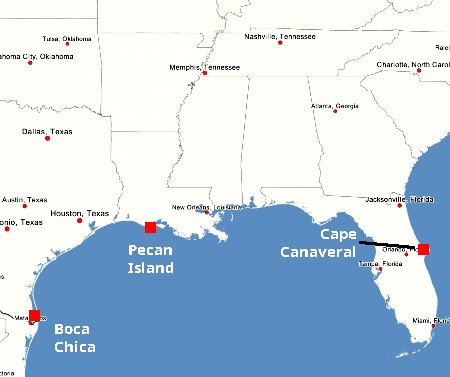
In response to the story earlier this week that SpaceX might be acquiring a 200-plus square mile patch of land near Pecan Island on the southern coast of Louisiana, a state senator has now confirmed that two unnamed aerospace companies have been talking with landowners about a possible purchase.
State Sen. Bob Hensgens, R-Abbeville, said he knows of two companies — he did not reveal if it is Elon Musk-owned SpaceX or Jeff Bezos’ Blue Origin — that have reached out to landowners in coastal Vermilion and Cameron parishes about a possible acquisition. “I know both companies are trying to find property in southwest Louisiana,” Hensgens said. “I know from people in the parishes that the companies have made outreach in the area.”
If so, we might actually have a bidding war for this property. Note however that nothing has yet been confirmed, including the names of the companies involved. The article at the link however provides some background into the 136K acre plot owned by Exxon, and how it might now be for sale. It also reports that a number of legislators (not Hensgens) have signed non-disclosure agreements about the negotiations.

On Christmas Eve 1968 three Americans became the first humans to visit another world. What they did to celebrate was unexpected and profound, and will be remembered throughout all human history. Genesis: the Story of Apollo 8, Robert Zimmerman's classic history of humanity's first journey to another world, tells that story, and it is now available as both an ebook and an audiobook, both with a foreword by Valerie Anders and a new introduction by Robert Zimmerman.
The print edition can be purchased at Amazon or from any other book seller. If you want an autographed copy the price is $60 for the hardback and $45 for the paperback, plus $8 shipping for each. Go here for purchasing details. The ebook is available everywhere for $5.99 (before discount) at amazon, or direct from my ebook publisher, ebookit. If you buy it from ebookit you don't support the big tech companies and the author gets a bigger cut much sooner.
The audiobook is also available at all these vendors, and is also free with a 30-day trial membership to Audible.
"Not simply about one mission, [Genesis] is also the history of America's quest for the moon... Zimmerman has done a masterful job of tying disparate events together into a solid account of one of America's greatest human triumphs."--San Antonio Express-News
Musk’s Louisiana Purchase!
Why can’t multiple space companies share the location? Zone it for space port use. Then sell plots on which companies build the infrastructure they need.
Steve Richter: Why are you suggesting a collectivist solution to a non-problem? Ownership conveys responsibility. What harm is there having multiple launch sites? None.
Shared facilities always get run-down because no one is truly responsible. They also increase costs to each company because they force sameness in operations, preventing innovation and new ideas.
I repeat: Why are you suggesting a collectivist solution to a non-problem?
Red baiting got old in the 1950’s, Robert.
Last I heard, no one launching out of “collectivist” Florida (snicker) sprouted a Che’ shirt by launching Falcon Heavy off a shuttle-pad.
Nothing wrong with multiple companies side by side.
They’re called “cities.”
For years, I heard market-worshippers lament Comsat, government restriction this and that.
The leash went lax—and Loral helped China go from bicycles to Moon programs.
Thanks lots.
Steve Richter,
Why does it need to have multiple users? There’s already multiple spaceports available for other launch providers, most of whom aren’t near launch, or do not need more launch capacity than they have and won’t for a while.
Jeff Wright,
Reasonable export controls and government actively hindering internal competition in the US are not the same thing. The US government is far more responsible for enabling China’s technical rise through Qian Xuesen in the 1950s compared to Loral participating in a review on why Intelsat 708 crashed in the 1990s. Your chain of causation is backwards.
Jeff Wright,
As long as there are reds, they will need baiting and, I, for one, have noticed no shortage of them lately. Fortunately, there is also no shortage of those willing – and well able – to ridicule them in public. The latest of those is, of all people, Spencer Pratt.
Spencer Pratt Gives Adam Carolla a Tour of his RV
“Malibu/PCH (Non)Re-building Update” (May, 5 2026)
Adam Carolla Video-Log
https://youtu.be/sJJxH_aRwXY
(35:44)
One can be against communism without hating community.
Jeff Wright,
And one can favor community without making it mandatory.
Steve Richter: Why are you suggesting a collectivist solution to a non-problem? Ownership conveys responsibility. What harm is there having multiple launch sites? None.
Shared facilities always get run-down because no one is truly responsible. They also increase costs to each company because they force sameness in operations, preventing innovation and new ideas.
I repeat: Why are you suggesting a collectivist solution to a non-problem?
—————————————-
Bob,
Airports are an analogue to this issue, no? Airports are run very well by governments.
Regionally administered space ports would enable startups to enter and operate in the launch business. Most important for Gulf launch sites is they require FAA approval and specific launch windows. These launches involve overflight rights and mandatory notifications to mariners as well as commercial airline flights, especially those operating in the Caribbean. ( thanks to Grok for writing those last two sentences :) )
A large, shared Gulf coast launch facility would/could have the infrastructure to get rockets certified ( that they will not explode over Caribbean Islands ) and have a common launch path that travels over the Caribbean islands and into space.
Steve Richter: The analogy with airports is faulty and inappropriate, at least at this time. Planes all use the same fuel. All are mostly identical in terms of take-off and landing. The facilities can thus be easily standardized for all airlines and airplanes.
Rockets from different companies are very different. Many use different fuels, requiring different tank farms and fueling technology. Each rocket functions uniquely depending on its design. They range vastly in size and power. Standardizing any spaceport for this wide variety is difficult if not impractical.
Most of the new commercial spaceports that have tried to attract multiple rocket companies to their sites have not done very well (Nova Scotia and Nordspace in Canada, Sutherland and Saxavord in the UK, several spaceports in Australia, Oman, Brazil). Some smaller rockets designed to be modular and transportable can fly from these standardized ports, but bigger rockets cannot.
Maybe someday the airport model might work, but not now, and to try to impose now it will only squelch the industry.
Don’t mind me. I asked Grok to help me express my POV.
“The worldwide commercial jet travel industry is extraordinarily successful and exceptionally well managed. Its global scale and safety record are made possible by the strong partnership between government and free enterprise. This collaboration — combining effective public oversight with private-sector innovation and execution — stands as one of the best examples of government working successfully for the benefit of the people.”
Steve Richter,
Bah. Screwed up quotes again. I know how to do this, I swear!