
Zvezda module on ISS is leaking once again
According to a report today at Ars Technica, the Zvezda module on ISS is once again leaking station air, despite recent repairs to the stress fractures in its hull that had appeared in recent months to halt the air loss.
After a couple of sources reported this to Ars, NASA confirmed the issue on Thursday. On May 1, after Russian cosmonauts unloaded cargo from the Progress 95 cargo spacecraft, Roscosmos noted a “slow pressure drop” in the PrK module.
“Teams performed data analysis, which indicated a loss of about one pound per day,” NASA spokesperson Josh Finch told Ars. “Roscosmos allowed the pressure in the transfer tunnel to gradually decrease while monitoring the rate. The area now is being maintained at a lower pressure, with small repressurizations as needed. There are no impacts to station operations, and NASA and Roscosmos are coordinating on next steps.”
A loss of one pound of air per day is comparable to the leak rate back in 2019, as shown in the lower right corner of the graphic below. It is also one third the loss rate seen for much of the following five years, which is I suppose good news.
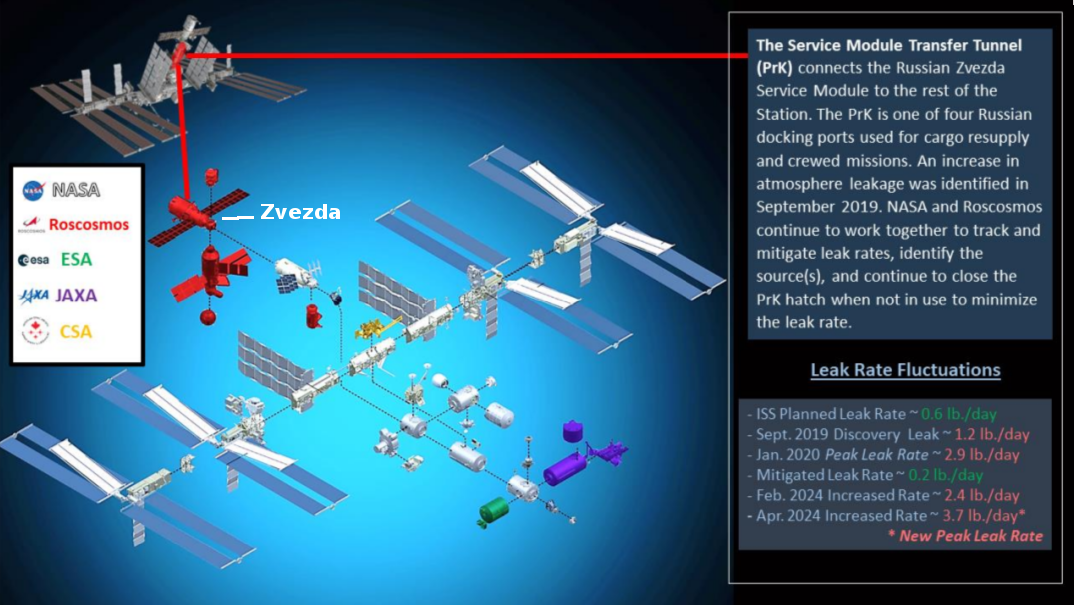
Figure 3 from September 2024 Inspector General report, showing Zvezda’s location on ISS, as well as the station’s leak rate at that time.
At the same time, it suggests once again that every docking to Zvezda puts stress on its hull, and apparently causes either new cracks or the reopening of old ones. In such a situation, a catastrophic failure of the module remains a possibility that cannot be dismissed. NASA closes the hatch between the Russian and American halves of the station whenever there is a docking, but that is only band-aid covering a much more serious problem.
Without question ISS’s life span is impacted by this issue. The sooner the U.S. can replace it with at least one or two of the private commercial stations under development, the better.

On Christmas Eve 1968 three Americans became the first humans to visit another world. What they did to celebrate was unexpected and profound, and will be remembered throughout all human history. Genesis: the Story of Apollo 8, Robert Zimmerman's classic history of humanity's first journey to another world, tells that story, and it is now available as both an ebook and an audiobook, both with a foreword by Valerie Anders and a new introduction by Robert Zimmerman.
The print edition can be purchased at Amazon or from any other book seller. If you want an autographed copy the price is $60 for the hardback and $45 for the paperback, plus $8 shipping for each. Go here for purchasing details. The ebook is available everywhere for $5.99 (before discount) at amazon, or direct from my ebook publisher, ebookit. If you buy it from ebookit you don't support the big tech companies and the author gets a bigger cut much sooner.
The audiobook is also available at all these vendors, and is also free with a 30-day trial membership to Audible.
"Not simply about one mission, [Genesis] is also the history of America's quest for the moon... Zimmerman has done a masterful job of tying disparate events together into a solid account of one of America's greatest human triumphs."--San Antonio Express-News
I know there is no way Russia could build any sort of replacement module. Why not give the plans and some money to a US manufacturer and build a copy of the module and launch it.
The reality is if we are to become space faring as a species, we need to learn to do this sort of thing.
As Kirk once said, “risk is our business”.
Joe asked “Why not give the plans and some money to a US manufacturer and build a copy of the module and launch it?”
We are already doing this, with five commercial stations being built by five different companies or consortiums. Each however will be new and privately owned. No reason to help the Russians prop up an old station with limited value that is owned and controlled poorly by governments.
When did they “fix” this? It wasn’t that long ago, I remember. Have there been any other docking/undockings on that port since the “fix” other than the one this week that evidently restarted the leak?
David Eastman: I need to check, but I think this was the first docking at Zvezda since the leak was “fixed.”
If not, it is the 2nd at most.
“At the same time, it suggests once again that every docking to Zvezda puts stress on its hull, and apparently causes either new cracks or the reopening of old ones. ”
Yeah, I continue to be puzzled that Roscosmos continues the risk of using the Zvezda port, when it has up to four other ports it can use. I understand why the approach vector is more desirable, but it really looks more and more like they are shortening the life of Zvezda — and by extension, the whole Russian segment — by continuing to use it.
To further reflect on Joe’s question, I think it’s likely that current U.S. sanctions imposed in 2021 and 2022 would bar such a transaction, though perhaps the waivers allowed for cooperation on ISS operations just might allow it, if the Trump Administration were open to exercising a waiver. (I could see that happening as a possible carrot in any peace deal regarding Ukraine.)
https://ofac.treasury.gov/media/928856/download?inline
Beyond that:
1. Looking at the calendar, it’s already spring 2026, and it is difficult to believe that anyone — even Vast — could whip together any replacement module, test it, and deliver it in time even if a contract was inked this weekend, before the station is scheduled for deorbiting in 2030 (assuming it lasts that long).
2. The even more fundamental problem with this idea is the idea that the Russian government would even entertain the idea, since there’s going to be a perception of national humiliation in attempting such a transaction, especially in the current tense state of U.S.-Russian relations. Thirty years ago, the Kremlin accepted an awful lot of such humiliation to get their part of the station off the ground, but today?
3. If somehow they DID pursue it, I think we must accept the possibility that some U.S. space company would take the contract if the price was right. But they would be best advised to get the payments for their deliverables up front, in cash.
A leaking module in this case is an opportunity to come up with the best repair methods that will last. And structural improvements that will prevent cracks in the first place.
I would like to see a private module it its place, so it could use the ISS solar panels as its own.
Jeff Wright,
Why? That subjects a private company to all the downsides of ISS operations, which are considerable.
Kick that module out and put in a very basic but stronger module just to keep it running till destruction.
It can than be disconnected and used on any other station project.
Its a tube with two docking ports. All parts we have known and accepted designs for.