
Category: Behind The Black
Bach’s Sheep May Safely Graze
An evening pause: An interesting arrangement of Bach’s wonderful aria.
Kepler tracks the tiny light variations and oscillations of 500 stars
Kepler does asteroseismology on 500 sunlike stars. The data says that the theories of star formation need to be revised.
Russian Spaceship ‘Gagarin’ Arrives at Space Station
Russian spaceship “Gagarin” arrives at ISS.
Newly discovered asteroid orbits in union with Earth
Newly discovered asteroid follows the Earth as it orbits the Sun, and has been doing it for a quarter million years.
Currently, three other horseshoe companions of the Earth are known to exist but, unlike 2010 SO16, these linger for a few thousand years at most before moving on to different orbits. Also, with an estimated diameter of 200–400 metres, 2010 SO16 is by far the largest of Earth’s horseshoe asteroids. The team has already used the Las Cumbres Observatory’s Faulkes Telescope in an on-going campaign to track the object and refine its orbit further. “It is not that difficult to spot with a medium-sized professional telescope”, says Dr Asher. “It will remain as an evening object in Earth’s skies for many years to come.”
A galaxy eats a star
Nyiragongo Crater: Journey to the Center of the World
Walking in Nyiragongo Crater in Africa. The pictures are stupendous.
Caving in Druid Cave, Cheat Canyon, West Virginia
An evening pause: Caving in Druid Cave, Cheat Canyon, West Virginia. The caver is David Riggs. The videographer is caver Aaron Bird. The caver who arrives at the end with the ATV is caver Brian Masney. All are world class cavers, with whom I’ve had the honor of caving.
The video is nicely done, and gives an excellent and accurate feel for modern cave exploration and techniques. Watch especially how the rigging allows David to climb past the waterfall while on rope and hardly get wet.
Hot time on the ol’ Sun tonight!
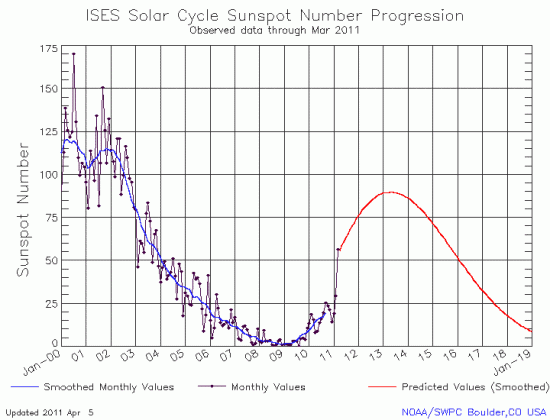
After literally years of inactivity, well below all initial predictions, the Sun truly came to life this past month. Below is the March monthly update of the Sun’s sunspot cycle, published by NOAA’s Space Weather Prediction Center. The red curve is the prediction, while the dotted black line shows the actual activity.
As you can see, the Sun’s sunspot activity shot up precipitously. Though I don’t have the data from past years, the March jump appears to me to probably be one of the fastest monthly rises ever recorded.
Does this mean the newest prediction from the solar scientists at the Marshall Space Flight Center calling for a weak solar maximum in 2013 is wrong? Probably not, though of course in this young field who knows? I would say, however, that the overall trend of the data still suggests the next maximum will be very weak.
Stay tuned! The next few months should finally give us a sense of where the next maximum is heading.
GOP Budget Proposal: ‘Not a Penny’ for Obamacare
More progress, if true: The Republican 2012 budget proposal includes nothing for Obamacare.
Bill Staines – River
An evening pause: Performed live 2015.
Evidence that liquid water once existed on a comet
Scientists have found strong evidence that liquid water once existed in the interior of a comet.