More hiking possibilities on Mars!

More hiking possibilities on Mars
Click for original image.

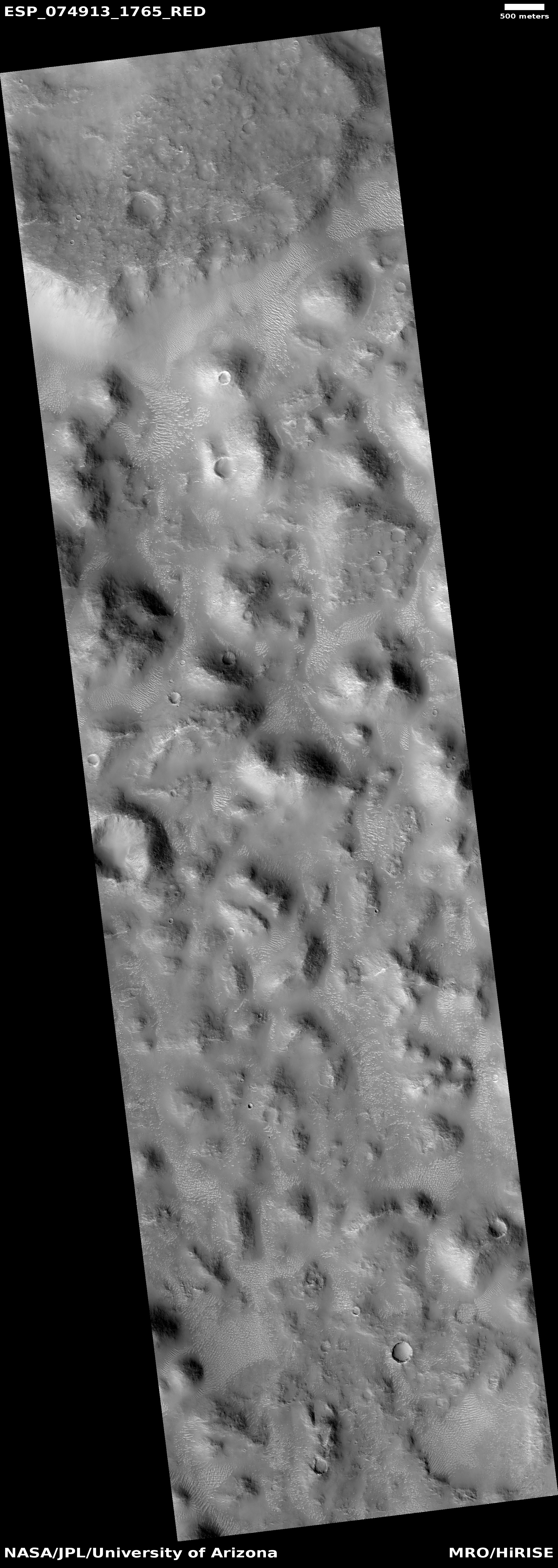
Cool image time! The picture to the right, rotated, cropped, reduced, and sharpened to post here, was taken on September 27, 2023 by the high resolution camera on Mars Reconniassance Orbiter (MRO). Dubbed a “terrain sample” by the science team, this picture was likely chosen not as part of any specific research project but to fill a gap in the camera schedule so as to maintain that camera’s proper temperature.

When the team needs to do this they try to pick interesting targets. In this case the location is the region of many many parallel north-south fissures that extend for more than 800 miles south of the giant but relative flat shield volcano Alba Mons. These fissures are grabens, cracks formed when underground pressure pushed the ground up and caused it to spread and crack.

What attracted me to this picture is the ridgeline. It struck me as a wonderful place to hike. I have even indicated in red the likely route any trail-maker would pick to go from the valley below up onto the ridge, and then along its knifelike edge to the south. The height of the cliff down to the east valley averages about six hundred feet, guaranteeing beautiful scenery the entire length.
» Read more

0 comments

Pushback: Parents of 9-year-old slandered by Deadspin reporter sue

Holden (R) with his father Bubba
Holden (R) with his father Raul, being interviewed
on television following the slander. Click for video.

Bring a gun to a knife fight: This is follow-up to my story only two days ago about the defamation and slander of 9-year-old Holden Armenta by Deadspin Senior Writer Carron Phillips. Both had falsely accused this innocent child of racism because he attended a game wearing facepaint with the red and black colors of the Kansas City Chiefs, like numerous fans have done for decades. My story was about a GiveSendGo fund-raising campaign still on-going to send Holden to the Super Bowl in Las Vegas this coming weekend to see his team play, in person.

On that same day the boy’s parents filed a lawsuit against Deadspin and its parent company, G/O Media, accusing both of defaming both Holden and themselves, and demanding actual and punitive damages.

You can read the complaint here [pdf]. It is a heart-breaking document to read, especially when it describes the painful consequences to Holden because of Phillips’ vicious and false attack.
» Read more

3 comments

A galaxy with a tail of star-forming clusters

A galaxy with a tail of newborn stars
Click for original image.

Cool image time! The picture to the right, reduced and sharpened to post here, was taken by the Hubble Space Telescope as part of a survey of twelve different galaxies that have long tails. In this case, the galaxy is named Arp-Madore 1054-325, and the tail that trails off in the upper left is caused by the gravity of the nearby neighboring galaxy, which I think is the patch of stars just below it. Within it are many star clusters where new stars are forming. From the caption:

A team of astronomers used a combination of new observations and archival data to get ages and masses of tidal tail star clusters. They found that these clusters are very young — only 10 million years old. And they seem to be forming at the same rate along tails stretching for thousands of light-years. “It’s a surprise to see lots of the young objects in the tails. It tells us a lot about cluster formation efficiency,” said lead author Michael Rodruck of Randolph-Macon College in Ashland, Virginia.

Before the mergers, the galaxies were rich in dusty clouds of molecular hydrogen that may have simply remained inert. But the clouds got jostled and bumped into each other during the encounters. This compressed the hydrogen to the point where it precipitated a firestorm of star birth.

In some ways this galaxy portends one possible future of the Milky Way, after it collides with the nearby Andromeda galaxy in the far future.

2 comments

Pieces of a defunct ESA Earth-observation satellite will hit the Earth

The orbit of a defunct European Space Agency (ESA) Earth-observation satellite, ERS-2, is expected to decay later this month, with most of the satellite burning up in the atmosphere but some pieces surviving to hit the ground.

The satellite will break apart when it hits an altitude of about 50 miles (80 km), according to the FAQ [from ESA]. Most of the resulting fragments will then burn up in the atmosphere. Don’t worry too much about the ones the make it down to the surface, for they’ll contain no toxic or radioactive substances, according to ESA.

The article and the FAQ both go out of their way to minimize the risks. Both are correct. However, the risk of this debris hitting anyone, though very very very VERY small, still exists.

0 comments

India’s proposed space station now has a name: Bharatiya Antariksh Station

Though no money has yet been allocated to build it, and India’s space agency ISRO has only begun design work, it has now apparently decided to name the space station the Bharatiya Antariksh Station.

They tentatively hope to launch a test module in 2028 to do unmanned rendezvous and docking tests, with assembly beginning in 2028 and completed by 2035.

None of this schedule is certain of course. ISRO has been proposing this space station since 2017. Nothing has ever come of those plans.

Only now does this seem more likely, with India’s effort to shift its space effort from a government-owned and run program to a competitive commercial industry.

3 comments

India to do 19 launches through March 2025

India's planned launches through March 2025

According to India’s space bureaucracy IN-SPACe, that nation has planned as many as 19 launches through March 2025.

The image to the right shows the manifest that IN-SPACe released. That agency is tasked with encouraging India’s private and independnt space industry, and it claims that 30 missions in total are planned, with half by commercial companies. This number however includes payloads and suborbital test missions, not just orbital launches. Based on the manifest to the right it appears that 19 of these missions are launches, with six being entirely private launches. One of those private launches, the first of Agnikul’s commercial Agnibaan rocket, will be suborbital.

It thus appears that in 2024 India hopes to complete 14 orbital launches. If so, this would double that nation’s previous record of seven launches in a single year. This schedule is very aspirational, with those six entirely commercial launches likely not all happening as planned.

0 comments

Solar-orbiting asteroid that is a quasi-moon of Venus gets a name

The asteroid 2002-VE, discoverd in 2002, is in a solar orbit that makes it a quasi-moon of Venus. This means that the asteroid and Venus are in very similar orbits around the Sun, with 2002-VE shifting back and forth periodically from within Venus’s orbit to outside it.

An official name for 2002-VE has now been approved by the International Astronautical Union, and the history of that name, Zoozve, is a silly one. It appears a podcaster had misread the name on a poster of the solar system that was on the wall of his 2-year-old son’s bedroom. (You can see the poster here). He read “2”s as “Z”s, so that instead of seeing “2002VE” he read it as “Zoozve”.

Since then he has been campaigning to make this misreading official, and has finally succeeded.

8 comments

Vibration testing of Sierra Space’s Tenacity mini-shuttle completed

NASA engineers have now completed vibration testing of Sierra Space’s Tenacity mini-shuttle, set to launch on a Vulcan rocket later this year.

Reading between the blather in the NASA press release at the link, it appears that testing was successful, proving that the Dream Chaser spacecraft can survive the vibrations of launch. This conclusion by me however remains unconfirmed. Engineers are now preparing the mini-shuttle for environmental testing.

Next up, Dream Chaser will move to a huge, in-ground vacuum chamber that will continue to simulate the space environment Dream Chaser will encounter on its mission. The spaceplane will be put through its paces, experiencing low ambient pressures, low-background temperatures, and dynamic solar heating.

Previously the launch date had been targeting April 2024, according to ULA officials. It now appears, from the vagueness of recent reports, as well as the actual testing now in progress, that the launch date has slipped. They appear to be targeting the first half of 2024, but are as yet unwilling to commit to a date.

0 comments

Scientists: We think the Saturn moon Mimas may have a young underground ocean

The uncertainty of science: Using computer modeling based on orbital data obtained from the orbiter Cassini, scientist now believe the Saturn moon Mimas may have a young underground ocean.

[I]n 2014, a team that included Lainey and that was led by Radwan Tajeddine, an astronomer then at the Paris Observatory, analysed images taken by NASA’s Cassini spacecraft, which explored Saturn and its moons between 2004 and 2017. By studying how the 400-kilometre-wide Mimas wobbled in its orbit around Saturn, the researchers concluded that it had either a buried ocean or a rugby-ball-shaped core. As more scientists studied how an ocean could have formed and evolved, it became harder to explain the geology of Mimas without invoking an ocean.

In the 2024 study, Lainey and his colleagues seem to have nailed the case. They went further than they had in 2014, by analysing not just the orbit’s wobble but also how Mimas’s rotation around Saturn changed over time. The team combined Cassini observations with simulations of Mimas’s interior and its orbit to conclude that there must be an ocean 20–30 kilometres below Mimas’s surface.

The journal Nature published the paper, and the link above goes to an article in Nature describing the results, with a headline “The Solar System has a new ocean — it’s buried in a small Saturn moon.” This is very poor journalism, but very typical these days from Nature. Nowadays that journal routinely pushes the results it publishes with great certainty, even if the data is quite uncertain.

And these results are quite uncertain. They are based on computer simulations using orbital data only. No data from Mimas itself is involved. While that orbital data and computer models might suggest an underground ocean that is very young, that is the best it does, “suggest.” Without question this conclusion is very intriguing, but it should not be treated as a discovery, only a theory that still needs confirmation with much better data.

2 comments

February 7, 2024 Quick space links

Courtesy of BtB’s stringer Jay. This post is also an open thread. I welcome my readers to post any comments or additional links relating to any space issues, even if unrelated to the links below.


1 comment
1 341 342 343 344 345 2,413