
John Prine – Sabu Visits The Twin Cities Alone
An eveing pause: A silly song for April Fools. Hat tip Edward Thelen.
An eveing pause: A silly song for April Fools. Hat tip Edward Thelen.
The competition heats up: Jeff Bezos indicated today on Twitter that the next New Shepard flight will be this weekend.
“Working to fly again tomorrow,” Blue Origin founder and Amazon.com CEO Jeff Bezos tweeted on Friday. “Same vehicle. Third time.” Adding to the intrigue, Bezos said there was a higher chance of a crash on the upcoming unmanned test flight. During its descent, the booster’s hydrogen-fueled BE-3 engine will re-light closer to the ground — just 3,600 feet up — and at higher thrust than before.
“Pushing the envelope,” said Bezos. “Impact in 6 sec if engine doesn’t restart & ramp fast.”
I will be out caving this weekend, so my reactions will have to wait until I return on Sunday night. Should be quite exciting however, especially as this will be third flight into space for this ship/rocket, a first as far as I know in space travel. There have been some vehicles reused, but I don’t remember any that reached space and were reused more than once.

On Christmas Eve 1968 three Americans became the first humans to visit another world. What they did to celebrate was unexpected and profound, and will be remembered throughout all human history. Genesis: the Story of Apollo 8, Robert Zimmerman's classic history of humanity's first journey to another world, tells that story, and it is now available as both an ebook and an audiobook, both with a foreword by Valerie Anders and a new introduction by Robert Zimmerman.
The print edition can be purchased at Amazon or any other book seller. If you want an autographed copy the price is $60 for the hardback and $45 for the paperback, plus $8 shipping for each. Go here for purchasing details. The ebook is available everywhere for $5.99 (before discount) at amazon, or direct from my ebook publisher, ebookit. If you buy it from ebookit you don't support the big tech companies and the author gets a bigger cut much sooner.
"Not simply about one mission, [Genesis] is also the history of America's quest for the moon... Zimmerman has done a masterful job of tying disparate events together into a solid account of one of America's greatest human triumphs."--San Antonio Express-News
I want to highlight these two stories as a group, because I think they both signal a significant landmark in human scientific and commercial development. Check them out. You will not be disappointed.
The competition heats up: At a workshop in Alabama this week Sierra Nevada’s vice president indicated that though the company has not yet finalized its decision, it is strongly leaning to picking Huntsville as the commercial spaceport for its Dream Chaser mini-shuttle, being built to ferry cargo to ISS.
“There was a leap of faith on the Huntsville side that we would be a company that could get this vehicle built and start servicing the space station…,” Sierra Nevada Vice President John Roth said Thursday. “Yes, we have been approached by other airports for ventures. We’re not moving forward at this time with any of those. Right now, Huntsville is the only community we’re moving forward with a (landing) license on.”
A preliminary local study identified four hurdles to landing Dream Chaser at the Huntsville International Airport: required licenses for the craft and airport, environmental impact approval, Federal Aviation Administration approval of the landing path and possible runway damage.
Why do I sense the unseen hand of porkmeister Senator Richard Shelby (R-Alabama) in this story? Could it be that one of the reasons NASA finally included Dream Chaser in its cargo contract was that the company had not only chosen the Alabama-based Atlas 5 rocket for its launch vehicle but was also courting Alabama for its commercial base, and Shelby had made it clear behind the scenes that he wanted that business? Could it be that Sierra Nevada is now returning the favor, having gotten the contract?
Don’t get me wrong. I think it was a good choice for NASA to give that contract to Sierra Nevada. I just think it important to note how giving some of our power away to politicians allows them to wield that power over us, sometimes to our benefit, sometimes against it, but always to make themselves more powerful. In the end, giving that power away is never a good option.

Now available in hardback and paperback as well as ebook!
From the press release: In this ground-breaking new history of early America, historian Robert Zimmerman not only exposes the lie behind The New York Times 1619 Project that falsely claims slavery is central to the history of the United States, he also provides profound lessons about the nature of human societies, lessons important for Americans today as well as for all future settlers on Mars and elsewhere in space.
“Zimmerman’s ground-breaking history provides every future generation the basic framework for establishing new societies on other worlds. We would be wise to heed what he says.” —Robert Zubrin, founder of the Mars Society.
All editions are available at Amazon, Barnes & Noble, and all book vendors, with the ebook priced at $5.99 before discount. All editions can also be purchased direct from the ebook publisher, ebookit, in which case you don't support the big tech companies and the author gets a bigger cut much sooner.
Autographed printed copies are also available at discount directly from the author (hardback $29.95; paperback $14.95; Shipping cost for either: $6.00). Just send an email to zimmerman @ nasw dot org.
In attempting several times this past week to climb the steepest ever tried by a rover on Mars and failing, Opportunity has moved on to a new less challenging target.
The rover’s tilt hit 32 degrees on March 10 while Opportunity was making its closest approach to an intended target near the crest of “Knudsen Ridge.”
Engineers anticipated that Opportunity’s six aluminum wheels would slip quite a bit during the uphill push, so they commanded many more wheel rotations than would usually be needed to travel the intended distance. Results from the drive were received in the next relayed radio report from the rover: The wheels did turn enough to have carried the rover about 66 feet (20 meters) if there had been no slippage, but slippage was so great the vehicle progressed only about 3.5 inches (9 centimeters). This was the third attempt to reach the target and came up a few inches short.
The rover team reached a tough decision to skip that target and move on.
Having operated thirteen years longer than originally planned, the science and engineering team that operates the Mars rover Opportunity are increasingly willing to try more risky things. For example, the valley the rover is in, called Marathon Valley, is actually an east-west slice through the rim of 14-mile-wide Endeavour Crater. Traveling into that slice towards the crater’s interior is a far riskier trip than ever dreamed of by Opportunity’s designs more than a decade ago.
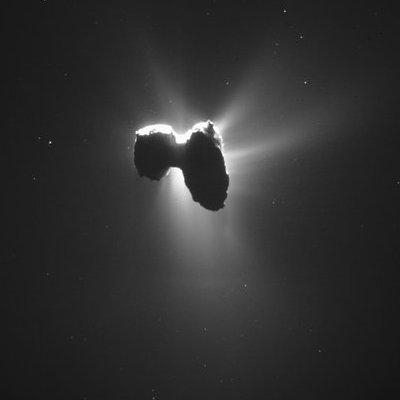
Cool image time! As part of its research plan, Rosetta has been moved outward from Comet 67P/C-G for the next few weeks in order to better study its coma and tail. In this new position, engineers were able to maneuver the spacecraft so that it was flying about 600 miles farther from the Sun and could look back and see the Sun being eclipsed by the comet.
Thanks to the combination of a long, four-second exposure, no attenuation filter and a low-gain setting on the analogue signal processor of NAVCAM (a setting that is used to image bright targets), the image reveals the bright environment of the comet, displaying beautiful outflows of activity streaming away from the nucleus in various directions. It is interesting to note hints of the shadow cast by the nucleus on the coma below it, as well as a number of background stars sprinkled across the image.
In the next week the spacecraft will move back in close to the comet.
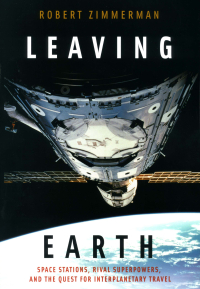
Leaving Earth: Space Stations, Rival Superpowers, and the Quest for Interplanetary Travel, can be purchased as an ebook everywhere for only $3.99 (before discount) at amazon, Barnes & Noble, all ebook vendors, or direct from my ebook publisher, ebookit.
If you buy it from ebookit you don't support the big oppressive tech companies and I get a bigger cut much sooner.
"Leaving Earth is one of the best and certainly the most comprehensive summary of our drive into space that I have ever read. It will be invaluable to future scholars because it will tell them how the next chapter of human history opened." -- Arthur C. Clarke
Government in action: In response to two executive orders by President Obama ordering federal agencies to review their regulations to eliminate red tape and streamline government operations, federal bureaucrats added 6.5 million paperwork hours to their workload and increased regulatory costs by $16 billion even as they wrote these reviews.
The American Action Forum has found the reviews consist mostly of recycled regulations by federal agencies that have actually increased regulatory costs. “The recent ‘retrospective reports’ from the administration reveal that executive agencies have added more than $16 billion in regulatory costs, up from $14.7 billion in the previous update, and 6.5 million paperwork hours,” the report said.
The agency reviews are a result of President Barack Obama’s initiative for a “government-wide review of rules on the books,” which the White House claims to have led to $28 billion in net five-year savings since 2011. However, the American Action Forum has found retrospective reviews often add additional costs to the economy. A review in 2014 added $23 billion in costs and 8.9 million paperwork burden hours.
No one should be surprised by this. Asking agencies to review their regulations will instead be seen by them as a glorious opportunity to justify their existence with more work. The way to eliminate these regulations is for the elected officials in charge to, surprise!, eliminate these regulations. Don’t ask the bureaucrats to do it. Tell them to do it.
And when these bureaucrats go to the press to complain and say how the elimination of this or that regulation will cause the sky to fall, the politicians have to have the courage to not back down, even when the press teams up with the bureaucrats to slander them for trying to bring the federal government under control.
An investigation into the early shutdown of the first stage engine on the Atlas 5 during last week’s Cygnus launch is now centered around the rocket’s fuel system.
Though they state that the system appears that it used its oxygen supply too quickly, the company has not released more details.
An evening pause: Hat tip Edward Thelen.
Bad news for bats: Scientists have confirmed a bat with white nose syndrome in the state of Washington, 1,300 miles further west than the previous detection.
On March 11, hikers found the sick bat about 30 miles east of Seattle near North Bend, and took it to Progressive Animal Welfare Society (PAWS) for care. The bat died two days later, and had visible symptoms of a skin infection common in bats with WNS. PAWS then submitted the bat for testing to the USGS National Wildlife Health Center, which confirmed through fungal culture, molecular and pathology analyses that it had WNS.
I hate to express such a thought, but I can’t help wonder about the legitimacy of this detection. It is so far west and so far from the nearest other bat with white nose syndrome I cannot understand how this bat came to be infected, naturally. In order for this discovery to be confirmed they are going to have to detect it again, and more than once, on a number of bats. Otherwise, it will remain suspect and a possible false positive.
The worst part of this is that the government is surely going to begin instituting draconian measures to protect the bats in Washington, as well as across the entire western United States, even before this detection is confirmed. Having this single detection will make it much easier for government officials to ban humans from many more places, even though white nose syndrome is nowhere close.
India today signed an agreement with the National Science Foundation to build its own LIGO gravitational wave detector
This deal, combined with the possibility that TMT might move to India as well, suggests that India is about to move aggressively from the Third World to the First. And the reason, after decades of wallowing in poverty and failure, is that they finally abandoned in the late 1990s the Soviet models of socialism and communism and embraced private enterprise and capitalism, ideas championed by the United States.
If only some modern Americans would do the same.
The competition heats up: The new satellite company OneWeb, with plans to launch a constellation of 900 satellites beginning next year, has begun hiring engineers for a manufacturing plant it intends to locate in Florida.
The article also notes the construction start of a new building that is suspected but not confirmed as the location of that manufacturing plant.
OneWeb’s existence is visible proof of my contention that if the launch business can lower the cost to orbit it will create new customers who can afford to buy the product. OneWeb is partly lowering the cost on its own by using small cubesat-like satellites, but it is also taking advantage of the renewed competition in the launch industry to get better deals on buying the rockets it needs to launch those satellites.

Worlds without end: The ground-based telescope ALMA has imaged a proto-planetary disk around a sun-like star that suggests an exoEarth is forming there the same distance from the star as our Earth is from our Sun.
The star, TW Hydrae, is a popular target of study for astronomers because of its proximity to Earth (approximately 175 light-years away) and its status as a veritable newborn (about 10 million years old). It also has a face-on orientation as seen from Earth. This affords astronomers a rare, undistorted view of the complete disk. “Previous studies with optical and radio telescopes confirm that this star hosts a prominent disk with features that strongly suggest planets are beginning to coalesce,” said Sean Andrews with the Harvard-Smithsonian Center for Astrophysics in Cambridge, Mass., and lead author on a paper published today in Astrophysical Journal Letters. “The new ALMA images show the disk in unprecedented detail, revealing a series of concentric dusty bright rings and dark gaps, including intriguing features that suggest a planet with an Earth-like orbit is forming there.”
Other pronounced gap features are located 3 billion and 6 billion kilometers from the central star, similar to the distances from the Sun to Uranus and Pluto in our own Solar System.
The image above right is the inner section of that disk, showing the gap at one astronomical unit, or about 100 million miles from the star, the same as the distance of the Earth from the Sun. Essentially, this relatively close star system is providing us a perfect opportunity to study the formation of a solar system not unlike our own.
In the heat of competition: A state judge has denied a request by Broadcom for a temporary injunction to block the five engineers hired from that company by SpaceX from doing work during the lawsuit.
The article includes further information, including details from one of the poached employees, justifying and explaining their job move.
One week after the Moscow Commercial Court ordered the contractor building the new Russian spaceport Vostochny to repay $52 million in bank loans, that contractor has now filed three lawsuits totaling $17.9 million against the organization that runs the spaceport.
The new lawsuits suggest that even as the contractor’s managers were embezzling millions from the spaceport, the spaceport organization was also pocketing some money that was supposed to go to the contractor.
Russia: a true worker’s paradise!
The competition heats up? Though he couldn’t reveal any details, the director of Russian space agency Roscosmos today said that they have found a buyer for Sea Launch.
“I cannot tell you who the investor is, or the value of the contract, due to certain obligations. I hope that we will have something to say about it by the end of April,” Komarov said. He did, however, say that investors from the U.S., Australia, China and Europe have expressed interest in the project.
Because Sea Launch is a floating launch platform, there really is no reason the company can’t be taken over by anyone in the world. And should the buyer use the Ukrainian Zenit rocket that the platform was designed to use, the technical problems might be reduced as well.
An evening pause: Performed live on the television show Shindig!, August 11, 1965. Be sure to read the notes about this song and group at the youtube link.
Hat tip Rocco.
Push back: Emory University alumini are circulating a petition calling for the university to recommit itself to free speech instead of pandering to protesters demanding “emotional comfort, ideological conformity, and yes, ‘safe environments’.”
The petition was authored by alumni Matthew Walker and Ed Thayer, who said this:
“My Emory experience, which I look upon fondly, was periodically defined by eruptions of illiberal behavior from various student groups, although nothing as shrill and totalitarian as we are witnessing today,” Thayer said, adding that Emory administrators used to err on the side of free speech. “Nowadays they seem inclined to appease the worst intolerant and alarmist instincts of some students, while undercutting the foundations of free speech, tolerance, and a robust debate, which should thrive at a university.
Matthew Walker, for his part, summed up the whole situation in one word: “Unacceptable.”
The article above begins by focusing on how the university president has backed down from his original willingness to support the squelching of free speech. I suspect this pressure from alumni, who with most universities provide a great deal of financial support, is making him rethink his positions.
Your tax dollars at work! The U.S.’s largest solar power company, heavily subsidized by the federal government, now faces bankruptcy.
An SEC filing from TerraForm Global, a unit of SunEdison, claims “due to SunEdison’s liquidity difficulties, there is a substantial risk that SunEdison will soon seek bankruptcy protection.” Both SunEdison and TerraForm are delaying the filing of their annual financial report to the SEC.
News of SunEdison’s impending bankruptcy filing comes after the company’s shares fell 95 percent in the past 12 months, with shares now trading for less than $1 for the first time since the green energy company went public in 1995. SunEdison’s market value fell from $10 billion in July 2015 to around $400 million today.
The news also comes after the SEC announced it was launching an investigation into SunEdison’s disclosures to shareholders regarding the company’s liquidity. SEC enforcement officials “are looking into whether SunEdison overstated its liquidity last fall when it told investors it had more than $1 billion in cash,” according to The Wall Street Journal.
…The pro-labor union group Good Jobs First reported last year that SunEdison and its subsidiaries got nearly $650 million in subsidies and tax credits from the federal government since 2000. It was the 13th most heavily-subsidized company in America. This includes nearly $4.6 million in subsidies from the Department of Energy and Department of Treasury. Watchdog.org reported in October 2015 that SunEdison had gotten nearly $4.6 million from the Obama administration, including funding to build semi-conductors. A SunEdison bankruptcy could leave taxpayers on the hook for more than $2 billion.
But hey, what’s a few billion here or there, if the cause is worthwhile?
The competition really heats up! A research team at the University of California, Santa Barbara (UCSB) has proposed that an array of space-based lasers can be used to accelerate a solar sail to speeds as much as 26% the speed of light, thus making interstellar travel possible.
[The] key breakthrough was the development of modular arrays of synchronized high-power lasers, fed by a common “seed laser.” The modularity removes the need for building powerful lasers as a single device, splitting them instead into manageable parts and powering the seed laser with relatively little energy. Lockheed Martin has recently exploited this advance to manufacture powerful new weapons for the US Army. In March last year, the aerospace and defense giant demonstrated a 30 kW laser weapon (and its devastating effect on a truck). By October, the laser’s power had already doubled to 60 kW and offered the option to reach 120 kW by linking two modules using off-the-shelf components.
The UCSB researchers refer to their own planned arrays as DE-STAR (Directed Energy System for Targeting of Asteroids and ExploRation), with a trailing number to denote their size. A DE-STAR-1 would be a square array 10 meters (33 ft) per side and about as powerful as Lockheed’s latest; at the other end of the spectrum, a DE-STAR-4 would be a 70 GW array covering a massive area of 100 square kilometers (39 square miles).
…Lubin stresses that even a relatively modest orbital array could offer interesting propulsion capabilities to CubeSats and nanosatellites headed beyond Earth orbit, and that useful initial tests would still be conducted on the ground first on one-meter (3-ft) arrays, gradually ramping up toward assembling small arrays in orbit. While even a small laser array could accelerate probes of all sizes, the larger 70-GW system would of course be the most powerful, capable of generating enough thrust to send a CubeSat probe to Mars in eight hours – or a much larger 10,000-kg (22,000-lb) craft to the same destination in a single month, down from a typical six to eight.
Further upgrades would make it possible to send a cubesate and its lightsail to Alpha Centuri in about fifteen years.
The important point here is that it appears that all the technology for building this already exists, or is relatively straightforward to develop.