
The first Earthrise picture taken from the Moon, 46 years ago today.
The first Earthrise picture taken from the Moon, 46 years ago today.
The first Earthrise picture taken from the Moon, 46 years ago today.
Does this make you feel safer? Hundreds of Homeland Security employees were arrested last year, for crimes ranging from child porn to aiding the drug cartels in Mexico.

On Christmas Eve 1968 three Americans became the first humans to visit another world. What they did to celebrate was unexpected and profound, and will be remembered throughout all human history. Genesis: the Story of Apollo 8, Robert Zimmerman's classic history of humanity's first journey to another world, tells that story, and it is now available as both an ebook and an audiobook, both with a foreword by Valerie Anders and a new introduction by Robert Zimmerman.
The print edition can be purchased at Amazon or any other book seller. If you want an autographed copy the price is $60 for the hardback and $45 for the paperback, plus $8 shipping for each. Go here for purchasing details. The ebook is available everywhere for $5.99 (before discount) at amazon, or direct from my ebook publisher, ebookit. If you buy it from ebookit you don't support the big tech companies and the author gets a bigger cut much sooner.
"Not simply about one mission, [Genesis] is also the history of America's quest for the moon... Zimmerman has done a masterful job of tying disparate events together into a solid account of one of America's greatest human triumphs."--San Antonio Express-News
Why “chemical-free” organic food is impossible, and why journalists should know better.
And in a related story, a science journalist tears apart a bad press release and the press-release-journalists who bought it, lock, stock, and barrel.
Phosphorus and the origins of life on Earth.
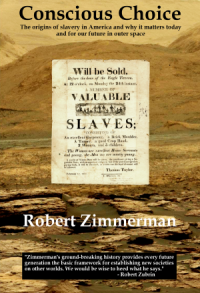
Now available in hardback and paperback as well as ebook!
From the press release: In this ground-breaking new history of early America, historian Robert Zimmerman not only exposes the lie behind The New York Times 1619 Project that falsely claims slavery is central to the history of the United States, he also provides profound lessons about the nature of human societies, lessons important for Americans today as well as for all future settlers on Mars and elsewhere in space.
“Zimmerman’s ground-breaking history provides every future generation the basic framework for establishing new societies on other worlds. We would be wise to heed what he says.” —Robert Zubrin, founder of the Mars Society.
All editions are available at Amazon, Barnes & Noble, and all book vendors, with the ebook priced at $5.99 before discount. All editions can also be purchased direct from the ebook publisher, ebookit, in which case you don't support the big tech companies and the author gets a bigger cut much sooner.
Autographed printed copies are also available at discount directly from the author (hardback $29.95; paperback $14.95; Shipping cost for either: $6.00). Just send an email to zimmerman @ nasw dot org.
Scientists have found new evidence that the solar sunspot cycle has influenced the Earth’s climate in the recent past.
Sirocko and his colleagues found that between 1780 and 1963, the Rhine froze in multiple places fourteen different times. The sheer size of the river means it takes extremely cold temperatures to freeze over making freezing episodes a good proxy for very cold winters in the region, Sirocko said.
Mapping the freezing episodes against the solar activity’s 11-year cycle — a cycle of the Sun’s varying magnetic strength and thus total radiation output — Sirocko and his colleagues determined that ten of the fourteen freezes occurred during years when the Sun had minimal sunspots. Using statistical methods, the scientists calculated that there is a 99 percent chance that extremely cold Central European winters and low solar activity are inherently linked.
Also this:
» Read more
A new AIDS-like disease has appeared, attacking about 100 Asians since 2004.
Scientists do not know what causes it, though it appears it is not contagious.
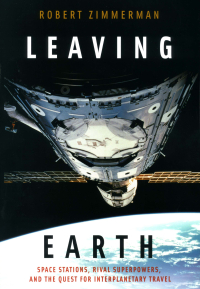
Leaving Earth: Space Stations, Rival Superpowers, and the Quest for Interplanetary Travel, can be purchased as an ebook everywhere for only $3.99 (before discount) at amazon, Barnes & Noble, all ebook vendors, or direct from my ebook publisher, ebookit.
If you buy it from ebookit you don't support the big oppressive tech companies and I get a bigger cut much sooner.
"Leaving Earth is one of the best and certainly the most comprehensive summary of our drive into space that I have ever read. It will be invaluable to future scholars because it will tell them how the next chapter of human history opened." -- Arthur C. Clarke
The European cargo ship docked at ISS today successfully fired its engines and raised the station’s orbit to 260 miles.
This is in contrast to a previous attempt on August 15, which cut off prematurely.
An evening pause:
Leftwing civility: Police are preparing for significant violence at next week’s Republican convention in Tampa, based on threats by a number of leftwing groups.
In related news, the man who entered the conservative Family Research Center with a gun and shot a security guard after announcing “I don’t like your politics” has been indicted.
Curiosity has made its first test drive, moving about fifteen feet.
Saving the day for freedom: A 5-year-old Oklahoma kindergarten student was banned from wearing a University of Michigan t-shirt because it violated a city ordinance banning any apparel that didn’t support the state’s college teams.
Update: I have corrected the post, as I initially called this a state law, which it is not. Thank you Blair.
A Florida university has broken ground on a new hurricane simulation machine capable of recreating category 5 hurricanes in three dimensions.
The facility will not only allow scientists to study hurricanes, they will also be able to test the engineering of objects trying to survive them.
Michael Mann threatens to sue a conservative magazine. Their answer: “Get lost.”
The uncertainty of science: Are the glaciers in the Himalayas shrinking? A third paper published today falls between one study that said no and another that said yes.
The new estimate raises further questions about satellite and field measurements of alpine glaciers, and ”will set the cat among the pigeons,” says Graham Cogley, a remote-sensing expert at Trent University in Peterborough, Ontario. … Although the ICESat results show twice as much ice loss as the re-interpreted GRACE data, this figure is still three times lower than regional losses estimated on the basis of field studies.
P.J. O’Rourke: “Of thee I sigh: Baby boomers bust.”
My sad generation of baby boomers can be blamed. We were born into an America where material needs were fulfilled to a degree unprecedented in history. We were a demographic benison, cherished and taught to be self-cherishing. We were cosseted by a lush economy and spoiled by a society grown permissive in its fatigue with the strictures of depression and war. The child being father to the man, and necessity being the mother of invention, we wound up as the orphans of effort and ingenuity. And pleased to be so. Sixty-six years of us would be enough to take the starch out of any nation.
The baby boom was skeptical about America’s inventive triumphalism. We took a lot of it for granted: light bulb, telephone, television, telegraph, phonograph, photographic film, skyscraper, airplane, air conditioning, movies. Many of our country’s creations seemed boring and square: cotton gin, combine harvester, cash register, electric stove, dishwasher, can opener, clothes hanger, paper bag, toilet paper roll, ear muffs, mass-produced automobiles. Some we regarded as sinister: revolver, repeating rifle, machine gun, atomic bomb, electric chair, assembly line. And, ouch, those Salk vaccine polio shots hurt.
The Soviet Union’s 1957 launch of Sputnik caused a blip in chauvinistic tech enthusiasm among those of us who were in grade school at the time. But then we learned that the math and science excellence being urged upon us meant more long division and multiplying fractions.
The Mercury, Gemini, and Apollo space programs were cool, but not as cool as the sex, drugs, and rock and roll we’d discovered in the meantime. When Neil Armstrong stepped on the moon in 1969, many of us had already been out in space for years, visiting all sorts of galaxies—in our own heads. And in our own heads was where my generation spent most of its time.
Read the whole thing. O’Rourke, in his witty style, captures the failure of my baby boom generation perfectly.
The day of reckoning looms: The Congressional Budget Office yesterday projected this year’s deficit to be $1.1 trillion dollars, making it the fourth year in a row that the deficit has broken the trillion dollar ceiling.
In the entire history of the U.S. the deficit never exceeded one trillion dollars, until Barack Obama became president. In fact, it never came close until Obama arrived.
A rose by any other name: NASA scientists are in a battle with astronomers over who gets to name things on Vesta and Mars.
This is not a new problem. The International Astronomical Union (IAU) has maintained its power over naming everything in space since the 1960s, even though the IAU has sometimes ignored the wishes of the actual discoverers and explorers and given names to things that no one likes. For example, even though the Apollo 8 astronauts wanted to give certain unnamed features on the Moon specific names, the IAU refused to accept their choices, even though those astronauts were the first human beings to reach another world and see these features up close.
Eventually, the spacefarers of the future are going to tell the IAU where to go. And that will begin to happen when those spacefarers simply refuse to use the names the IAU assigns.
NASA can put a man on the Moon and a rover on Mars, but somehow it can’t comply with a Freedom of Information document request.
The request was an attempt by a newspaper to find out if NASA officials have been partying extravagantly at conferences, like officials in GSA. That NASA can’t provide the documents suggests that something stinks somewhere.
What do you do with a giant space station when its lifespan is over?
The article notes that no date has been set for deorbit, and that it likely will not happen before 2028. The article also includes information about some of medical and engineering problems of long term weightlessness that have been discovered on ISS, and how engineers have attempted to address them.
Unfortunately, some of these problems, such as the recently discovered vision problems, remain unsolved. It is a shame that while Russia wants to do multi-year missions on the station to study these issues, NASA continues to resist.