
The non-face on Mars
Mars Reconnaissance Orbiter takes a picture of the non-face on Mars.
Mars Reconnaissance Orbiter takes a picture of the non-face on Mars.
An evening pause: Not only does Eddi Reader probably have one of the most beautiful voices in the singing world today, she links that voice to some of the best Irish instrumentalists in the game. Watch her and her band bring down the house in this live performance of “Willie Stewart”.

On Christmas Eve 1968 three Americans became the first humans to visit another world. What they did to celebrate was unexpected and profound, and will be remembered throughout all human history. Genesis: the Story of Apollo 8, Robert Zimmerman's classic history of humanity's first journey to another world, tells that story, and it is now available as both an ebook and an audiobook, both with a foreword by Valerie Anders and a new introduction by Robert Zimmerman.
The print edition can be purchased at Amazon or any other book seller. If you want an autographed copy the price is $60 for the hardback and $45 for the paperback, plus $8 shipping for each. Go here for purchasing details. The ebook is available everywhere for $5.99 (before discount) at amazon, or direct from my ebook publisher, ebookit. If you buy it from ebookit you don't support the big tech companies and the author gets a bigger cut much sooner.
"Not simply about one mission, [Genesis] is also the history of America's quest for the moon... Zimmerman has done a masterful job of tying disparate events together into a solid account of one of America's greatest human triumphs."--San Antonio Express-News
The space war continues. Jeff Foust has two reports today on the political state of NASA’s budget. First, Congress has approved language that requires continuing funding of Constellation. Second, it looks like the House may vote on the new NASA authorization bill this week.
The Mars rover Opportunity has spotted its first dust devil after six-plus years of travel.

Now available in hardback and paperback as well as ebook!
From the press release: In this ground-breaking new history of early America, historian Robert Zimmerman not only exposes the lie behind The New York Times 1619 Project that falsely claims slavery is central to the history of the United States, he also provides profound lessons about the nature of human societies, lessons important for Americans today as well as for all future settlers on Mars and elsewhere in space.
“Zimmerman’s ground-breaking history provides every future generation the basic framework for establishing new societies on other worlds. We would be wise to heed what he says.” —Robert Zubrin, founder of the Mars Society.
All editions are available at Amazon, Barnes & Noble, and all book vendors, with the ebook priced at $5.99 before discount. All editions can also be purchased direct from the ebook publisher, ebookit, in which case you don't support the big tech companies and the author gets a bigger cut much sooner.
Autographed printed copies are also available at discount directly from the author (hardback $29.95; paperback $14.95; Shipping cost for either: $6.00). Just send an email to zimmerman @ nasw dot org.
Glenn Reynolds of Instapundit today said the following (in recognizing Jeff Foust’s op-ed for Technology Review):
CONGRESS BLOWS IT: Commercial Spaceflight, We Have A Problem. Congress will always choose short-term pork over long-term development unless there’s strong Presidential leadership. But while the Obama space policy is good, the White House hasn’t provided the kind of legislative push it takes to make it work. Without strong leadership, a good policy will always lose out to pork.
Didn’t someone say this already? In fact, didn’t that someone say this more than once?
An evening pause: Yesterday we had a modern animation of a machine that made music. Tonight let’s watch a very different take on a vaguely similar idea, this time to produce comedy. This is a classic skit from Your Show of Shows, Sid Caesar’s variety show from early television. The four performers are, left to right, Sid Caesar, Imogene Coco, Carl Reiner, Howard Morris.
Leaving Earth: Space Stations, Rival Superpowers, and the Quest for Interplanetary Travel, can be purchased as an ebook everywhere for only $3.99 (before discount) at amazon, Barnes & Noble, all ebook vendors, or direct from my ebook publisher, ebookit.
If you buy it from ebookit you don't support the big oppressive tech companies and I get a bigger cut much sooner.
"Leaving Earth is one of the best and certainly the most comprehensive summary of our drive into space that I have ever read. It will be invaluable to future scholars because it will tell them how the next chapter of human history opened." -- Arthur C. Clarke
Two NASA probes, originally launched to study the Sun and having completed their mission, have had their orbits adjusted so that they can study the Moon instead.
Radar images from Lunar Reconnaissance Orbiter appear to show deposits of approximately 1.6 trillion pounds of water ice on the Moon.
The United Space Alliance, which runs shuttle operations for NASA at Cape Canaveral, has announced layoffs roughly 900 effective October 1. Key quote: “Local workforce officials expect that up to 8,000 KSC employees could lose jobs by the time the shuttle program ends.”
The space war continues. Congressman Frank Wolf (R-Va) of the House Appropriations committee says that there is little chance the NASA budget will be approved until January.
An evening pause: Though it might look real, the music machine in this short is animated, a creation of Animusic, a company dedicated to producing animated shorts set to music.
Solar sail engineers from around the world gathered in Brooklyn last week for the Second International Symposium on Solar Sailing. Ben Diedrich, fellow caver, solar sail expert, and the man behind wiki.solarsails.info, gave two papers. He also emailed me to say that “Japan’s contingent gave several talks – many of which compared analysis of deployment, flight, or steering with actual flight data” of Ikaros. A review of the program [pdf] revealed some fascinating uses for solar sails. I like this paper title the best: “Deflecting Apophis with a flotilla of solar sails.” [ed. Apophis is an asteroid with the potential of hitting the Earth.]
Update: Japanese scientists have now announced that they have been able to adjust Ikaros’s attitude using sunlight.
Another update: Ben Diedrich emailed me the link to read the actual proceedings from the conference. See pg 103 to read the paper on using solar sails to deflect Apophis.
An experiment flown in space for 10 days by the European Space Agency has found that three species of lichen can survive the hazards of outer space.
End of the world alert! Scientists have identified an almost half mile wide asteroid with a 1 in 1000 chance of hitting the Earth in 2182.
During a spacewalk at ISS yesterday, two Russian cosmonauts successfully replaced a broken camera and installed new wiring for the recently added Russian Dawn module. They also lost a washer and an “attachment fixture” used to fasten the wiring in place, both of which were spotted floating away.
The General Accountability Office has ruled that the Obama administration’s decision to require contractors to reserve money for the possible termination of the contract, thereby forcing them to cut back early on the Constellation program, was legal.
An evening pause: Here’s some modern music, Poker Face, performed not by its original singer, Lady GaGa, but by Molly Lewis, someone far more appealing.
A cave exacavation in East Timor has uncovered the bones of the largest rat species on record, weighing over 13 pounds and living approximately one to two thousand years ago. The dig also uncovered 11 previously unknown rat species.
James Fincannon of NASA took the two images of the Marius Hills lunar pit taken at different times by Lunar Reconnaissance Orbiter (which I posted here) and did an overlay so that the shadow produced by pit’s rim could be easily compared with the rim itself (see below). He then did some calculations based on the sun’s angle of light shining into the cave and came up with the following calculations:
I estimate it is 60 meters from rim to bottom. The floor is flat below the surface. The rocks on the flat surface below ground are in stark relief (hard shadows) compared to above ground due to the sun coming only at one angle while above ground the albedo/reflections makes for soft shadows at this high sun angle (65 deg elevation). I cannot tell if the black portion of the combo image is a slope or more flat floor. Need a different high sun angle or azimuth to fill that in. Still I like the general pattern of the rim matching the shadow on the floor, although the image I found originally has that edge of the cave rim in shadow for a large extent.
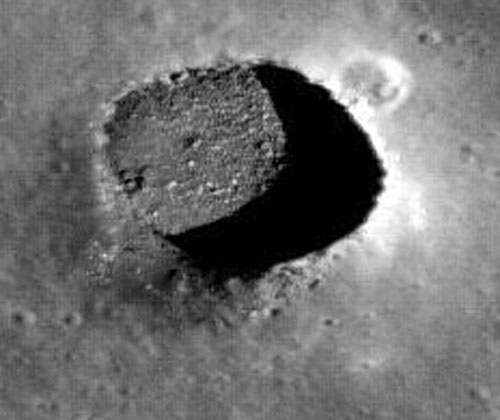
A 60 meter drop is about 200 feet deep. This result is reasonably close to the depth estimated by Japanese scientists, 88 meters or 288 feet, based on images of the same lunar pit taken by their Kaguya probe.
Knowing the approximate depth of the entrance pit raises the much more important question: How will future lunar explorers to get to the bottom of this pit? It is ironic » Read more
In its first six weeks of observation, the Kepler mission apparently found almost 150 planets similar in size to the Earth. The results, learned by accident because a talk given by one of the co-investigators was posted on the web, have not yet been officially announced because the project scientists feel a need for additional time to confirm them. Many of these so-called planets might turn out to be false positives, so some caution is in order.