
NASA revises its SLS launch schedule, pending approval of the range’s safety office

NASA today announced that it is now targeting September 27, 2022 for the first test launch of its SLS rocket and Orion capsule.

Engineers have — on the launchpad — completed the repair work on the hydrogen leak that caused the previous launch scrubs. The plan now is to do a test fueling on September 21st to see if the repair worked.

If all is then well, the agency wants to launch on September 27th. To do so however NASA needs to get the approval of the safety range office to waive the use-by date of the batteries used to terminate the flight after launch, should something go seriously wrong. The rules require those batteries to be checked every 20 days, and as of today they have been in use for 31 days. The range had already given NASA a five day waiver so it could try to launch on September 5. To launch on September 27th will require the range to allow those batteries to remain unchecked for 46 days, more than double their accepted use-by date.

For the range to allow such a waiver would be I think entirely unprecedented, especially for the very first launch of a new rocket. Such test launches are exceedingly risky. A lot can go wrong, and often does when a rocket tries to fly for the first time. To allow such a lift-off with a questionable flight termination system seems completely insane and irrational.

NASA is also proposing an October 2nd launch date. I suspect this date is based on the range safety office refusing to give this waiver. If so, NASA would then do its September 21st fueling test on the launchpad, quickly roll the rocket back to the assembly building to check the batteries, and then try to get it back to the launch pad in time for that October 2nd date.
21 comments

NASA wants to launch SLS in September; needs range safety office waiver to do it

In outlining the status of the repair work on the hydrogen leak on SLS on the launchpad yesterday, NASA officials indicated that they are targeting a September 23rd launch date that will require the Space Force range safety office to okay the use of a flight abort system with batteries that are significantly past their use-by date.

NASA has submitted a request to the Eastern Range for an extension of the current testing requirement for the flight termination system. NASA is respecting the range’s processes for review of the request, and the agency continues to provide detailed information to support a range decision.

The range office had required that the batteries for that flight termination system be checked every 20 days, a process that requires the rocket to be rolled back to the assembly building. It had already given NASA a five day extension to 25 days, but even that was insufficient to get the rocket launched in its previous launch window, expiring on September 6th. Though NASA has not said how long an extension it is requesting, to do a September 23rd launch would require another extension of 17 days, making for a total 23-day waiver for those batteries. Thus, instead of limiting the life of those batteries to 20 days, NASA is requesting the range to allow the batteries to go unchecked for 43 days, at a minimum.

For the range to give that first waiver I think is somewhat unprecedented. To do it again, for that much time, seems foolish, especially as this will the rocket’s first launch, and a lot can go wrong.

NASA officials also hinted during yesterday’s press conference — in their bureaucrat way — that human error might have caused the hydrogen leak.

NASA has not confirmed if an “inadvertent” manual command that briefly overpressurized the hydrogen fuel line caused the leak, but the agency is investigating the incident. Bolger said new manual processes replaced automated ones during the second attempt and the launch team could have used more time to practice them. “So we didn’t, as a leadership team, put our our operators in the best place we could have,” Bolger said. During the Sept. 17 fueling test, NASA will try out a slower, “kinder and gentler” process that should avoid such events.

If the Space Force and the Biden administration demand the range officer allow this rocket, with this team, to be launched with a questionable flight termination system, we should expect public resignations from several range officers. Whether anyone in our present government however has the ethics to do such a thing appears very doubtful.

9 comments

NASA to roll SLS back to assembly building, delaying launch by weeks at minimum

NASA managers today decided they will not attempt another launch of SLS during the present launch window that closes on September 6, 2022, and will bring the rocket back to assembly building for more detailed trouble-shooting.

Engineers not only need to solve the hydrogen fuel leak in a fuel line connection that caused today’s launch scrub, they will also have to replace the flight termination batteries needed in case the rocket has to be destroyed during liftoff because it is flying out of control. These batteries only have a few weeks life, and the launch delays this week caused them to reach their limit.

The next launch windows are either from September 19 to October 4, excluding September 29-30, or October 17 to October 31, excluding October 24, 25, 26, and 28.

At that point SLS’s two solid rocket strap-on boosters will have been stacked for about two years, one full year past what NASA once considered their safe lifespan. The agency has waived that rule for SLS, but waiving it for more than a full year might simply be too risky. If the boosters need to be replaced, that will delay the launch by at least another three months, at the minimum.

Right now the odds remain high this launch will not occur in 2022.

32 comments

SLS test launch scrubbed again

NASA engineers once again were forced to scrub the launch of the SLS rocket today due to another hydrogen leak during fueling.

The launch director waived off today’s Artemis I launch attempt at approximately 11:17 a.m. EDT. Teams encountered a liquid hydrogen leak while loading the propellant into the core stage of the Space Launch System rocket. Multiple troubleshooting efforts to address the area of the leak by reseating a seal in the quick disconnect where liquid hydrogen is fed into the rocket did not fix the issue.

NASA has one more chance, on September 5th, to launch this rocket before it must return it to the assembly building to replace the flight termination batteries, used to abort the launch after liftoff should something go seriously wrong during flight. As I understand it, their use-by date is September 6th, and it would require a major safety waiver by the military range officer, who is entirely independent from NASA and under no obligation to it, to allow for a launch after that date with those batteries.

8 comments

NASA thinks engine issue on SLS launch caused by misreading sensor

NASA engineers have now concluded that the improper temperatures in one engine in SLS’s core stage that forced the August 29, 2022 launch to be scrubbed were caused by a faulty sensor, and that the actual temperatures in the engine were correct.

During a news conference on Tuesday evening, NASA’s program manager for the SLS rocket, John Honeycutt, said his engineering team believed the engine had actually cooled down from ambient temperature to near the required level but that it was not properly measured by a faulty temperature sensor. “The way the sensor is behaving does not line up with the physics of the situation,” Honeycutt said.

The problem for NASA is that the sensor cannot be easily replaced and would likely necessitate a rollback to the Vehicle Assembly Building at Kennedy Space Center in Florida, a few kilometers from the launch pad. This would delay the launch of the rocket at least into October, and the space agency is starting to get concerned about wear and tear on a rocket that has now been stacked for nearly a full year.

With this SLS rocket, NASA management is now trapped between a rock and a hard place. The rocket’s solid rocket boosters has been stacked for just short of two years, almost a full year beyond their use-by date. Moreover, there are batteries on the rocket that only function for about a month before they must be replaced. Their replacement date is September 6th, which means if NASA cannot get the rocket launched by that date it will have to return it to the assembly building, delaying the launch to at least October. If it has to replace the solid rocket boosters the launch will likely then be delayed until next year, which will seriously impact the second SLS launch, set to send astronauts around the Moon and back.

At the moment the launch is scheduled for a two hour launch window beginning at 2:17 pm (Eastern) on Saturday, September 3, 2022. The countdown will be live streamed here. At the moment the weather for Saturday has improved, with s 60% chance the launch can proceed.

10 comments

SLS launch scrubbed

An issue in one of the refurbished shuttle main engines that are used in SLS’s core stage caused the launch today to be scrubbed.

The launch director halted today’s Artemis I launch attempt at approximately 8:34 a.m. EDT. The Space Launch System rocket and Orion spacecraft remain in a safe and stable configuration. Launch controllers were continuing to evaluate why a bleed test to get the RS-25 engines on the bottom of the core stage to the proper temperature range for liftoff was not successful, and ran out of time in the two-hour launch window. Engineers are continuing to gather additional data.

More information here and here. From the second link:

The four RS-25 engines on Artemis I are ones that were still in service at the end of the Shuttle program. But, for Artemis I, at least one component on each of the Core Stage engines comes from the three engines that powered Columbia to orbit on STS-1 on April 12, 1981. “It might be a valve, it might be a bolt, for others, it’s pieces of wiring, little things like that,” said Aerojet Rocketdyne’s Bill Muddle, RS-25 lead field integration engineer, in an interview with NASASpaceflight. “But there is something from the STS-1 engines on each of these [for Artemis I].”

Originally NASA had wanted to do this same bleed test during one of the two wet dress rehearsal countdowns prior to today’s launch attempt, but other issues with the rocket during those rehearsals made it impossible. As a result, the agency discovered this issue during the launch countdown.

Nor was this engine problem the only issue during this morning’s countdown.
» Read more

19 comments

How SLS reveals the difference between state-run propaganda and real journalism

The cost of SLS

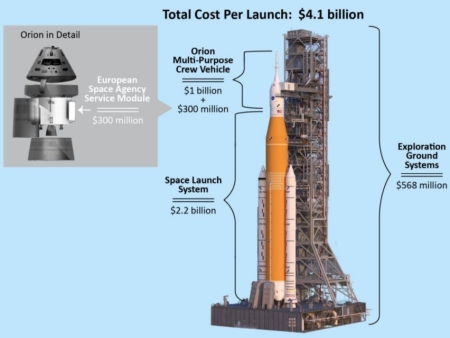
On August 29, 2022, NASA will attempt the first launch of a government-built, government-owned, and government-designed rocket in more than a decade. The rocket’s development took more than eighteen years, moved in fits and starts due to political interference and mandates, cost more than $50 billion, and has been both behind schedule and overbudget almost from day one. Along the way NASA management screwed up the construction of one multi-million dollar test stand, built another it will never use, mismanaged that test program, dropped a rocket oxygen tank, and found structural cracks in an early Orion capsule.

This dubious achievement, even if the launch and month-plus-long mission of the Orion capsule to lunar orbit and back is a complete success, is hardly something to tout. NASA claims it and this rocket will make it possible for America to explore the solar system, but any honest appraisal of SLS’s cost and cumbersome design immediately reveals that claim to be absurd. SLS can launch at best once per year, and in truth will likely lift off at a much slower rate. It will also eat up resources in the American aerospace industry from technology better designed, more efficient, and more capable of doing the job.

Worse, the generally sloppy management of this program, with numerous major errors in design and construction, raises serious questions about the safety of any future manned flight.

And yet, as this launch day approaches, the American established press is going ga-ga over SLS. Below are just a small sampling:
» Read more

16 comments

Engineers replace engine controller on SLS core; launch to be delayed

Engineers have successfully replaced the failed engine controller on the core stage of NASA’s SLS rocket.

Last week engineers and technicians successfully removed and replaced an engine controller from one of four RS-25 engines after the team identified an issue during a power-up test of the rocket’s core stage. Engineers are now performing standard engine controller diagnostic tests and check-outs, including controller power-up and flight software load. Subsequently, the team will work to complete all remaining SLS pre-flight diagnostic tests and hardware closeouts in advance of a mid-February rollout for a wet dress rehearsal in late February. NASA will set a target launch date after a successful wet dress rehearsal test.

The official schedule still lists the launch for February, but NASA has already admitted this is now impossible. Once they complete the wet dress rehearsal on the launchpad they will have to roll the rocket back into the Vehicle Assembly Building to do further tests. While it remains possible for NASA to meet an April launch window, more likely the agency will push back to windows during the summer.

Thus, the race between SLS and Starship for completing the first orbital flight remains neck-and-neck. Starship could launch this spring, but it faces an uncertain schedule determined not by SpaceX but by the bureaucracy in the federal government, which is reviewing the FAA’s environment reassessment for the Boca Chica launch site and really has no requirement to meet any schedule at all. The FAA says it plans to approve the reassessment by the end of February, but that is simply made up deadline. It could revise it at will at any time.

NASA meanwhile is still pushing to launch SLS in April, but this launch date is entirely unrealistic. Expect NASA to announce a new target date sometime in the summer in the coming weeks.

0 comments
1 2 3