Former astronaut once again blasts NASA decision to fly Artemis-2 manned

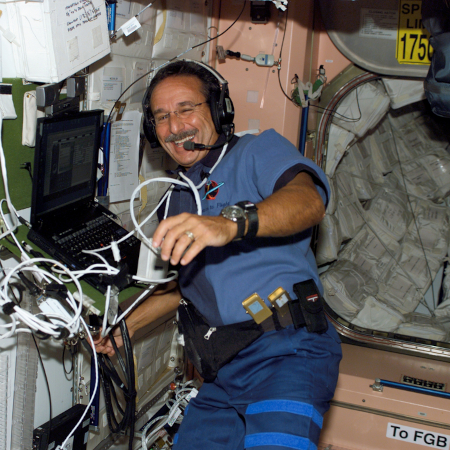
Charles Camarda on the shuttle
Charles Camarda on the first shuttle flight
after the Columbia failure.

The opposition to NASA’s decision to fly humans in the Orion capsule around the Moon with a questionable heat shield continues. Charles Camarda, an engineer and former NASA astronaut who has repeatedly expressed concerns about that heat shield and had been invited to attend the review meeting that NASA administrator Isaacman had arranged to ease his concerns, has now revealed his concerns were not eased in the slightest by that meeting, and that the Ars Technica article by Eric Berger that suggested otherwise was wrong, and that he is still “outraged” at NASA’s bad engineering decisions.

The rage you witnessed was my observing the exact behaviors used to construct risk and flight rationale which caused both Challenger and Columbia Accidents. Using “tools” inappropriately and then claiming results to be “Conservative.” Not to mention the reliance on Monte Carlo simulations to predict failure probabilities which were also proven to be inaccurate by orders of magnitude in my book “Mission Out of Control” which you claim to have read.

I suggest, in the spirit of transparency, you should ask NASA to release just the “Findings” of NESC Report TI-23-01849 Volume I. Finding 1 states the analysis cannot accurately predict crack initiation and propagation at flight conditions. And there was so much more which was conveniently not presented.

In other words, he finds NASA’s engineering claims that Orion’s heat shield will work using a different less stressful return trajectory as it dives back into the atmosphere about 25,000 mph to be false and untrustworthy. Worse, he sees it as proof that this is a continuation of the same culture at NASA that resulted in the Columbia failure.

Some of the exact same people responsible for failing to understand the shortcomings of the Crater Analysis tool (used tiny pieces of foam impacts to Shuttle tiles to predict a strike from a piece of foam which was 6000 larger and which caused the Columbia Accident) were on the Artemis Tiger Team now claiming they could predict the outcome of the Orion heatshield using a tool (similar to CRATER) called the Crack Identification Tool (CIT) which was also not physics based and relied on predictions of the key paramenter, permeability, which they claim to be the “root” cause, pressure, to vary by three orders of magnitude (that’s over 1000x).

In defense of NASA, those engineers had also presented data that showed Orion’s hull was strong enough to survive re-entry, even if the heat shield failed entirely. It is unclear if Camarda’s objections here apply to that data as well.

Regardless, his strong public disagreement with NASA on this once again raises serious questions about the upcoming manned Artemis-2 mission, set to launch sometime in the February to March time frame.

An outline of NASA’s present schedule leading up to the Artemis-2 manned lunar fly-by mission

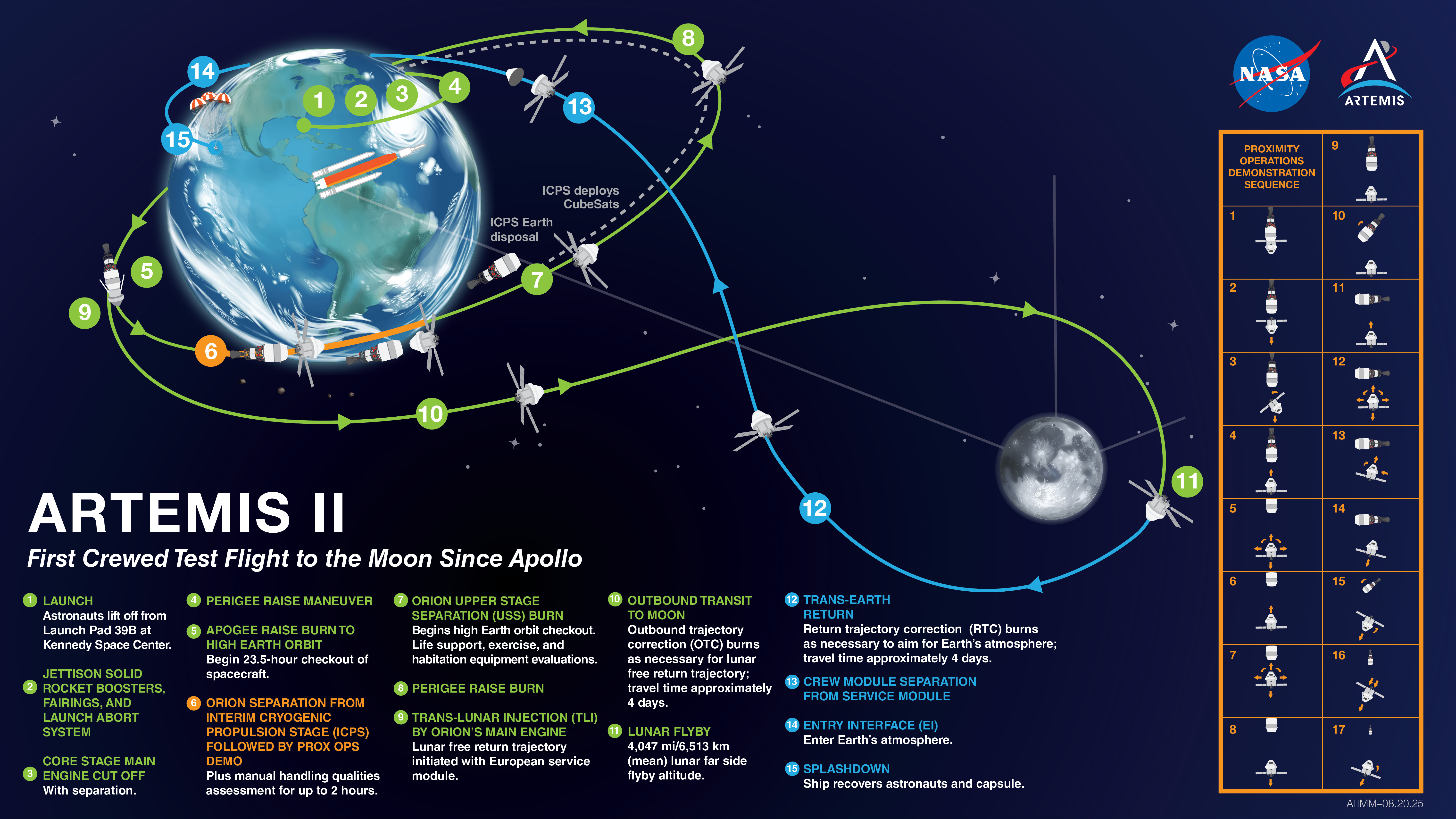
Link here. The mission will slingshot four astronauts around the Moon and back to Earth. The update includes lots of details about the rollout, the dress rehearsal countdown, the follow-up, and finally the various launch windows and the requirements that determine them.

This paragraph however about those requirements struck me:

The launch day and time must allow SLS to be able to deliver Orion into a high Earth orbit where the crew and ground teams will evaluate the spacecraft’s life support systems before the crew ventures to the Moon.

That life support system will be making its first flight in space, with four humans as the guinea pigs. Though this is another example of NASA putting schedule ahead of safety (the system should have flown at least once unmanned), it does indicate the agency recognizes the risk it is taking, and has added this extra longer orbit to give engineers time to test the system.

There are three launch windows, within which there are only five available launch dates:

January 31 to February 14 (February 6, 7, 8, 10, and 11)
February 28 to March 13 (March 6, 7, 8, 9, 11)
March 27 to April 10 (April 1, 3, 4, 5, 6)

In 2022, once NASA managers chose their first launch window, they were able to get the rocket off on the first attempt. There were no scrubs or aborts, though prior to that attempt the launch date was delayed numerous time over five years. Based on that past history, it is likely the agency will succeed on its first attempt in February, barring weather issues.

Isaacman okays flying Artemis-2 manned, despite heat shield questions

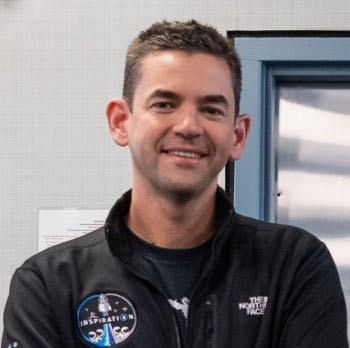
According to an article posted today at Ars Technica, after a thorough review NASA administrator Jared Isaacman has decided to allow the Artemis-2 mission — set to launch sometime before April and slingshot around the Moon — to fly manned with four astronauts despite the serious questions that still exist about its heat shield.

The review involved a long meeting at NASA with NASA engineers, several outside but very qualified critics, as well as two reporters (for transparency).

Convened in a ninth-floor conference room at NASA Headquarters known as the Program Review Center, the meeting lasted for more than three hours. Isaacman attended much of it, though he stepped out from time to time to handle an ongoing crisis involving an unwell astronaut on orbit. He was flanked by the agency’s associate administrator, Amit Kshatriya; the agency’s chief of staff, Jackie Jester; and Lori Glaze, the acting associate administrator for NASA’s Exploration Systems Development Mission Directorate. The heat shield experts joined virtually from Houston, along with Orion Program Manager Howard Hu.

Isaacman made it clear at the outset that, after reviewing the data and discussing the matter with NASA engineers, he accepted the agency’s decision to fly Artemis II as planned. The team had his full confidence, and he hoped that by making the same experts available to Camarda and Olivas, it would ease some of their concerns.

My readers know that I have been strongly opposed to flying Artemis-2 manned, an opposition I expressed in an op-ed at PJMedia only yesterday. However, after reading this Ars Technica report, my fears are allayed somewhat by this quote:
» Read more

Zimmerman Op-Ed at PJ Media

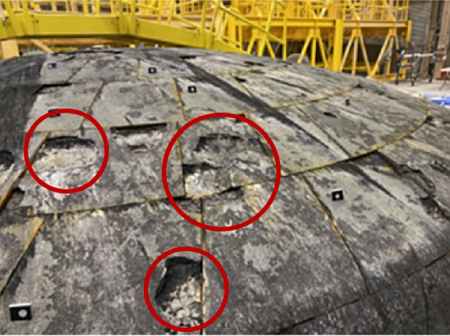
Orion's damage heat shield
Damage to Orion heat shield caused during re-entry in 2022,
including “cavities resulting from the loss of large chunks”

PJ Media this evening published an op-ed I prepared this week in a last desperate effort to convince both President Trump and NASA administrator Jared Isaacman to rethink the manned nature of the Artemis-2 mission scheduled to launch sometime in the next three months.

President Trump and NASA Administrator Isaacman: Please Take the Crew Off of Artemis II

Nothing I say in this op-ed will be unfamiliar to my readers. I choose to farm it to PJ Media because I wanted it to get as much exposure as possible. As big as my audience is becoming, from 4 to 6 million hits per month, PJ Media has a wider reach.

I also decided in the op-ed to make no general arguments against SLS or Orion. Though my opposition to them is long standing and well known, this is not the time to fight that battle. My goal was simply to get NASA to put engineering ahead of schedule, so as to avoid the possibility of it repeating another Apollo 1 fire or Challenger accident.

I doubt at this point this op-ed will make a difference, but to paraphrase a quote written by Gordon Dickson in his wonderful science fiction book Way of the Pilgrim, there was a hand pushing me from behind, forcing me forward. I had no choice. The image of Orion’s heat shield to the right, after the 2022 return from the Moon, required action.

“Blemish” on Orion hatch’s “thermal barrier” delays countdown rehearsal

According to a report yesterday, a countdown rehearsal two weeks ago for the Orion/SLS stack that also included the four astronauts to fly on the next mission was delayed because a “blemish” was found on the Orion hatch “thermal barrier.”

“Prior to the countdown demonstration test, the agency had planned to conduct a day of launch closeout demonstration. This demonstration was paused when a blemish was found on the crew module thermal barrier, preventing hatch closure until it could be addressed,” the statement read. “A repair was completed on Nov. 18 allowing the closeout demo to successfully complete on Nov. 19. To allow lessons learned from the closeout demo to be incorporated into the planning for the countdown demonstration test, the decision was made to proceed into water servicing next and place the countdown demonstration test after this servicing completes.”

It was not clear from the NASA statement how a ‘blemish’ prevented the closure of the hatch and NASA would not say exactly when the countdown rehearsal will take place. Declining to provide further details, the space agency spokesperson said: “NASA remains on track to launch Artemis 2 no later than April 2026 with opportunities to potentially launch as soon as February.”

NASA released no additional details, though it claimed this delay will have no impact on the launch schedule for the Artemis-2 mission, planned for launch no later than April 2026.

The lack of detailed information from NASA is disturbing. What was the “blemish?” It appears it was on the rubber gaskets that circle the hatch’s edge. What caused it? Was it some damage? A production flaw? NASA’s general silence forces us to consider more serious possibilities.

I continue to pray that these four astronauts are not going to end up as sacrificial lambs to the political scheduling demands that is forcing NASA to push on blindly, as it did with both the Challenger and Columbia failures, ignoring or minimizing issues that common sense should never be minimized.

Senate demands a second hearing before voting on Isaacman as NASA administrator

Jared Isaacman
Billionaire Jared Isaacman

Despite being days from a confirmation vote in June after undergoing a Senate hearing previously — when Trump nominated Jared Isaacman for NASA administrator the first time — the Senate has now demanded a second hearing before it will schedule a second confirmation vote on Isaacman.

Sen. Ted Cruz has scheduled a Dec. 3 hearing for Jared Isaacman, the billionaire entrepreneur and commercial astronaut renominated to lead NASA, before the Senate Commerce, Science and Transportation Committee. … The new hearing will mean that Isaacman will not be confirmed by the Senate in the next batch of nominees, which will likely see the floor in the first week of December.

Trump first nominated Isaacman in December 2024, only to withdraw that nomination in May 2025. Trump then renominated Isaacman two weeks ago.

This extra hearing means Isaacman will likely not be confirmed as NASA administrator until early in 2026. It also means he will probably not be in a position to review and reconsider NASA’s plans to send astronauts around the Moon in the February-April time frame, using an Orion capsule with a questionable heat shield and an untested environmental system.

In fact, I suspect this decision to hold hearings was pushed by Cruz partly to make sure Isaacman couldn’t review those plans. Cruz has made it his goal to save SLS and Orion, no matter the cost, and appears willing to play whatever games necessary to prevent any actions that would delay or impact NASA’s present plans.

This however is not the only reason this new hearing has been scheduled. It appears a lot of Senators, especially the Democrats, want to question Isaacman about Isaacman’s 62-page policy paper that was leaked to many in DC in the past few months. It is certain that questioning will have no impact on the final vote (Isaacman is expected to be confirmed handily), but it will allow these senators to preen before the camera, for no good purpose.

The bottom line however is that Isaacman will not be in place early enough to review and change that Artemis-2 mission. It means that almost certainly NASA will once again fly a manned mission that places schedule above engineering, putting four human lives at risk using a spacecraft that has not be vetted properly.

NASA now targeting a February-to-April launch window for first manned Artemis mission

Orion's damage heat shield
Damage to Orion’s heat shield caused during re-entry in 2022,
including “cavities resulting from the loss of large chunks”.
Nor has this issue been fixed.

According to a NASA official at an event yesterday, the agency is now targeting launch window starting on February 5, 2026 and extending into April for the first manned Artemis mission, dubbed Artemis-2, that will slingshot four astronauts around Moon and back to Earth on a 10-day-flight.

If Artemis 2 does lift off on Feb. 5, it will be at night, NASA officials said. The space agency has about five days apiece in February, March and April to launch the flight. The latest possible date is April 26, according to NASA. NASA will aim to hit the earlier part of that launch window, Hawkins said, but she stressed that crew safety will drive the timeline.

That mission will fly with an Orion capsule that has safety concerns, including a questionable heat shield (see picture above) and an untested environmental system.

Meanwhile, as part of NASA’s never-ending PR effort to sell the mission, it announced today that the mission’s four astronauts have now given their Orion capsule a name, Integrity.

The name Integrity embodies the foundation of trust, respect, candor, and humility across the crew and the many engineers, technicians, scientists, planners, and dreamers required for mission success.

Considering NASA’s level of dishonesty during the entire development of SLS and Orion, the ironies of this name and these claims is quite breath-taking.

First SLS/Orion manned mission faces new delays because of Orion heat shield issues

Orion's damage heat shield
Damage to Orion heat shield caused during re-entry in 2022,
including “cavities resulting from the loss of large chunks”

Because the damage to the heat shield on the Orion capsule that flew around the Moon in late 2022 remains somewhat unexplained, NASA is considering delaying the next SLS/Orion mission, presently planned for September 2025 and intended to be the first Artemis flight to carry humans and take them around the Moon.

The heat shield, already installed at the base of the Orion spacecraft, will take the brunt of the heating when the capsule blazes through Earth’s atmosphere at the end of the 10-day mission. On the Artemis I test flight in late 2022, NASA sent an Orion spacecraft to the Moon and back without a crew aboard. The only significant blemish on the test flight was a finding that charred chunks of the heat shield unexpectedly stripped away from the capsule during reentry as temperatures increased to nearly 5,000° Fahrenheit (2,760° Celsius).

The spacecraft safely splashed down, and if any astronauts had been aboard, they would have been fine. However, the inspections of the recovered spacecraft showed divots of heat shield material were missing.

Two years later, despite extensive investigation and analysis, it appears NASA has not yet identified the root cause of the damage. The ablative material used on Orion was similar (though not identical) to the material used successfully on numerous other heat shields since the 1960s, yet it did not perform as expected.

NASA is presently facing three options. Do nothing and fly the next mission as planned, with four astronauts. It could rethink the trajectory used during re-entry, though this would likely not change things significantly unless the astronauts don’t go around the Moon as planned. Or it could change the heat shield itself.

The first two options are very risky, considering the unknowns. The latter involves a major delay of at least two years.

A decision must be made soon however. To meet the agency’s schedule it must begin stacking SLS’s two solid-fueled strap-on boosters next month. Those boosters have a limited life expectancy originally estimated to be one year. In the first unmanned Artemis test flight in 2022, NASA because of other delays stretched that life span to two years, and had no problems with the launch. If it stacks the boosters now and then has to delay for two more years to redesign Orion’s heat shield, those boosters will have been stacked for three years when launched.

Considering how seriously NASA is taking the issues with Starliner, which are likely not as serious as a heat shield that doesn’t work reliably, it would seem insane for NASA to launch Orion manned without fixing its own problem. And yet, for more than two decades NASA has consistently not demanded the same safety standards for SLS that it has demanded for the private commercial rocket startups. We shall see if this pattern now persists.

I continue to believe that the first Artemis lunar landing will not take place before 2030 (at least six years behind schedule). This heat shield dilemma only strengthens that prediction.

Technical issues with Lockheed Martin’s Orion capsule to delay next Artemis mission

It appears that technical issues with Lockheed Martin’s Orion capsule are one of the main reasons NASA has had to delay next Artemis mission, the first to put humans inside that capsule and then take them around the Moon.

In January 2024 it was reported that the mission would be delayed from a launch before the end of 2024 until 2025. We now know why:

NASA is working with Orion spacecraft prime contractor Lockheed Martin to resolve a handful of issues that came up late last year during ground testing, forcing the space agency to delay the launch readiness target date for its Artemis II circumlunar mission to September 2025. The Lockheed Martin assembly, test, and launch operations (ATLO) team at Kennedy Space Center (KSC) is reinstalling some electronics and implementing workarounds for others affected by an electrical circuit flaw found in digital motor controllers on the spacecraft.

While a resolution to that issue appears to be getting closer, the Orion program and contractor teams are also working through the corrective actions process for a problem with how the Orion batteries handle the shock of an extreme abort case.

In other words, Lockheed Martin discovered these two electrical issues only last year, after spending almost two decades and more than $15 billion developing Orion.

As I predicted in January, “None of these dates will be met. I predict that further delays will be announced next year and the year after that, pushing all these missions back again, in small increments.” I also predicted that NASA will be lucky to land a human on the Moon by 2030, a mere fifteen years after its original target date of 2015, set by George Bush Jr. in 2004.

In the meantime, expect SpaceX’s Starship to begin regularly commercial and governmental flights to the Moon in the next five years. Long before SLS and Orion put humans on the Moon, Starship will be doing it privately for less cost.

ESA transfers its Artemis-2 Orion service module to NASA

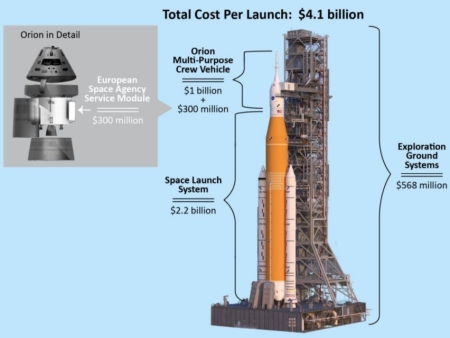
The European Space Agency (ESA) yesterday officially handed over to NASA its second completed Orion service module, to be used in 2024 on the first manned Artemis mission, dubbed Artemis-2, that will carry four astronauts on a mission around the Moon.

The European Service Module-2 will power the Orion spacecraft on the Artemis II mission that will see NASA astronauts commander Reid Wiseman, pilot Victor Glover, and mission specialists Christina Koch with Canadian Space Agency astronaut Jeremy Hansen complete flyby of the Moon and return to Earth.

The crew will fly Orion to 8889 km beyond the Moon before completing a lunar flyby and returning to Earth. The mission will take a minimum of eight days and will collect valuable flight test data, in the first time for over 50 years that humans have voyaged to our natural satellite.

The odds of this launching in 2024 are relatively slim. It will also be the first time NASA will be flying Orion’s environmental systems (the systems that keep the astronauts alive). We all hope those system work perfectly this first time, since people will be on board.

NASA names four astronauts to fly on first manned Artemis mission around Moon

NASA today named the four astronauts who will fly on its Artemis-2 in a 10-day mission around the Moon, launched on SLS’s second launch in an Orion capsule and tentatively scheduled for late 2024.

The crew assignments are as follows: Commander Reid Wiseman, Pilot Victor Glover, Mission Specialist 1 Christina Hammock Koch, and Mission Specialist 2 Jeremy Hansen. They will work as a team to execute an ambitious set of demonstrations during the flight test.

The approximately 10-day Artemis II flight test will launch on the agency’s powerful Space Launch System rocket, prove the Orion spacecraft’s life-support systems, and validate the capabilities and techniques needed for humans to live and work in deep space.

The flight, set to build upon the successful uncrewed Artemis I mission completed in December, will set the stage for the first woman and first person of color on the Moon through the Artemis program, paving the way for future for long-term human exploration missions to the Moon, and eventually Mars. This is the agency’s Moon to Mars exploration approach. [emphasis mine]

The highlighted words illustrate some important facts. First, this first manned flight of Orion will also be the first that will use the capsule’s life-support systems, which were not included the first flight around the Moon in December. Thus, these four humans are essentially guinea pigs for this engineering. Seems such a plan should have been questioned by NASA’S corrupt safety panel, but then, it is corrupt, and never seems to have much problem with unsafe practices done by NASA itself. Instead, it spends a lot of time making up problems for SpaceX and missing problems at Boeing and NASA.

Second, note NASA’s emphasis on race and sex for the first landing on the Artemis-3 mission. Note too that Artemis-2 crew also includes a black and a woman. Though the press release wisely and correctly makes no mention of race when describing the four astronauts, it does tout the achievements of Christina Koch as a woman, not as a person.

Don’t get me wrong. It is good that a black and a woman are flying to the Moon. It just appears very clear that NASA now has a firm quota system, requiring one of each for every mission.

Finally, there is something not mentioned in the press release or on the Artemis-2 webpage that is very telling. Neither says anything about a launch date, which NASA had previously announced as November 2024. I have been predicting from the beginning that this date is a fantasy. It now appears NASA realizes it but is not yet ready to admit it publicly.

1 2