
Hayabusa 2 test fires its cannon in preparation for its 2014-2018 asteroid sample return mission.
Hayabusa 2 test fires its cannon in preparation for its 2014-2018 asteroid sample return mission.
Hayabusa 2 test fires its cannon in preparation for its 2014-2018 asteroid sample return mission.
A newly discovered half-mile wide asteroid has 1 in 63,000 chance of hitting the Earth in 2032.
That’s the Russian report above, which on these matters tend to be panic-stricken. Here’s the JPL version, which downplays the concern.
Divers working at a Russian lake have recovered a half-ton piece of the asteroid that exploded over Chelyabinsk on February 15.
Boom! A remotely operated Russian telescope, located in New Mexico, on Wednesday discovered a kilometer wide Near Earth asteroid.
The asteroid, believed to be the 704th largest with an orbit that comes relatively near Earth, does not pose a danger of crashing into our planet, said the head of the observatory that made the discovery. “It’s a big asteroid, but it poses no danger for us,” Leonid Elenin, who lives in the Moscow Region, told RIA Novosti on Friday.
Finding a new asteroid like this illustrates that there might be other such large objects out there undiscovered. Also cool is how the Russians discovered it, using equipment in the United States!
Posted from Midland, Texas, the center of the world for the American oil industry.
Astronomers have found evidence of the remains of an exoplanet that they think was once wet and rocky.
Using observations obtained with the Hubble Space Telescope and the large telescopes of the W. M. Keck Observatory , they found an excess of oxygen – a chemical signature that indicates that the debris had once been part of a bigger body originally composed of 26 per cent water by mass. By contrast, only approximately 0.023 per cent of the Earth’s mass is water.
From what I can gather, the actual data here is somewhat skimpy, requring a lot of assumptions for the scientists to come to this conclusion. Nonetheless, the data is interesting and very tantalizing.
Posted from Memphis, Tennessee.
Scientists in Egypt have found what they think is evidence of a comet impact from 28 million years ago.
The best part however is this:
At the centre of the attention of this team was a mysterious black pebble found years earlier by an Egyptian geologist in the area of the silica glass. After conducting highly sophisticated chemical analyses on this pebble, the authors came to the inescapable conclusion that it represented the very first known hand specimen of a comet nucleus, rather than simply an unusual type of meteorite.
Assuming this claim is confirmed it is a very significant discovery. As far as I know, no other specimens from a comet nucleus have been identified previously.
The asteroid that might hit the Earth in 2880.
Divers have pulled fragments from the February 15 Chelyabinsk meteorite impact out of nearby Chebarkul Lake.
Posted from Gaitlinburg, Tennessee, the Coney Island of the Smoky Mountains. The drive today was sadly a lot longer than planned, as we hit bad traffic in Nashville.
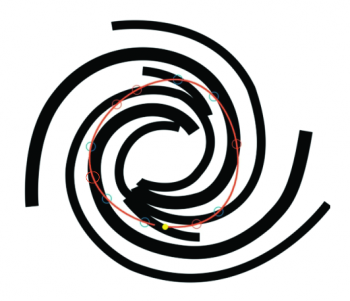
In a paper published today on the Los Alamos astro-ph preprint service, astronomers propose that as many as eleven past extinction events can be linked to the Sun’s passage through the spiral arms of the Milky Way. (You can download the paper here [pdf].)
A correlation was found between the times at which the Sun crosses the spiral arms and six known mass extinction events. Furthermore, we identify five additional historical mass extinction events that might be explained by the motion of the Sun around our Galaxy. These five additional significant drops in marine genera that we find include significant reductions in diversity at 415, 322, 300, 145 and 33 Myr ago. Our simulations indicate that the Sun has spent ~60% of its time passing through our Galaxy’s various spiral arms.
The figure on the right, from their paper, shows the Sun’s orbit in red over the last half billion years. The Sun’s present position is indicated by the yellow spot, and the eleven extinctions are indicated by the circles.
There are obviously a great deal of uncertainties in this conclusion. Most significantly, the shape and history of the Milky Way remains very much in doubt, especially since we reside within it and cannot really get a good look at it. Though in recent years astronomers have assembled a reasonable image of the galaxy’s shape — a barred spiral with two major arms and several minor ones — this picture includes many assumptions that could very easily be wrong.
Nonetheless, the paper’s conclusions are interesting.
» Read more
Using photos from Dawn astronomers have now assembled an online atlas of the asteroid Vesta that the public can explore.
NASA will reactivate the Wide-field Infrared Survey Explorer (WISE) next month to use it to look for more near Earth asteroids.
This decision raises two thoughts.
Engineers have identified twelve asteroids that could be captured with today’s technology.
Their number one most easily moved space rock is named 2006 RH120. A single rocket burn in 2021 would be enough to place this roughly 4-meter-wide asteroid into orbit around a Lagrange point by 2026. NASA could then launch people to study this object (which would barely be bigger than the astronauts themselves) and learn about its history.