
Kepler tracks the tiny light variations and oscillations of 500 stars
Kepler does asteroseismology on 500 sunlike stars. The data says that the theories of star formation need to be revised.
Kepler does asteroseismology on 500 sunlike stars. The data says that the theories of star formation need to be revised.
Newly discovered asteroid follows the Earth as it orbits the Sun, and has been doing it for a quarter million years.
Currently, three other horseshoe companions of the Earth are known to exist but, unlike 2010 SO16, these linger for a few thousand years at most before moving on to different orbits. Also, with an estimated diameter of 200–400 metres, 2010 SO16 is by far the largest of Earth’s horseshoe asteroids. The team has already used the Las Cumbres Observatory’s Faulkes Telescope in an on-going campaign to track the object and refine its orbit further. “It is not that difficult to spot with a medium-sized professional telescope”, says Dr Asher. “It will remain as an evening object in Earth’s skies for many years to come.”
Scientists have found strong evidence that liquid water once existed in the interior of a comet.
The ripples in the rings of Saturn and Jupiter were caused by comet impacts decades ago.
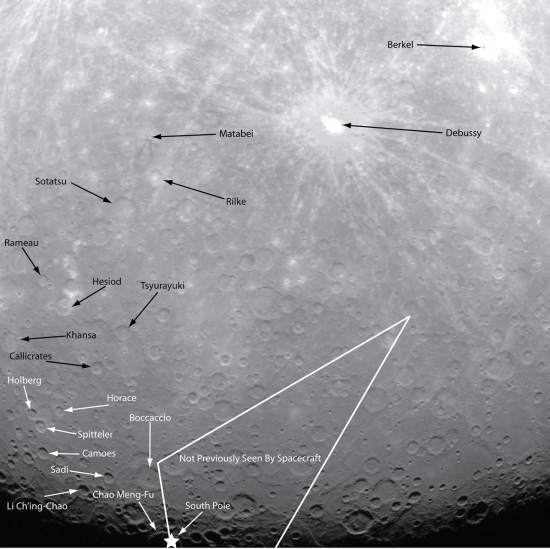
Above, an annotated version of the first orbital image, showing areas of the south pole never before seen.
From the press conference about the first Messenger images from Mercury orbit:
» Read more
Which near-Earth asteroids are ripe for a visit?
When is an asteroid not an asteroid?
The layered structure of Vesta (core, mantle and crust) is the key trait that makes Vesta more like planets such as Earth, Venus and Mars than the other asteroids, McCord said. Like the planets, Vesta had sufficient radioactive material inside when it coalesced, releasing heat that melted rock and enabled lighter layers to float to the outside. Scientists call this process differentiation.
This question immediately demonstrates once again the terrible mess the International Astronautical Union made when it decided several years ago to define what makes a planet, and came up with a definition that simply doesn’t work. For if Vesta should be considered a planet, why not Pluto?
The first image from Mercury orbit.
The brightest supernovae yet found.
Supernova 2008am is 3.7 billion light-years away. At its peak luminosity, it was over 100 billion times brighter than the Sun. It emitted enough energy in one second to satisfy the power needs of the United States for one million times longer than the universe has existed.