
The Sky Is Falling … More Than We Thought
Chicken Little was right! The sky is falling!
Chicken Little was right! The sky is falling!
Here we go again: NASA’s already overbudget Mars Science Laboratory rover is in need of even more cash.
A fizzy ocean on Enceladus? Key quote:
[Scientists believe] that gasses dissolved in water deep below the surface [of Enceladus] form bubbles. Since the density of the resulting “sparkling water” is less than that of the ice, the liquid ascends quickly up through the ice to the surface. “Most of the water spreads out sideways and ‘warms’ a thin surface ice lid, which is about 300 feet thick,” explains Matson. “But some of it collects in subsurface chambers, builds up pressure, and then blasts out through small holes in the ground, like soda spewing out of that can you opened.”
Ikaros takes a picture of Venus.
Hubble detects what may be oldest, most distant object ever seen.
The ESA probe Mars Express flew past the Martian moon Phobos today. Great image!
The University of Kentucky has agreed to pay $125,000 to the astronomer who was denied a job because of academic religious bigotry.
From the American Astronomical Society meeting this week:
A team of astronomers, using the data from the Sloan Digital Sky Survey, calculated the galactic orbits of nearly 40,000 low mass stars. These stars are generally M dwarfs, cool, not very bright, and thus generally somewhat close to the Sun since if they are too far away we would not see them. You can read the abstract here, and download their full poster here [pdf].
For the astronomers, the data told them a great deal about the orbital properties of these stars. Though a majority are in circular orbits between 20 to 30 thousand light years from the galactic center, a small minority are in extremely eccentric orbits that travel far out into the galactic halo, as much 260,000 light years. A few others dive inward, getting within 6000 light years of the galactic center.
What made this poster stand out to me, however, was this quote from the abstract:
In addition, we have identified a number of stars that will pass very close to the Sun within the next [billion years]. These stars form the “Nemesis” family of orbits. Potential encounters with these stars could have a significant impact on orbits of Oort Cloud and Kuiper Belt members as well as the planets. We comment on the probability of a catastrophic encounter within the next [billion years].
All told, they found that 18 low-mass cool M dwarf stars that will eventually pass close to the Sun. One star, SDSS J112612.07+152517.6, an M3 star that is about 2,300 light years away, is in an orbit that has it moving right towards us at about 90,000 miles per hour. Its mass is less than half that of the Sun, about 0.4 solar masses. This figure from the poster roughly illustrates the star’s position relative to our solar system over the next billion years:
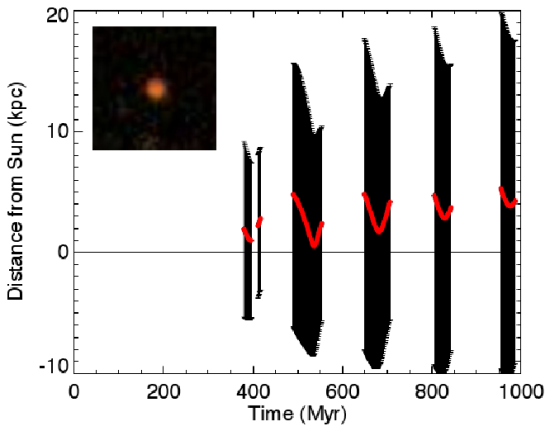
The star itself is shown in the inset. The red curve shows its calculated distance from the Sun over time, with the black area above and below showing the uncertainties of the calculation. As you can see, every hundred million years or so the distance between this star and the Sun shrinks, with the very very very rare possibility that the distance will sometimes shrink to zero!
With 18 stars each doing this every few 100 million years or so, the average time between close approaches is about 5 million years. These results suggest that another star passes close enough to our solar system frequently enough to not only disturb the comets in the Oort cloud, but also possibly affect the orbits of the planets in the outer solar system and Kuiper belt. One wonders, for example, if such an event had some influence on Pluto’s strange orbit.
From the AAS meeting, the black hole press conference!
From today’s first press conference at the AAS meeting, astronomers have found that two of the fundamental objects they use as units of measure might not be as reliable a unit of measure as they thought.