
India negotiating a possible Gaganyaan docking at ISS
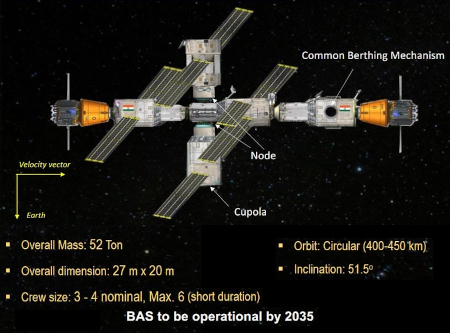
India’s Bharatiya Antariksh Station as outlined in 2024.
Click for original image.
The head of India’s space agency ISRO, it is negotiating with NASA about doing a variety of manned space operations in conjunction with NASA, including a possible Gaganyaan docking to ISS.
According to a presentation by Isro chairman V Narayanan reviewed by TOI [Times of India], the future cooperation areas span three key areas of collaboration between the two nations’ space agencies.
The first involves comprehensive training of ISRO personnel, including astronauts, at NASA facilities across multiple domains, including robotics systems, extravehicular activity (EVA), extravehicular mobility unit (EMU) systems, resource management, space medicine and spaceflight operations, LEO and lunar mission control operations, rendezvous and docking procedures, and payload and science operations.
An important initiative outlined is the uncrewed docking demonstration of India’s Gaganyaan Orbital Module with the US Orbital Segment of the ISS — this would mark a significant technological milestone for India’s human spaceflight programme.
The third area focuses on cooperation in docking, berthing, and inter-operability systems.
It is clear ISRO wishes to get training from NASA for its manned missions. It also makes sense for it to make sure its Gaganyaan’s docking systems are compatible with ISS, Dragon, Starliner, Soyuz, and even China’s station.
Doing a test unmanned docking at ISS would also provide ISRO valuable experience in preparation for its own Bharatiya Antariksh Station (BAS). Its first module is presently scheduled for launch in 2028, with the entire station assembled by 2035.
None of this however has been finalized. If India were to do a docking at ISS, it would like have to wait until 2029, after the two tourist missions assigned to Axiom and Vast. ISS has a limited number of available ports, and I suspect a port really won’t be available until after those missions.

India’s Bharatiya Antariksh Station as outlined in 2024.
Click for original image.
The head of India’s space agency ISRO, it is negotiating with NASA about doing a variety of manned space operations in conjunction with NASA, including a possible Gaganyaan docking to ISS.
According to a presentation by Isro chairman V Narayanan reviewed by TOI [Times of India], the future cooperation areas span three key areas of collaboration between the two nations’ space agencies.
The first involves comprehensive training of ISRO personnel, including astronauts, at NASA facilities across multiple domains, including robotics systems, extravehicular activity (EVA), extravehicular mobility unit (EMU) systems, resource management, space medicine and spaceflight operations, LEO and lunar mission control operations, rendezvous and docking procedures, and payload and science operations.
An important initiative outlined is the uncrewed docking demonstration of India’s Gaganyaan Orbital Module with the US Orbital Segment of the ISS — this would mark a significant technological milestone for India’s human spaceflight programme.
The third area focuses on cooperation in docking, berthing, and inter-operability systems.
It is clear ISRO wishes to get training from NASA for its manned missions. It also makes sense for it to make sure its Gaganyaan’s docking systems are compatible with ISS, Dragon, Starliner, Soyuz, and even China’s station.
Doing a test unmanned docking at ISS would also provide ISRO valuable experience in preparation for its own Bharatiya Antariksh Station (BAS). Its first module is presently scheduled for launch in 2028, with the entire station assembled by 2035.
None of this however has been finalized. If India were to do a docking at ISS, it would like have to wait until 2029, after the two tourist missions assigned to Axiom and Vast. ISS has a limited number of available ports, and I suspect a port really won’t be available until after those missions.