
Cassini captures a truly huge storm on Saturn.
Cassini has captured an image of a truly huge storm on Saturn. Click on the image below to see the full image.

Cassini has captured an image of a truly huge storm on Saturn. Click on the image below to see the full image.
Cassini has directly sampled the plumes from Enceladus and discovered a salty ocean-like spray.
The new paper analyzes three Enceladus flybys in 2008 and 2009 with the same instrument, focusing on the composition of freshly ejected plume grains. The icy particles hit the detector target at speeds between 15,000 and 39,000 mph (23,000 and 63,000 kilometers per hour), vaporizing instantly. Electrical fields inside the cosmic dust analyzer separated the various constituents of the impact cloud.
The data suggest a layer of water between the moon’s rocky core and its icy mantle, possibly as deep as about 50 miles (80 kilometers) beneath the surface. As this water washes against the rocks, it dissolves salt compounds and rises through fractures in the overlying ice to form reserves nearer the surface. If the outermost layer cracks open, the decrease in pressure from these reserves to space causes a plume to shoot out. Roughly 400 pounds (200 kilograms) of water vapor is lost every second in the plumes, with smaller amounts being lost as ice grains. The team calculates the water reserves must have large evaporating surfaces, or they would freeze easily and stop the plumes.
Saturn and Enceladus linked by electricity.
The spring rains (of methane) have arrived on Titan.
Cassini went into safe mode on Tuesday, November 2nd. At the moment engineers expect it to take at least another week to get the spacecraft back to normal.
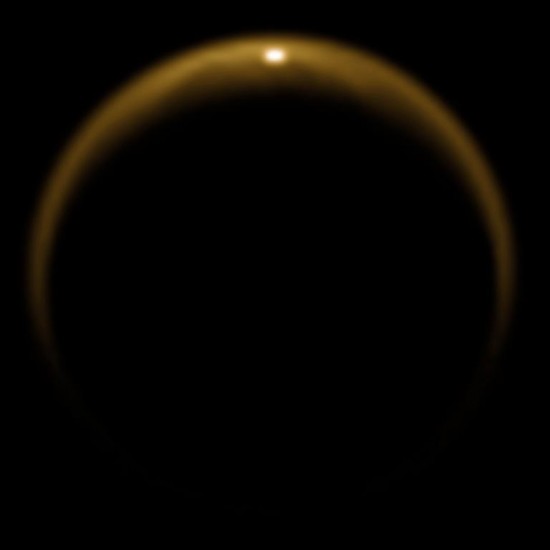
The Cassini image below, released today at the 42nd meeting of the AAS Division for Planetary Sciences, shows light reflecting off a lake on Titan’s northern hemisphere. According to the scientists who took the image, this is the first definitive confirmation of the presence of liquid in those lakes.
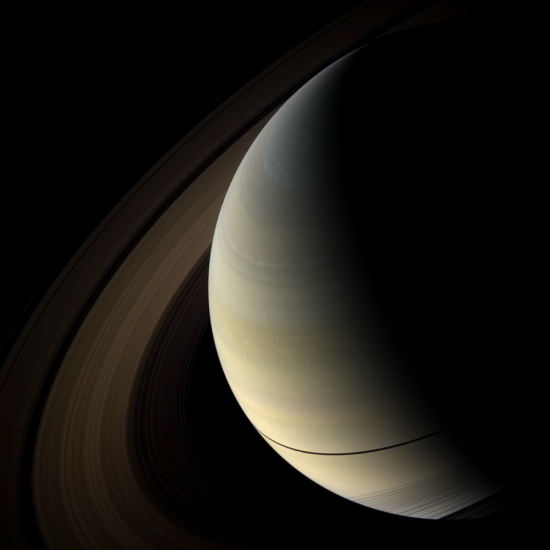
This breath-taking image of Saturn and its rings was taken by Cassini on July 19, 2009 and posted on the Cassini image gallery on August 27, 2010.
It appears we are entering the dry season on Titan. Scientists have observed a 1 meter drop in the levels of Titan’s methane lakes over the last four years as the seasons on the moon go from summer to fall. Fun quote: “[The scientists] report that the shoreline of Ontario Lacus receded by about 10 kilometers (6 miles) from June 2005 to July 2009.”