
Riot police attack Hong Kong airport protesters

Riot police today attacked the Hong Kong airport protesters, storming into their midst with batons and pepper spray.

CNN International reported, following the police operation that reporters witnessed at least four arrests and that officers appeared to be targeting specific people. To get through the protesters, police used pepper spray and batons to push back the crowd. According to an official statement from Hong Kong police, airport officials requested that the riot officers enter the airport to rescue a man who protesters had apprehended and accused of being an undercover police officer. The South China Morning Post also reported that the airport received a court injunction requesting police remove the protesters from the premises, though Hong Kong police did not issue an official statement to that effect and officers left without clearing out every protester.

Pro-democracy protesters shut down the airport Tuesday for the second day in a row, forcing administrators to cancel all flights, in a bid to get the China-controlled Hong Kong government to listen to their demands. Some protesters appeared to panic and target others suspected of working for the communist government after officials admitted this weekend that officers had dressed up as protesters to infiltrate the marches.

So far this attack today does not appear to be an effort to shut the protest down with violence. It appears that after extracting two men, possibly pro-China reporters, the police retreated, though the authorities are now limiting access to the airport, probably with the goal of starving the protest with a lack of new supporters.

A very sad messy situation. The Chinese want to impose its tyranny on Hong Kong. Hong Kong’s citizens want to remain free. The result are street protests that can only turn violent, one way or the other, because China’s government is very unlikely to back down.
4 comments

Linkspace completes vertical take-off and landing test

China’s semi-private company Linkspace on August 9 successfully completed its highest vertical take-off and landing test flight yet, flying to a height of 300 meters.

The 8.1-meter-tall, 0.65-meter-diameter, 1.5-metric-ton rocket reached an altitude of 300.2 meters during its 50-second flight before making a powered descent and vertical landing with an accuracy of 0.07 meters, Linkspace CEO Hu Zhenyu stated on Sina Weibo, a Chinese Twitter-like service. The launch follows two tests reaching 20 and 40 meters in March and April respectively.

The latest test was carried out at a new facility in the Lenghu region of Qinghai province in the northwest of the country. Chinese magazine Future Aerospace states that the RLV-T5 is powered by five variable-thrust rocket engines which use ethanol and liquid oxygen, a propellant combination used by the German V2 rockets.

Unlike the other new semi-private Chinese commercial companies, Linkspace appears to be using liquid fueled rockets, rather than depending on military solid rocket technology. This suggests to me that this company, aggressively supervised by the Chinese government, will eventually be going for both the small and big orbital business, not just smallsats.

I also give credit to the Chinese, both their government and this company, for quickly facing reality posed by SpaceX’s capabilities and working to develop their own rocket reusability as fast as possible. In contrast, Europe, Russia, and the old American big rocket companies have mostly sat twiddling their thumbs, making believe that this capability is either irrelevant, or still impossible, even as SpaceX has taken all of their business because it can undercut their prices significantly as it repeatedly re-uses its Falcon 9 first stages.

1 comment

As protesters shut down Hong Kong airport, government brings military into city

Be prepared for bad news: While protesters against a new Chinese law in Hong Kong have shut the airport down, the Chinese government has begun to bring its military into the downtown area.

The initial cause of these protests is an attempt by China to impose a new extradition law on Hong Kong that would allow them to extradite people from Hong Kong into mainland China.

The changes will allow for extradition requests from authorities in mainland China, Taiwan and Macau for suspects accused of criminal wrongdoings, such as murder and rape. The requests will then be decided on a case-by-case basis.

Several commercial offenses such as tax evasion have been removed from the list of extraditable offenses amid concerns from the business community. Hong Kong officials have said Hong Kong courts will have the final say whether to grant such extradition requests, and suspects accused of political and religious crimes will not be extradited.

The government has sought to reassure the public with some concessions, including promising to only hand over fugitives for offenses carrying maximum sentences of at least seven years.

It appears that the population in Hong Kong does not trust the Chinese government that has ruled them since the British left in 1999. They fear the misuse of this law in order to arrest anyone the Chinese government doesn’t like.

The question is whether the Chinese can do in Hong Kong what they did in Tiananmen Square in 1989. Then the government moved the military in and massacred the protesters, effectively ending any political opposition to communist rule. If they do this in Hong Kong they will also end the lingering freedom in that city left over from British rule..

4 comments

Video of Long March 2C grid fins used in July

China Central Television has released a very short video showing the grid fins used during the July 26 launch of China’s Long March 2C rocket in order to better control the descent of that rocket’s expendable first stage.

I have embedded the video below the fold. It shows the four grid fins unfolding, but not much else. It also reveals that the Chinese very clearly were inspired by SpaceX’s Falcon 9 grid fin design.

The video also gives me the impression that the Long March 2C first stage does not have any thrusters, which were SpaceX’s primary mode for controlling its first stages, the grid fins added later when they understood better the engineering required. Thus I suspect that the fins were not very successful in controlling that stage’s flight.

Nonetheless, the Chinese are doing these tests during operations, which means they are only a first step on a path to success.
» Read more

6 comments

Yutu-2 and Chang’e-4 go to sleep again

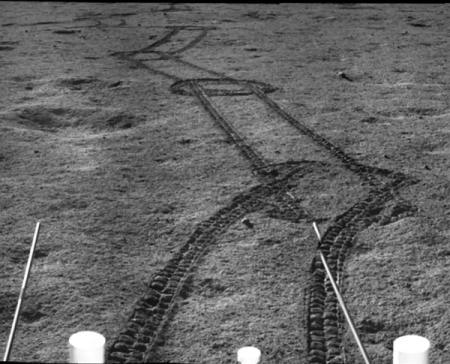
Yutu-2's travels

Both Yutu-2 and Chang’e-4 have been put in dormant mode after completing their eighth lunar day on the far side of the Moon.

The article at the link provides a lot of new details about what both spacecraft have learned and done since they landed, including a nice detailed map showing Yutu-2’s exact path during those eight lunar days. The image to the right, reduced to post here, was taken by Yutu-2, and shows the rover’s tracks during what appears to be its seventh lunar day. It appears that the rover periodically stopped and did a pirouette, probably to obtain a 360 degree mosaic of the surrounding terrain.

Yutu-2’s travels have tended west from Chang’e-4, and on its eighth lunar day it continues that route, traveling 271 meters. After a period of short traveling days, they have now upped the distance traversed by a considerable amount. Since the planned nominal mission for both spacecraft had been three lunar days, both are demonstrating that the Chinese have figured out how to do this, and are now pushing Yutu-2 hard as a result.

The article vaguely describes some of the science obtained so far, but in general the Chinese remain tight-lipped about most of their discoveries.

0 comments

Hundreds arrested in Moscow demonstrating for open elections

Continuing protests in Moscow demanding the right of independent candidates to run for election have resulted in hundreds of arrests in the past week.

I am very much reminded of the protests that led to the fall of the Soviet Union in the early 1990s. The difference is that then the government did little to stop them, and then allowed their candidates to run for office, sweeping the communists from power.

Now, Putin’s government seems to be following China’s approach to such protests, which cracked down hard against its own protests in the early 1990s and was thus able to stay in power.

Meanwhile in Hong Kong China is faced with its own new protest movement, now in its ninth week. At this moment China has held off using its full military power to stop the protests, but that might change soon. If so, things will get very bloody.

2 comments

Chinese test microsat deorbits and crashes into Moon

The new colonial movement: A Chinese tiny smallsat, sent to lunar orbit to test the technology of such microsats, has been deorbited and allowed to crash into the far side of the Moon.

The micro satellite crashed into a predetermined area on the far side of the Moon at 10:20 p.m. on July 31 (Beijing Time), the center said Friday.

Weighing 47 kg, Longjiang-2 was sent into space on May 21, 2018, together with the Chang’e-4 lunar probe’s relay satellite “Queqiao,” and entered the lunar orbit four days later. It operated in orbit for 437 days, exceeding its one-year designed lifespan.

The development of the micro lunar orbiter explores a new low-cost mode of deep space exploration, said the center. The micro satellite carried an ultra-long-wave detector, developed by the National Space Science Center of the Chinese Academy of Sciences, aiming to conduct radio astronomical observation and study solar radiation.

China might be stealing a lot of the space technology it is using to make it a major space power, but it is also doing a fine job of refining and improving that technology. Its capability to do practically anything in space as well if not better than anyone else continues to grow.

And with their government using its space effort as a management test for determining the best individuals to promote into the government’s power structure, do not expect their space effort to wane anytime in the near future.

0 comments

iSpace plans eight launches in 2020

After its first successful orbital mission last week, China’s semi-private rocket company iSpace announced today that it hopes to complete eight launches in 2020.

Clients from Singapore, Italy, Spain, Hong Kong and Sri Lanka, as well as mainland customers, have already either signed up for a spot on iSpaceโ€™s rockets or expressed interest.

iSpace is open to both private and government clients. โ€œItโ€™s the same for us whether itโ€™s a private or a state-owned company,โ€ Vice President for Marketing and Communications Yao Bowen said.

The price tag to launch a rocket is 4.5 million euros ($5 million), Yao added.

This launch price is just under what Rocket Lab has been charging, $6 million, and is clearly designed to take business from them. It is however higher than what Vector says it will charge, $4 million, should that company ever get its rocket off the ground.

The article also notes the investment capital raised by iSpace, totaling just over $100 million. This does make this company appear a private company, but don’t believe it. Its existence is very much tied to and supervised by the Chinese government.

1 comment

China tests controlled flight for returning first stage

Chinese news sources today confirmed that during its last launch on July 26, they tested the use of grid fins (essentially copied from SpaceX’s Falcon 9) to control the return flight of the first stage of their Long March 2C rocket.

The success of the test is of great significance for improving China’s inland rocket landing safety, minimizing the inconvenience to the local people, as well as promoting the follow-up development of carrier rockets’ controllable recovery, soft landing and reuse, according to He Wei, an official with the CASC.

“The swinging grid fins were used to control the rocket debris’ direction and attitude, much like the wings of the debris,” said Cui Zhaoyun, the deputy chief designer of Long March-2C rocket. The landing site control of large and medium rockets is much more difficult than that of small rockets, he added.

For almost forty years China has allowed these first stages to crash, sometimes very close to villages and habitable areas. Now, inspired by what freedom and U.S. innovation has accomplished, they have finally begun the process of figuring out how to land these stages vertically. Since their propellants are very toxic, it is not clear however whether they will be able to reuse them should they succeed in landing them undamaged.

8 comments

China smallsat company succeeds in orbital launch

A Chinese semi-private company, iSpace, successfully launched two smallsats into orbit today.

iSpaceโ€™s Hyperbola-1 rocket blasted off from the Jiuquan Satellite Launch Centre at 1 p.m. (0500 GMT) Thursday, sending two satellites and payloads into a predetermined orbit, the company said in a statement on its official Wechat account.

The successful orbital launch was preceded by two failures since late last year by other startups.

More here.

I am very reluctant to call this company, along with the other Chinese smallsat companies OneSpace and LandSpace, a private commercial firm. While it might get investment capital within China, it is very clearly supervised closely by the government. Moreover, its use of solid rocket motors, as noted in the second link, strongly suggests it is taking advantage of Chinese military technology, something that could only happen under government control. From the second link:

Itโ€™s unclear how much it cost for iSpace to build the rocket. Chinese state-owned automaker Changanโ€™s passenger car brand Oushang said it would sponsor the launch, but didnโ€™t specify the amount. In OneSpaceโ€™s case, the firmโ€™s nine-meter-tall, solid-propellent rocket cost the company $78 million to design, build, and launch. iSpaceโ€™s main private backers (link in Chinese) include domestic private-equity firms CDH Investments and Matrix Partners.

iSpace didnโ€™t immediately respond to requests for comment.

But private space companies are also getting state support in China. All of the private launches so far, for example, have taken place at Jiuquanโ€”Elon Muskโ€™s SpaceX recently launched a rocket at NASAโ€™s Kennedy Space Center, while its main customer is the US Air Force. Whatโ€™s different in China is the constraints that come with having state backing. In June, China rolled out a set of rules that restrict what private companies can develop and manufacture. Itโ€™s unclear if that may restrict private companiesโ€™ capabilities in building larger rockets that could rival state rocket builders. [emphasis mine]

The money for this comes from state-owned companies. The technology comes from military hardware. The goals are almost all military in nature. I would also bet, because of the lack of information released, that the satellites launched today were military payloads. This is hardly an independent private company competing on the open market.

Nonetheless, this success gives China a new capability and raises its status as a world space power.

The leaders in the 2019 launch race:

10 China
9 Russia
8 SpaceX
5 Europe (Arianespace)
4 India

The U.S. still leads China 14 to 10 in the national rankings.

0 comments

China deorbits Tiangong-2

China yesterday successfully deorbited its second space station test module, Tiangong-2, landing it harmlessly over the south Pacific.

Meanwhile the date of next launch of Launch March 5, the rocket that China must have operational in order to launch its full space station, remains unknown. It had been expected in July, but it appears this will not happen, and there is no indication when it will fly.

0 comments
1 75 76 77 78 79 118