It no longer makes sense to recycle

Link here.

For one, China’s decision in 2017 to no longer accept imported recycled materials is still in place, and is likely not to change in the near future..

For decades, the country was content to accept, process, and transform recycled materials from across the globe, but no longer. In July 2017, the government announced new policies that would effectively ban imports of most recyclables, particularly plastics. They went into effect last March. Considering that China has imported a cumulative 45% of plastic waste since 1992, this is a huge deal.

Where once China offered a market for the world’s plastic bottles, tubs, and other packaging to be turned into – for example – polyester clothing, now, that market is gone. This means that recycling costs have skyrocketed. A few years ago, Franklin, New Hampsire could sell recyclables for $6 per ton. Now, it costs the town $125 per ton to recycle that same stuff!

Municipalities across the country are facing this startling arithmetic, so hundreds are choosing the drastically cheaper option: throw most traditionally recycled materials in the trash, instead.

For another, it has become even more obvious that the cost of recycling is more damaging to the environment.

As Kinnaman discovered in a 2014 study – a complete life cycle analysis of the recycling process – it currently doesn’t make much economic or environmental sense to recycle plastic and glass in much of the developed world. Both of these materials are fairly easy on the environment to produce, but oftentimes very tricky and intense to recycle. When you factor in all of the water used to decontaminate plastic and glass, the immense distances traversed transporting them (usually by truck, train or ship), and the mechanical and chemical processes utilized to transform them into new goods, it becomes clear that they are better off in a landfill.

Will these facts cause local governments to change their laws and end recycling? Don’t bet on it. Recycling has never had anything to do with actually saving the environment. Its purpose has always been to make people feel good about themselves. Those emotions make it impossible for most people to consider these facts.

Try it. Tell you friends and family about these facts. You will find yourself faced with an unalterable skepticism that no fact can change.

12 comments

Chang’e-4/Yutu-2 return to dormant mode for lunar night

According to one story in the Chinese press today, the science teams running Chang’e-4 and Yutu-2 on the far side of the Moon have now put both into dormant mode for the coming lunar night after completing their seventh lunar day.

What is intriguing about this short story is that while to lauds the work done by Chang’e-4 during that seventh lunar day, it says nothing about Yutu-2. Early comparable reports would have at least told us how far the rover moved during the lunar day. This time they say nothing at all about Yutu-2, other than it has been placed in dormant mode.

It could very well be that they had a problem with the rover. Sadly, China is not an open society. We can only wait for them to tell us.

0 comments

UCLA professor found guilty of stealing military technology for China

A UCLA professor has been found guilty of stealing military technology and sending it to China.

UCLA adjunct professor Yi-Chi Shih was convicted June 26 on 18 federal charges, Newsweek reported, and could now lose hundreds of thousands of dollars, while also facing up to 219 years behind bars for numerous violations of the law. These include conspiracy to break the International Emergency Economic Powers Act (IEEPA), committing mail and wire fraud, lying to a government agency, subscribing to a false tax return, and conspiring to gain unauthorized access to information on a protected computer, according to a Department of Justice news release.

Shih and co-defendant Kiet Ahn Mai tried to access illegally a protected computer owned by a U.S. company that manufactured semiconductor chips called monolithic microwave integrated circuits (MMICs). MMICs are used by the Air Force and Navy in fighter jets, missiles and missile guidance technology, and electronic military defense systems.

The chips were exported to Chengdu GaStone Technology Company (CGTC), a Chinese company, without a required Department of Commerce license. Shih previously served as the president of CGTC, which made the Commerce Department’s Entity List in 2014 “due to its involvement in activities contrary to the national security and foreign policy interest of the United States – specifically, that it had been involved in the illicit procurement of commodities and items for unauthorized military end use in China,” according to court documents cited by the DOJ.

The only surprise here is that the these guys got caught. Since the late 1990s China has been making aggressive effort to steal American know-how, and has largely been successful. The visible result of that effort has been their space program, almost all of which began with technology thefts.

1 comment

The travels of China’s Yutu-2 rover on the Moon

Yutu-2 and Chang'e-4
Click for full image.

The Lunar Reconnaissance Orbiter (LRO) science team today released images that track the travels of China’s lunar rover Yutu-2 from its landing on January 30, 2019 through June 3, covering the rover’s first six lunar days on the Moon.

The image to the right, cropped, reduced, and annotated to post here, shows the relative positions of both spacecraft as of June 3, 2019. In the release they also included a gif movie showing the progression of Yutu-2’s movements since landing.

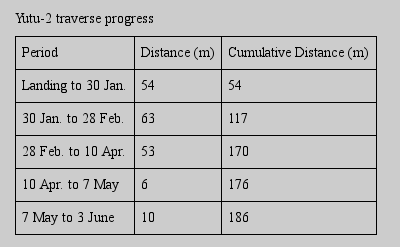
Once a month, LRO passes over the Chang’e 4 landing site, allowing LROC to capture a new image. LROC has now imaged the site five times (since the landing) and observed Yutu-2 to have traveled a total of 186 meters (distance measured using the rover tracks). If you squint, portions of the rover tracks are visible as a dark path in the images from April, May, and possibly June.

table of Yutu-2's movements through June 2019

The LRO release also included a table showing the distance Yutu-2 has traveled with each lunar day, shown on the right. The table does not include the 23 meters (75 feet) the rover traveled on its sixth lunar day. My estimate yesterday that Yutu-2 was traveling an average of about a 100 feet per day, with the distances per day shrinking with time, seems largely correct. During the rover’s fourth and fifth lunar days it moved very little, either because they had found something very interesting they wanted to inspect more closely, or they were moving more cautiously as the rover’s life extended past its planned lifespan of three lunar days.

On the sixth day however they increased their travels again, suggesting that either they had finished the observations at the previous location, or they had gained more confidence in the rover’s staying power.

0 comments

Chang’e-4 and Yutu-2 awake for 7th lunar day

The new colonial movement: Chinese engineers have awakened both the Chang’e-4 lander and the Yutu-2 rover to begin work on their seventh lunar day on the Moon’s far side.

The text of this Chinese news report is almost identical to the text in the news report a month ago, when both spacecraft were awakened for the sixth lunar day. And as before, it tells us little.

What today’s story reveals is that Yutu-2 traveled only about 75 feet during the sixth lunar day. With an overall odometer reading of 695 feet, it appears it is averaging about 100 feet per lunar day, with the per day number dropping with time. Either the science team is becoming cautious, or they have had unstated issues that have slowed them down.

Still, the rover’s nominal mission was only three lunar days, so it is survived more than twice as long as designed.

0 comments

Hacker steals JPL data

A hacker last year was successfully able to hack into the computer system at the Jet Propulsion Laboratory (JPL) in California and steal 500MB of data.

Who did the hacking is not revealed in the inspector general report [pdf], but the report lists six different hacks of JPL’s computers going back to 2009, two of which were linked to China. It is therefore reasonable to assume that China, which routinely steals new ground-breaking technology rather than develop it itself, was the likely culprit. In addition, the timing of these hacks, from 2009 to 2017, fits well with the steady growth of China’s lunar program. If you wanted to find out how to build an unmanned probe to go to the Moon, JPL would be the ideal facility to steal the technology from.

2 comments

More delays for Long March 5?

It appears that there might be more delays in the next launch of China’s largest rocket, the Long March 5, which in turn will cause delays to the Moon, Mars, and space station projects.

The Long March 5 heavy-lift rocket is China’s most powerful launch vehicle and was designed to launch large spacecraft to geosynchronous orbits and planetary bodies. It was being prepared for a third flight in July, Yang Baohua, vice president of the China Aerospace Science and Technology Corporation (CASC), China’s main space contractor and developer of the Long March 5, announced in a Jan. 29 news conference in Beijing.

The mission would come two years after the failure of the second launch. However that schedule appears to have slipped as the launch vehicle has yet to be delivered to the launch site, with knock-on effects possible for China’s major space plans. [emphasis mine]

The Chinese have said nothing to explain the situation.

Without this rocket they cannot launch their next lunar mission, Chang’e-5 sample return mission, their next Mars mission, set for the launch window 2020, and their space station, set for construction beginning in 2021.

0 comments

China announces international experiments to fly on its space station

The new colonial movement: China and the UN today jointly announced the nine international experiments that China will fly on its own space station, set to be completed by 2022.

The nine projects involve 23 entities from 17 countries in the fields of aerospace medicine, space life sciences and biotechnology, microgravity physics and combustion science, astronomy and other emerging technologies.

It seems to me that the competition in space is definitely heating up. Both China and Indian now plan their own space stations. And the Trump administration’s announcement that it will allow private commercial and competitive operations on ISS, is certainly going to lead eventually to more than one private station in orbit, plus ISS.

The result is going to be many different stations, all offering different capabilities and all in competition to lower the cost to get there and to do research or to sightsee. All are also going to be contributing aggressively in learning how to build vessels that humans can live on for long periods, which in turn will teach us how to build interplanetary spaceships. In fact, every one of these stations will be prototypes for those interplanetary spaceships.

Isn’t competition wonderful? After almost thirty years of boring international cooperation on ISS, with little new achievement or innovation, the space station competition coming in the next decade will revitalize space exploration in ways we as yet cannot imagine.

1 comment

China tightens rules for its private space companies

China has released new rules governing the work of that country’s private space companies, tightening its control over them.

[The rules] require companies to obtain official permission before carrying out rocket research and development as well as production, according to a notice published on the web site of the State Administration of Science, Technology and Industry for National Defense on Monday.

The new rules also require a confidentiality system to be established among commercial rocket companies and asks them to follow state export control regulations when in doubt about whether they can provide overseas services and products.

These rules really only codify the control the government has always had over Chinese private companies.

2 comments

China completes first launch from ocean launchpad

The new colonial movement: China today successfully completed its first launch from ocean launchpad, placing seven satellites in orbit with its Long March 11 rocket.

I have embedded a short video of the launch below the fold. It appears they have adapted submarine ICBM engineering for this ocean launch. The rocket is propelled upward from the launchpad before its first stage engines fire.

The rocket:

The Long March-11 (Chang Zheng-11) is a small solid-fueled quick-reaction launch vehicle developed by the China Academy of Launch Vehicle Technology (CALT) with the goal to provide an easy to operate quick-reaction launch vehicle, that can remain in storage for long period and to provide a reliable launch on short notice.

The leaders in the 2019 launch race:

8 China
6 SpaceX
5 Russia
4 Europe (Arianespace)
3 India

The U.S. leads China in the national rankings, 11 to 8.
» Read more

5 comments
1 76 77 78 79 80 118