Rover update: April 11, 2019

Summary: Curiosity successfully drills into the clay unit. Yutu-2 continues its exploration on the far side of the Moon.

For the updates in 2018 go here. For a full list of updates before February 8, 2018, go here.
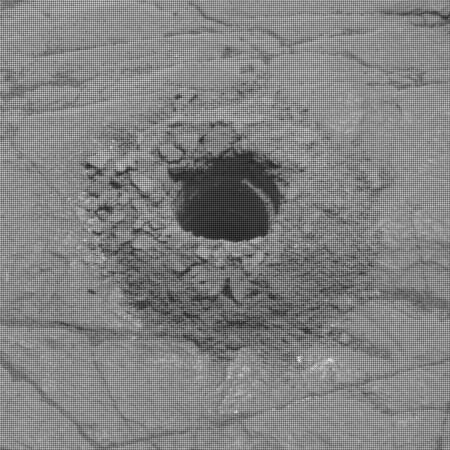
Curiosity drill hole in clay unit on slopes of Mount Sharp

Curiosity

For the overall context of Curiosity’s travels, see my March 2016 post, Pinpointing Curiosity’s location in Gale Crater.

The news this week from Curiosity is that the rover has successfully drilled into the ground in the clay unit valley the rover is presently exploring betweent Vera Rubin Ridge and Mount Sharp’s higher slopes.

The image to the right shows is a close-up of that drill hole.

The rover’s drill chewed easily through the rock, unlike some of the tougher targets it faced nearby on Vera Rubin Ridge. It was so soft, in fact, that the drill didn’t need to use its percussive technique, which is helpful for snagging samples from harder rock. This was the mission’s first sample obtained using only rotation of the drill bit.

Since my last rover update on February 20, 2019, they have been traveling for several weeks to get to a spot where they can do this drilling. The clay unit seems very soft, and almost mudlike, which made finding a good surface to drill somewhat challenging. Most of the terrain seemed too soft to drill into. It almost would be better to have a scoop, as the Viking landers had. Curiosity doesn’t really have this however. It needs to use its drill, which really is a more efficient way to get down deeper into the ground anyway.

The map below shows their recent travels.
» Read more
0 comments

Telescope store sues Asian telescope manufacturers for fixing prices

A San Francisco store that sells telescopes to the public is suing two Asian telescope manufacturers — who make almost all recreational telescopes sold in the U.S. — for conspiring together to fix prices and create that monopoly.

Orion Telescopes and Binoculars, which is headquartered in Watsonville and has stores there and in Cupertino, is seeking more than $180 million in damages in a lawsuit. A federal court in Northern California said the complaint against telescope maker Ningbo Sunny, filed in 2016, can go to trial. A subsidiary of Ningbo Sunny, a Chinese company, bought Irvine telescope maker Meade Instruments in 2013.

In the complaint, Orion alleges that Ningbo Sunny and a Taiwanese telescope manufacturer, Synta Technology, shared confidential information that competitors normally would not share, including product pricing, order forecasts and credit arrangements.

My question is this: Why are no American telescope manufacturers competing in this market? Are our labor costs too high? Our government regulations too restrictive? A little bit of competition could easily end this collusion by these Asian manufacturers, assuming it is happening.

11 comments

Yutu-2 and Chang’e-4 awake for fourth lunar day

The Chinese rover Yutu-2 and lander Chang’e-4 were awakened on March 30, 2019 to begin work for their fourth lunar day on the surface of the Moon’s far side.

The rover was designed to last for three lunar days, but much like NASA missions that regularly outlive their initial mandates, Yutu 2’s mission may stretch on longer, the Chinese space agency hopes. (The current rover’s predecessor, Yutu, lost its roving ability on its second day on the moon.)

The China Lunar Exploration Program, which heads up the mission, has not provided any details about its scientific plans for the fourth day of Chang’e 4, which is focused on exploring the far side of the moon and how it differs from the near side.

Based on the images taken by Lunar Reconnaissance Orbiter, it appears they will be heading west, following the smoothest route away from Chang’e-4. This will place Yutu-2 in an area of small craters.

0 comments

India claims it has successfully destroyed a satellite using an anti-sat missile

The new colonial movement: In a speech to his nation today, India’s Prime Minister Narendra Modi announced that they have successfully completed their first anti-sat test, using a missile to destroy a satellite in low Earth orbit.

The Indian ASAT test is believed to have destroyed either the Microsat-R or the Microsat-TD satellite, likelier the former according to some sources. They were both built by the Defence Research and Development Organisation (DRDO). ISRO launched the Microsat-R on January 24 this year and the Microsat-TD a year before that.

Prime Minister Modi declared the test, codenamed Mission Shakti, a success and claimed that an ASAT missile had destroyed the satellite in its low-Earth orbit.

The missile in question is described as a kinetic kill vehicle, which means it does not carry any explosives or other devices. Instead, its ‘kill’ capability arises simply from the fact that it smashes into the target satellite and shatters it using its kinetic energy.

At this altitude, about 300 km, experts said that debris from the collision would fall back to Earth, burning up in the atmosphere in a matter of weeks instead of posing a threat to other satellites. As a result, Mission Shakti is called a controlled ASAT test.

What this anti-sat test really demonstrates is India’s ability to to hit a very tiny target that is moving more than 17,000 miles per hour with a missile shot from Earth, which proves they can hit any target on Earth, with great accuracy. And it thus a blunt message to both Pakistan and China. Don’t attack us, because if you do, we have the capability to do you great harm.

6 comments

OneSpace orbital launch fails

Capitalism in space? The first orbital launch attempt by China’s smallsat company OneSpace failed today.

No information about the cause of the failure or what happened has been released as yet.

I’m going to say this again: While OneSpace is financed through private capital, like a private company, it is also supervised closely by the Chinese government. It is hardly a private company as we in the West would define it.

0 comments

OneSpace to attempt first orbital launch this week

OneSpace, one of a bunch of companies in China attempting to launch smallsats, is expected to attempt its first orbital launch this week.

The article gives a nice overview of the present competition in China between several of these smallsat private companies, dubbed OneSpace, LandSpace, ISpace, and LinkSpace. All are funded through private investment capital, so all claim to be a private companies. However, nothing done in space in China is done without the approval and direction of the government. They might be designed as private companies, but they are also designed expressly to serve the needs of the Chinese government. That their company names are all so similar only strengthens this conclusion.

1 comment

Yutu-2 heads west!

LRO images of Yutu-2 on the Moon
Click for full image.

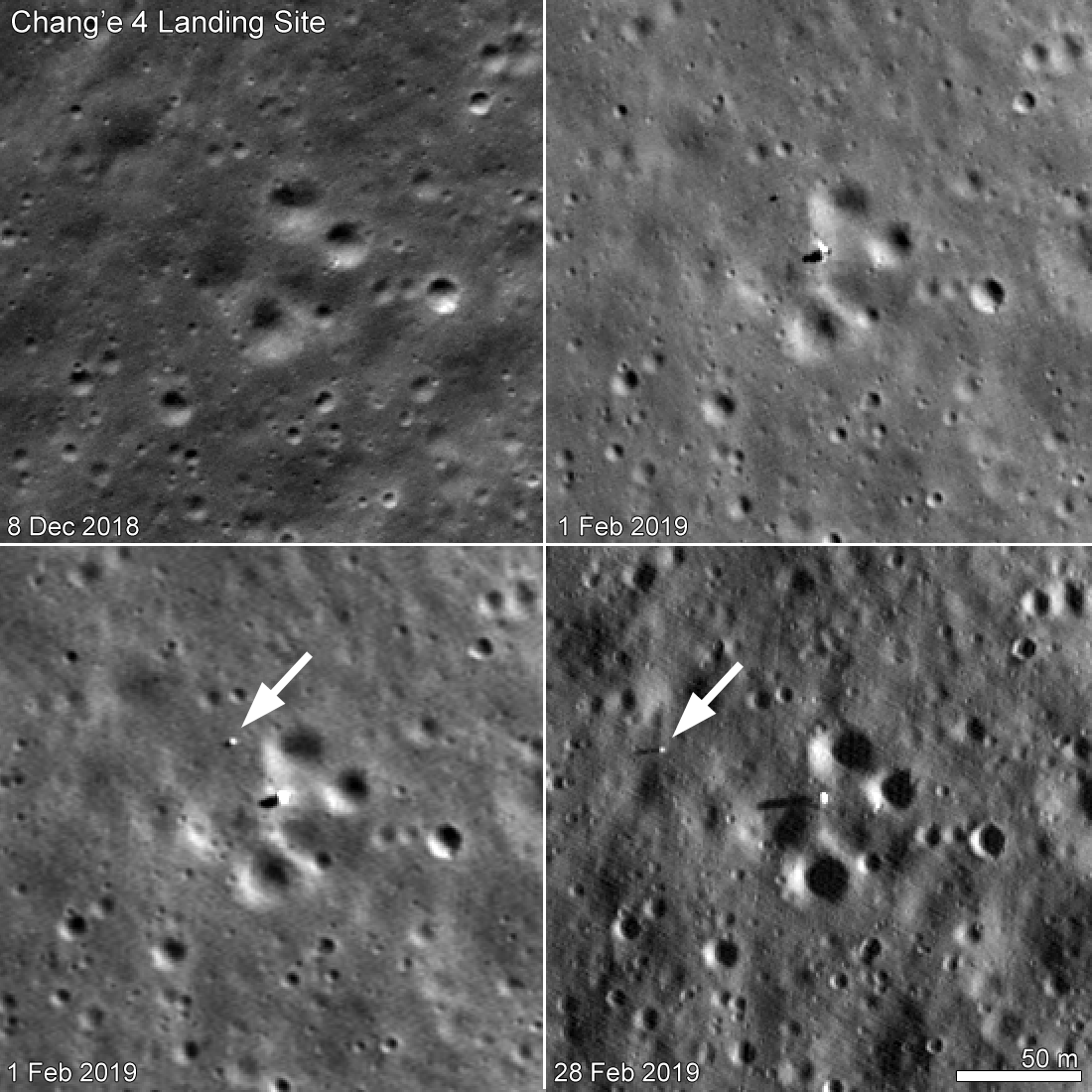
A new image from Lunar Reconnaissance Orbiter (LRO) shows the path taken by the Chinese lunar rover Yutu-2 during its second lunar day of travel on the Moon. The LRO images on the right, cropped and reduced in resolution to show here, compares the rovers position at the start and end of February. The white arrow indicates the rover, with its Chang’e-4 lander visible between the three craters to the east. As noted by the LRO science team:

LRO passes over any given place on the Moon at least once every month (in the daylight), allowing the westward progress of the Yutu-2 rover to be seen. At the end of February, Yutu-2 was 69 meters from it’s home base, the Chang’e 4 lander; LROC images show Yutu-2 made 46 meters of westward progress during the month of February.

It appears from these orbital images that they are taking the smoothest route, with the fewest obstacles, away from the lander.

0 comments

China’s future lunar exploration plans

In a poster presented on Tuesday at this week’s 50th Lunar and Planetary Science Conference in Texas, China outlined its future plans for lunar exploration.

Systematically considering the major scientific issues of the Moon and the lunar in-situ utilization resources, Chinese scientists and technical experts have proposed a vision to preliminarily build a research station on the Moon’s South Pole by implementing 3-4 missions before 2035.

The first mission will carry out a comprehensive exploration in the South Pole of the Moon, including the topography, elemental composition and volatile contents of the Moon, and the information on the structure of the South Pole from shallow to deep levels. Water (ice) in the permanent shadow area was detected in-situ to reveal the content, distribution and source of water and volatiles on the surface of the Moon. After that, a sampling return mission will be arranged to collect samples from the South Pole of the Moon and return them to the Earth. In addition to the scientific exploration of the Moon, the utilization of lunar resources should also be taken into consideration. In later missions, lunar platforms will be used to make astronomical or earth observations and to consider the use of lunar resources. [emphasis mine]

China clearly intends to put its footprints on the Moon. It is not fiddling around with an orbital lunar station, as it looks like we are with NASA’s Gateway project. While China explores the surface, we will be stuck in orbit (maybe).

4 comments

Chinese lunar rover and lander enter their third lunar night

The Chinese lunar rover Yutu-2 and its lander Chang’e-4 have gone into hibernation as they enter their third lunar night on the far side of the Moon.

According to Chinese news reports, both spacecraft have now exceeded their nominal lifespan.

With all systems and payloads operating well, the Yutu-2 team will continue roving and science data collection on lunar day 4 of the Chang’e-4 mission, according to a [Chinese] announcement.

Yutu-2 added 43 meters to its overall drive distance in its third day of activities, continuing a path to the northwest of the landing site, which was recently named ‘Statio Tianhe’ by the International Astronomical Union. The rover just covered seven meters between waking for lunar day 3 on Feb. 28 and Mar. 3, during which time it navigated carefully toward a 20 centimeter diameter rock in order to analyze the specimen with an infrared and visible light spectrometer to determine its origin.

I am struck by how tentative the Chinese and their rover appear. The first Russian lunar rover, Luna 17, traveled 6.5 miles in eleven months. The second, Luna 21, traveled 23 miles in four months. At the pace Yutu-2 is setting, it will not come close to these mileages. Moreover, my impression of Chinese space technology in the past decade has been that it is quite robust. This tentativeness thus surprises me. Maybe because this is a government project they are simply covering their butts should something go wrong, and thus making believe the rover is more delicate than it really is.

As Scotty on Star Trek once said, “Always under predict, then over perform.” We might be seeing that pattern here.

0 comments

The military components of China’s space effort

Link here. Key quote:

Beijing now has a goal of “[building] China into a space power in all respects.” Its rapidly growing space program—China is second only to the United States in the number of operational satellites—is a source of national pride and part of President Xi Jinping’s “China Dream” to establish a powerful and prosperous China. The space program supports both civil and military interests, including strengthening its science and technology sector, international relationships, and military modernization efforts. China seeks to achieve these goals rapidly through advances in the research and development of space systems and space-related technology.

China officially advocates for peaceful use of space, and it is pursuing agreements at the United Nations on the non weaponization of space. Nonetheless, China continues to improve its counterspace weapons capabilities and has enacted military reforms to better integrate cyberspace, space, and EW into joint military operations.

The PLA [People’s Liberation Army] views space superiority, the ability to control the information sphere, and denying adversaries the same as key components of conducting modern “informatized” wars. Since observing the U.S. military’s performance during the 1991 Gulf War, the PLA embarked on an effort to modernize weapon systems and update doctrine to place the focus on using and countering adversary information-enabled warfare.

What this report makes clear is that while China’s space program might have many visibly peaceful components, it is still tightly integrated with China’s military. Everything China does in space goes through the PLA.

We should also be aware that former managers of their space program are dominate throughout China’s entire political structure. Being a good manager in space has become the best route to gaining a powerful political position.

Both facts suggest that China’s space program will for the next few decades only grow in size and ambitions, for many military and nationalistic reasons. This also tells us that it is likely not a good idea to do any cooperative projects with them. They will not really be your partner, but will be using you to further their own ends, entirely.

0 comments

New LRO image of Chang’e-4 and Yutu-2

Chang'e-4 and Yutu-2

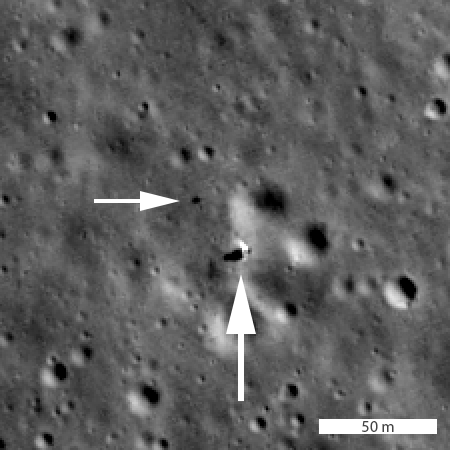
The Lunar Reconnaissance Orbiter (LRO) science team has released its third and best image of the Chinese Chang’e-4 lander and Yutu-2 rover. The image on the right is a full resolution cropped section, with the lander on the bottom and the rover above and to the left.

Just after midnight (UTC) on 1 February 2019 LRO passed nearly overhead the Chang’e 4 landing site. From an altitude of 82 kilometers the LROC Narrow Angle Camera pixel scale was 0.85 meters (33 inches), allowing a sharper view of the lander and Yutu-2 rover. At the time the rover was 29 meters northwest of the lander, but the rover has likely moved since the image was acquired. This view has close to the smallest pixel size possible in the current LRO orbit. In the future however, LROC will continue to image the site as the lighting changes and the rover roves!

These future LRO images will allow us to track Yutu-2 and get an idea of its research, even if the Chinese do not release any information.

0 comments
1 78 79 80 81 82 118