
Tiangong-1 reentry window narrowed to 24 hours centered on April 1st
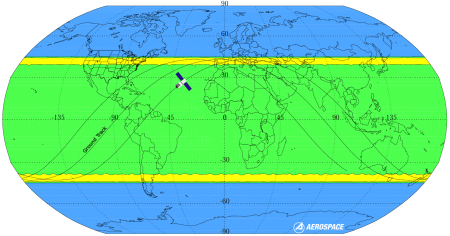
Tiangong-1 landing possibilities

The reentry window for Tiangong-1 has now been narrowed to 24 hours, centered on April 1st. It is still too soon, however, to determine where it will land. The map on the right shows the likeliest regions in yellow, the next likeliest in green, and areas with no chance of impact in blue.

The focus so far has been on where the surviving pieces of Tiangong-1 might land. The summary at the link notes that it also will provide an interesting fireworks display.

It may be possible to see Tiangong-1 reentering depending on your location, the time of day, and visibility during reentry which will not be known until a few days prior to the event…. Visibly incandescent objects from this reentry will likely last tens of seconds (up to a minute or more) in contrast with the vast majority of natural meteors which last mere seconds.

…Depending on the time of day and cloud visibility, the reentry may appear as multiple bright streaks moving across the sky in the same direction. Due to the relatively large size of the object, it is expected that there will be many pieces reentering together, some of which may survive reentry and land on the Earthโ€™s surface.

The spacecraft does carry toxic hydrazine fuel, so if by some miracle a piece falls near you don’t touch it.

4 comments

Tiangong-1 re-entry narrowed to four days centered on April 1

Tiangong-1's likely landing locations

China’s first space station, Tiangong-1, is now predicted to crash to Earth in a window that has been narrowed to four days centered on April 1. The map to the right shows the station’s most likely landing areas, with yellow the most likely, green less likely, and blue not at all. Essentially, there is about a 50-50 chance the station will come down in the north mid-latitudes, with about a 70 percent chance it will land in water if it does so.

Thus, the odds of the station hitting a populated area is not large, but it definitely exists. We will not know the exact area of impact until very close to the moment the station finally comes down.

3 comments

Chinese competition in smallsat rocket industry forcing prices down

Capitalism in space: The price to launch smallsats is plummeting, partly because of competitive pressure coming from China.

During a panel discussion at the Satellite 2018 conference here March 12, executives of several launch providers said they expected small launchers under development or entering service in China, either by state-owned enterprises or private ventures, to sharply reduce launch prices in the coming years. โ€œI think the Chinese are going to drive an order of magnitude reduction in launch costs, building satellites and operating satellites. That will happen in the next five years,โ€ said Rich Pournelle, vice president of business development for NanoRacks, a company that offers rideshare launch services for smallsats, primarily from the International Space Station.

Pournelle said that there are already signs of price pressure on launches. โ€œCubesats that used to cost $350,000โ€“400,000 to launch are now $250,000 and going down,โ€ he said. โ€œYouโ€™re seeing a tremendous pressure from Asia, especially, on the launch side.โ€

Others on the panel agreed. โ€œI think prices will settle and start to go lower as the Chinese put more launchers on,โ€ said Curt Blake, president of Spaceflight, which also provides rideshare launch services on a variety of vehicles. โ€œThat will put pressure on U.S. launch vehicles.โ€

The industry concern here is that the Chinese companies are not really private, and can be heavily subsidized by China so that they can offer lower prices than anyone else. They are therefore suggesting that the government should step in and act to protect them from this competition.

I say, the government should stay out. For one thing, U.S. law today prevents American companies from using Chinese launchers, and a vast majority of the launch business is going to come from the U.S. The U.S. smallsat launch industry will have plenty of work, and can very effectively deal with the Chinese competition without government help. Moreover, this Chinese competition will only serve to enliven the market, and bring about more innovation and lower prices. The last thing we need is the government stepping in to interfere with that healthy and free competition.

0 comments

Tiangong-1 reentry window narrowed

Tiangong-1 re-entry map

New estimates by the European Space Agency of when China’s Tiangong-1 space station prototype will re-enter the atmosphere have now been narrowed to one week, centered on around April 4.

The map on the right, created by the Aerospace Corporation, indicates the latitudes where the module is most likely to fall. Yellow is the more likely, green is less likely, and blue is no chance at all. Note that Aerospace has not yet narrowed its re-entry window, still holding it at two weeks centered on April 4.

1 comment

China launches military surveillance satellite

China today successfully launched a military surveillance satellite using its Long March 2D rocket, designed to put smaller payloads in low Earth orbit.

I think the 2D would compare nicely with India’s PSLV rocket.

The leaders in the 2018 launch standings:

8 China
5 SpaceX
3 Japan
3 ULA
2 Russia
2 Europe

The U.S. and China are presently tied at 8. Note also that I am now counting Rocket Lab as a New Zealand rocket, not an American one.

2 comments

China’s big space launch schedule

This Space News article does a nice job outlining the known schedule situation for China’s Long March 5 rocket. To summarize, it appears the launch schedule is roughly as follows:

November 2018: Long March 5 launches new geosynchronous communications satellite
Early 2019: Long March 5 launches Chang’e-5 to the Moon on sample return mission
June 2019: Long March 5B launches first test flight of upgraded and reusable Shenzhou manned capsule
2020: Long March 5B launches Tianhe, first module of China’s space station
Summer 2020: Long March 5 launches China’s first rover to Mars
2020 to 2022: Long March 5B launches two more modules to complete China’s space station

This schedule all hinges on the success of that first launch.

1 comment

More big space rumors from China

Two stories today tout two different future big space projects coming out of China.

The first story describes a proposed Chinese X-37B concept, that unlike the X-37B would be launched from a airplane-like mother ship, like Orbital ATK’s Pegasus rocket. This would make the entire vehicle reusable. I would not book passage, however. This is concept stuff, and possibly being touted by the designers to lobby for funding.

The second story is more real, outlining the design work being done right now for a second generation Chinese manned capsule to replace its Shenzhou spacecraft. It appears they want something with greater capacity and more reusability, and also with the robustness to return from lunar missions.

1 comment

Tiangong-1 reentry update: April 3rd, give or take a week

Tiangong-1 landing map

Link here. Right now the de-orbit window of the dead Chinese space station suggests it will come down to Earth sometime around April 3, plus or minus a week. As we get closer this will get refined somewhat, but the uncertainties are always going to be great, until the actual moment it hits the atmosphere.

The map on the right, reduced to post here, comes from the link and was produced by the Aerospace Corporation and indicates the relative possibilities of debris falling in a given region.

Yellow indicates locations that have a higher probability while green indicates areas of lower probability. Blue areas have zero probability of debris reentry since Tiangong-1 does not fly over these areas (north of 42.7ยฐ N latitude or south of 42.7ยฐ S latitude). These zero probability areas constitute about a third of the total Earthโ€™s surface area.

Depending on orbit, and whether the station is heading north or south in its orbital inclination, the odds of it crashing in populated areas changes significantly. If it is moving north the odds of coming down in the populated mid-latitudes of the northern hemisphere go up considerably. Of course, it could just as well come down in the northern mid-latitudes above the Pacific.

Regardless, the risks remain tiny, no matter what. Tiangong-1 is a small module, just large enough for some of it to survive reentry.

1 comment

China’s space station delayed to 2020

Because of redesign work required on its Long March 5 rocket, China revealed today that the launch of the first module, Tianhe, of their planned space station, has now been set for 2020.

Launch of Tianhe had earlier been planned for 2018, but the launch failure in July last year of the Long March 5 rocket, a heavy-lift launch vehicle required to loft the 20-tonne space station modules to low Earth orbit, meant a delayed schedule.

The next attempt at a Long March 5 launch, which will send a large telecommunications satellite into a geostationary transfer orbit, will take place from Wenchang in the second half of 2018. If that is successful, it will pave the way for a test launch of the low Earth orbit variant of the rocket, the Long March 5B, around June 2019. The follow-up flight will then launch the Tianhe module, now set to take place in 2020.

During the Soviet era, it was not unusual for the Russians to suddenly invent a new variant of a rocket or space capsule in order to provide cover for their need to redesign or fix problems. That is what I think is happening here. Until the still unexplained launch failure of Long March 5 in July 2017, I had never heard of a Long March 5B. It was the Long March 5 that was going to do all the heavy lifting.

Now we suddenly have a Long March 5B, a “low Earth orbit variant of the rocket.” I increasingly suspect that the problems with Long March 5 were so serious that they have caused a complete redesign. It was able to get its first payload into orbit, but not its second. The failure was not accompanied by any catastrophic event, which suggested, based also on later reports, that the rocket’s first stage engines simply under-performed significantly. I wonder now if what China is doing now is making that weak rocket the 5B, while they redesign the 5 so it can lift the big payloads required.

We also cannot trust them entirely with the naming they use of their rocket for each launch. The next Long March 5 launch in 2018 might actually be the 5B variant, without the name, and the so-called first test of the 5B in June 2019 might actually be the first test of the full powered 5.

Wheels within wheels!

0 comments

China test fires core engine for its Long March 5 rocket

On February 11 China did a static fire test of the core engine for its Long March 5 rocket, that country’s largest rocket that has been grounded since a launch failure in July 2017.

The YF-77 is China’s most powerful rocket engine, burning liquid hydrogen fuel and liquid oxygen oxidiser to provide 510 kN (110,000 lbf) of thrust at sea level. A pair of these engines power the core stage of the Long March 5.

The Long March 5 heavy-lift rocket successfully debuted in late 2016 but failed to reach orbit with its second flight, in July. Following an investigation into the launch failure, it has been announced that the next launch is being planned for the second half of 2018 from the specially built Wenchang Space Launch Centre on the island province of Hainan, at 19 degrees North. No causes of the failure, which some observers pin to an underperformance of the first stage brought on by an engine issue, have been publicly revealed, and thus no indication as to whether the issue was related to design or a manufacturing problem.

The Chinese continue to be very tight-lipped about the situation with the Long March 5. This static fire test suggests however that the issue was with the core engine.

1 comment

Tiangong-1 reentry now estimated between March 25 and April 17

China’s first space station, a test module called Tiangong-1, is now expected to reenter the atmosphere and crash to Earth sometime between March 25 and April 17.

The Tiangong-1 space lab was launched in 2011 to test docking technology and life support by hosting two crews, but loss of control over the spacecraft’s propulsion means it cannot be deorbited in a controlled manner.

The spacecraft’s orbit is decaying due to atmospheric drag and that process is accelerating as Tiangong-1 runs into denser concentrations of particles at lower altitudes.

The station will break-up during reentry, and most of it will burn up. However, some chunks will hit the ground. The article gives details about how they are tracking it in preparation for reentry.

0 comments
1 87 88 89 90 91 118