The battle of Gettysburg as seen by those who lived it
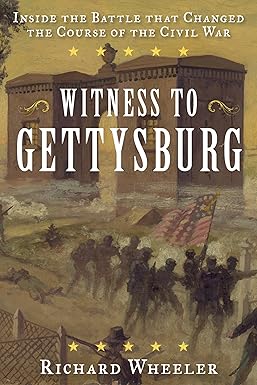
Witness to Gettysburg by Richard Wheeler

I just finished one of the best histories I have ever read, and want to recommend enthusiastically to my readers. It is called Witness to Gettysburg, and was written by Richard Wheeler. My version was the 1987 edition, but a new edition was published in 2021.

Why was it so good? To understand this we need to look at the nature of the material historians use to construct their work. Some of this source material is more important than others. In the case of Wheeler’s book, he used the best material in the most vivid way possible, and put aside other materials that could have distracted from the story.

In writing my own histories of space exploration in the 20th century, I quickly learned there were two types of sources I needed to depend on. First there are what historians call original or primary sources. These are the testimonies of the actual participants, the individuals who actually did the deed and thus knew better than anyone what really happened. In the case of space, astronauts, their families, and the engineers and managers of NASA at the time made up this group.

Primary sources can also include others who were not actually participants but lived at the time and witnessed the events as they occurred. For example, news articles written by reporters as events unfolded fall into this group. So can the historian himself, if he or she was alive during those events. In the case of my own books, that made me this kind of primary source. I was alive when the space age began, and saw it unfold in real time, with my own eyes.

Any history that does not rely on these original sources, or gives them short shrift, should not be taken seriously.

Next come secondary sources, books and academic articles written after the fact by historians, economists, sociologists, or researchers from any number of academic fields. Such works are of great value for any historian, as they can give you a wider context and alternative interpretations of the long term consequences of what happened. They can also be invaluable for tracking down more original sources.

There is however a danger if you rely too much on these secondary sources. Often academics begin treating their analysis of events as more important than that of the primary sources, even though they weren’t there and only know of the events secondhand. When I got my masters degree in early colonial history in the 1990s I discovered this tendency to be a very big problem in academia. My history teachers wanted me to learn early colonial history from what past historians thought about it. I wanted to learn that history from the people who lived it. My teachers didn’t like that, and constantly challenged my conclusions because I was contradicting those other historians. I countered that I had read the original sources, and discovered those other historians were simply wrong.

In the end, I found I actually knew more about that history than my teachers, as they were seeped in arguing the analysis of their compatriots rather than studying the real data.

Now, back to Wheeler’s book, which focuses entirely on the battle of Gettysburg, from the moment Robert E. Lee began his invasion north to the end of the battle when he was retreating in defeat.

What made this book so good is Wheeler’s approach. To quote him in his introduction:
» Read more
Only the power-hungry truly lust for war

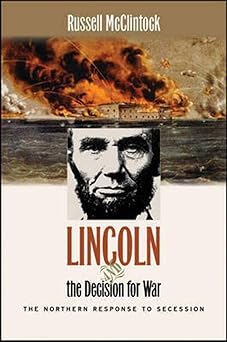
Russell McClintock's Lincoln and the Decision for War

Today is “President’s Day”, a meaningless holiday created by our stupid lords in Congress in order to denigrate George Washington by devaluing the holiday celebrating his birth, February 22nd, by applying that holiday to all presidents, from great to the trashy. This fake holiday also acted to devalue any remembrance of Abraham Lincoln’s birthday on February 12th, as it forced many states that used to celebrate that holiday separately to fold that celebration into today as well.

I don’t accept Congress’s stupid holiday. Instead, I separately try each year to honor both Washington and Lincoln on their actual birthdays, because without these great men the nation of my birth would never have become the great and free and prosperous place it became.

In honor of Lincoln today, I thought I’d post a short review of Russell McClintock’s fine 2008 history, Lincoln and the Decision for War. McClintock took a decidedly different look at the Civil War by focusing not on larger events, but specifically at the time period between the election of Lincoln on November 6, 1860 and the beginning of the Civil War in April 1861.

What many forget with the passage of time is that the Civil War did not start instantly with Lincoln’s victory. For six months furious negotiations took place between politicians from the North and South, with Northern politicians desperately trying to somehow convince the southern states not to secede from the Union. McClintock details those negotiations, including Lincoln’s own efforts in numerous ways to placate the most radical southern states.

You see, as much as Lincoln opposed slavery — and he truly did — he was far more committed to the American Constitution and the nation it had created. If he had to let the issue of slavery take a back burner to saving the Union, he was quite content to do so. More important, as McClintock shows, if the southern states hadn’t seceded and had stayed part of the Union, their power bloc in Congress would have been strong enough to block any anti-slavery action by Lincoln anyway. He really didn’t have sufficient political power in Congress to change anything.

For the South, none of these actual facts about Lincoln mattered. The South had developed Lincoln Derangement Syndrome, and was not going to allow itself to be ruled by Lincoln no matter what, even if that rule was weak and ineffectual. As noted by the Ohio’s radical anti-slavery senator Ben Wade in a speech on the Senate floor on December 17, 1860:
» Read more

American Battlefield Trust – Famous Civil War Photos in 360°

An evening pause: I just finished reading a book of letters written by a soldier who participated in the battle of Antietam, just south of Burnside Bridge. The irony was that Burnside spent more than a day and multiple attempts to capture the bridge, when in fact his troops could have simply walked across the creek at any point, never getting their legs wet above the knee. The soldier was Captain Wolcott Pascal Marsh, and his regiment actually forded the creek further south and advanced farther than almost anyone else in Burnside’s battalion. The book: Letters to a Civil War Bride.

Like all the Civil War battle fields, Antietam is definitely worth visiting.

Hat tip Cotour.

Abraham Lincoln proclaims a day of Thanksgiving in the middle of the Civil War

Abraham Lincoln
Abraham Lincoln

The date was October 3, 1863. The Civil War was at its height, with no end in sight and no clear sign yet of victory for the Union. For all anyone knew, the great American experiment in self-government, freedom, and constitutional law was about to end in failure, with one half of the nation continuing on founded on the idea that it was okay to enslave other human beings, based on their race.

In such a moment, President Abraham Lincoln did what all past leaders in America had done, call for a day of prayer to God for the future while giving thanks for the blessings still abounding. For this purpose he set aside the last Thursday of November of that year.

Since then, Americans have never stopped celebrating Thanksgiving on that day. Today comes another Thanksgiving during a time of chaos, hate, violence, and oppression. There is much to invoke horror and outrage.

There is much more to be thankful for. As much as some have tried to squelch freedom here in America and abroad, all signs say that freedom-lovers everywhere are refusing to go down without a fight. Let us join together to renew that effort, so that “government of the people, by the people, for the people, shall not perish from the earth.”

Below is Lincoln’s Thanksgiving proclamation. If only we had leaders today who could think and write with similar elegance and humility.
—————————–
A Proclamation.

The year that is drawing towards its close, has been filled with the blessings of fruitful fields and healthful skies. To these bounties, which are so constantly enjoyed that we are prone to forget the source from which they come, others have been added, which are of so extraordinary a nature, that they cannot fail to penetrate and soften even the heart which is habitually insensible to the ever watchful providence of Almighty God.
» Read more

Tuesday’s election results

The election results from Tuesday, where Democrats won most of the significant races, has produced a lot of commentary, from both conservatives and liberals, about its significance.

To me, however, these results merely confirmed the increasingly regional nature of today’s partisan politics. This story, about a victory by a Democrat state senator candidate that puts the Democrats in complete control of Washington’s legislature, illustrates this best.

Dhingra’s victory in Washington state over Republican Jinyoung Englund means the West Coast is now the solid center of the resistance, with Democrats controlling legislatures and governorships from Seattle down to San Diego.

The Democratic victories on Tuesday all took place in areas where they strongly dominate (the coasts and urban centers), thus merely solidifying their control over those localized regions. I expect that future elections will show Republicans solidifying their control over their own regions (which is the rest of the country). In other words, people are beginning to choose sides, and we are heading to a regional and political divide that can only be solved in one of two ways: The U.S. splits, or a civil war (in the literal sense) breaks out.

Civil War museum closes rather than remove its Confederate flags

The coming dark age: A Civil War museum is forced to close when Virginia county officials ordered them to remove all Confederate flags.

A Henry County commissioner requested a few months ago that a local Civil War museum remove its Confederate flags.

But without that symbol, the Nash Farm Battlefield and Museum announced that it can’t conduct its mission properly and will close June 1. In a Facebook post, the museum’s directors cited the request by District 2 Commissioner Dee Clemmons that all Confederate flags be removed from the museum, in addition to the gift shop, “in an effort not to offend anyone.”

“To exclude any Confederate flag would mean the historical value has been taken from our exhibits, and a fair interpretation could not be presented to each guest,” the post read. “Confederate flags were on this hallowed ground, as were the Union flags. To remove either of them would be a dishonor.”

In other words, it is better now for people to be ignorant of history so that they might avoid looking at a flag.

Lincoln’s Second Inaugural Address

An evening pause: This recreation attempts to recapture the reality of how Lincoln himself might have said the speech. Listen to the words, however. This is no pandering speech, as we routinely see today. It is hard, muscled, and honest, bluntly recognizing that all, from both sides of the Civil War, must pay for the scourge of slavery.

It is fitting to watch it today, on the anniversary of Lincoln’s assassination.

Hat tip Jim Mallamace.

The story of the writing of the Battle Hymn of the Republic

Some more Civil War history on this July fourth.

The Battle Hymn of the Republic became one of the most popular songs in the North during the Civil War, and was also an important rally song used during the 1950s/1960s civil rights movement. And its central theme is stated by its last stanza:

In the beauty of the lilies
Christ was born across the sea,
With a glory in His bosom
That transfigures you and me;
As He died to make men holy,
Let us die to make men free;
While God is marching on.

That stanza in many ways encompasses much of American history, since many of the original colonies were formed by deeply religious Christians who had made their religion and its moral rules central to their lives. That faith ended up being seeped in much of American culture for the next four hundred years, and guided the country’s actions both in domestic and foreign policy.

Archeologists reap treasures from a newly-discovered POW camp from the Civil War

Archeologists reap treasures from a newly-discovered POW camp from the Civil War.

Camp Lawton’s obscurity helped it remain undisturbed all these years. Built about 50 miles south of Augusta, the Confederate camp imprisoned about 10,000 Union soldiers after it opened in October 1864 to replace the infamous Andersonville prison. But it lasted barely six weeks before Sherman’s army arrived and burned it during his march from Atlanta to Savannah.

Barely a footnote in the war’s history, Camp Lawton was a low priority among scholars. Its exact location was never verified. While known to be near Magnolia Springs State Park, archaeologists figured the camp was too short-lived to yield real historical treasures. That changed last year when Georgia Southern archaeology student Kevin Chapman seized on an offer by the state Department of Natural Resources to pursue his master’s thesis by looking for evidence of Camp Lawton’s stockade walls on the park grounds.