
Doubts about GISS data in the Himalayas
Willis Eschenbach at WattsUpWithThat has once again discovered serious questions about the climate temperature data produced by the Goddard Institute of Space Studies (GISS).
Willis Eschenbach at WattsUpWithThat has once again discovered serious questions about the climate temperature data produced by the Goddard Institute of Space Studies (GISS).
Data from the AIRS instrument on NASA’s Aqua satellite shows the dramatic increase in carbon monoxide in the atmosphere at 18,000 feet over Russia due to the wildfires there. Key quote from press release:
The concentration of carbon monoxide is continuing to grow. According to Aug. 4 NASA estimates, the smoke plume from the fires spans about 3,000 kilometers (1,860 miles) from east to west.
Let’s have some conspiracy silliness. A Russian political scientist is claiming that the U.S. military “is using climate-change weapons to alter the temperatures and crop yields of Russia and other Central Asian countries.”
After a very long winter where the Arctic Oscillation has been deeply negative, setting records and resulting in very cold conditions in the northern hemisphere, the oscillation has finally entered its positive phase in the last month.
Steve Goddard notes the state of ice at the North Pole, both then and now, with pictures.
The Met Office in the United Kingdom has issued a report on the state of the climate. In it they state unequivocally that the “world is warming”. Unfortunately, the report fails to address the questions that have been raised about much of the existing climate data, following the climategate scandal.
It appears that McCarthyism and the blacklist are both alive and well, thriving happily in the field of climate research. Key quote:
It is disturbing, to say the least, that organisations and persons who would be quick to claim professional status consider that it is their current duty to disparage, or to refuse to debate with, or to muzzle scientists whose views on climate change they apparently disagree with.
Read the whole article.
On Saturday (July 24) the American Geophysical Union published a paper in Geophysical Research Letters, entitled “Northern Hemisphere winter snow anomalies: ENSO, NAO and the winter of 2009/10.” This paper attempted to explain the unusually cold 2009-2010 winter, with its record snow falls.
The conclusions of the paper were reasonable, noting that this past winter experienced both an El Nino event in the Pacific as well as a very negative (cold) North Atlantic Oscillation (NAO). To quote the paper’s conclusions: “In winters when an El Nino event and a negative NAO combine, analysis reveal that there are positive snow anomalies across the southern U.S. and northern Europe.”
The authors of the paper made no attempt to explain why these two climate events “combined” this past winter, which in the field of climate change is actually the essential question. What caused it? Moreover, did the deep and extended negative (cold) phase of the Arctic Oscillation (AO) contribute as well, and if so, why did the AO also go negative this winter? And finally, were all these climate events somehow related to the Sun’s unusally long and deep solar minimum?
That they didn’t answer these fundamental questions is not surprising. Climotogists have been struggling with them for decades, and to expect this quickly written paper focused on this one climate event — the cold winter of 2009-2010 — to answer them would be unreasonable. In fact, considering the state of our knowledge, it probably is impossible for any paper to answer these questions at this time.
What makes this particular paper really noteworthy, however, is a quote in its introductory paragraphs:
The wintry winter has encouraged deniers of global warming » Read more
It’s not the crime but the cover-up: Michael Mann refuses to answer reasonable questions from a reporter for The Dailer Caller.
In today’s version of global warming fear-mongering, Senator John Kerry (D-Massachusetts) declared that the Arctic will be ice-free in “five or 10 years.” He apparently based this statement on a 2009 Geophysical Research Letters paper [pdf] that, using computer models, predicted an ice-free Arctic in September could occur as soon as the late 2020s but was more likely in the late 2030s.
Wanna bet? Since that 2009 paper was published, Arctic ice has seen a rebound in ice extent. Moreover, the Arctic oscillation remains in the deepest freeze it has seen in years. And the sun remains quiet, less active than we have seen it since scientists began tracking its behavior from space. Such inactivity means a dimmer sun, which in turn brings with it cold temperatures. Here is the most recent graph (updated on July 20) from the Total Solar Irradiance Time Series produced by Physikalisch- Meteorologisches Observatorium Davos (PMOD) using satellite data since 1978:
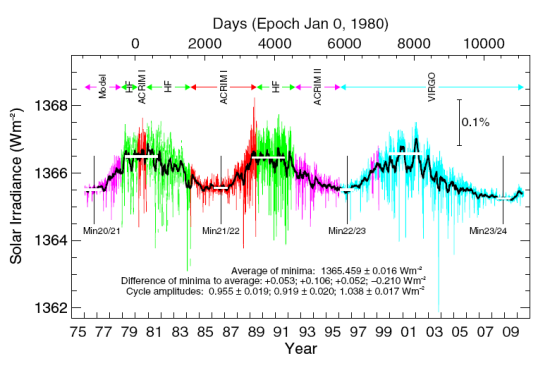
Even though the sun’s total irradiance has shown an up-tick recently as it slowly moves from solar minimum towards solar maximum, if you look closely you will see this up-tick still remains below the lowest points for the previous three solar minimums. And as I have noted here, we appear to be heading for the weakest solar maximum in two centuries.
Of course (as stock brokers say), the past performance of all of these trends is no guarantee of the future performance. Nonetheless, the data indicates clearly the simplistic nature of statements like Kerry’s.