Voyager Technologies and Max Space team up to develop inflatable planetary structures

The station designs as of the end of 2025

The space station startups Voyager Technologies, which is leading the consortium developing Starlab, and Max Space, which is developing its own inflatable Thunderbird station, have now partnered to use their combined talents to develop inflatable planetary structures for habitation and cargo.

In terms of their space stations, they are similar but different. Voyager’s Starlab station will be a single giant module launched on Starship. The consortium building this module had hired the interior decoration company Journey to design the interior, and yesterday showed off a mock-up of that interior.

Max Space’s Thunderbird is an equally large single module but because it uses inflatable technology it will launch on a Falcon 9. The company plans to launch a smaller demo module in ’27 to prove this technology.

Both companies will now use their skills together to begin design work on inflatable habitats that both NASA and SpaceX could use on the planned lunar and Mars colonies.

The phased development path includes ground validation and in-space demonstrations later this decade, with the goal of enabling operational lunar and Mars capabilities aligned with NASA’s exploration timelines. The partnership emphasizes early risk retirement, interoperability and commercial scalability as guiding principles.

In other words, these companies are expanding their business model to sell their products across a wider range of uses. This deal does not change my rankings of the five space stations currently under development, as shown below, but it is an interesting data point that suggests the technology of these space stations can be marketed in many other space-related areas.
» Read more

2 comments

Stephen Sondheim – Someone in a Tree

An evening pause: For my birthday, a repost of a 2010 evening pause of one of my favorite Broadway songs, from Stephen Sondheim’s Pacific Overtures, which I only recently learned was his favorite song as well.

It tells the story of a significant moment in history, the moment when Japan’s leaders signed their first international treaty in 1852 with the United States, but from the point of view of outside witnesses. Its point is profound, that history is not just made by the leaders who sign the deals, but by every individual who makes up the whole of human society.

It’s the fragment, not the day
It’s the pebble, not the stream
It’s the ripple, not the sea
That is happening.
Not the building but the beam
Not the garden but the stone
Only cups of tea
And history
And someone in a tree.

0 comments

French startup The Exploration Company completes first splashdown tests of Nyx capsule prototype

The French cargo capsule startup, The Exploration Company, has successfully completed the first splashdown tests of a smallscate prototype model of its proposed Nyx capsule.

On 5 February, The Exploration Company announced that it had successfully completed a splashdown test campaign at the National Research Council’s Institute of Marine Engineering (CNR-INM) in Rome.

A 1:4-scale mockup of Nyx, with a mass of around 135 kilograms, was built for the test campaign by Poli Model, a small Turin-based model builder. For reference, the full-scale capsule will be 4 metres wide and stand at 7 metres tall. The subscale model’s exterior was fitted with pressure sensors, accelerometers, and a gyroscope.

The tests were conducted in the CNR-INM facility’s Umberto Pugliese towing tank, a 470-metre-long pool measuring 13.5 metres across and 6.5 metres deep. Between 13 and 28 January, a total of 20 drops were conducted at varying heights and speeds in calm water, which the company explained maximised repeatability.

The company hopes to fly a fullscale demo mission to ISS in 2028, and wants to upgrade Nyx to manned capabilities in the 2030s.

2 comments

Israeli weather satellite startup raises $175 million in investment capital

An Israeli weather satellite startup, dubbed Tomorrow.io, has now raised $175 million in investment capital to build an AI-driven constellation of satellites to supplement the smallsat constellation it has already launched.

This financing builds on a proven foundation of execution. Tomorrow.io has completed the full deployment of its first satellite constellation, having launched 13 satellites to space, achieving 60-minute global revisit, while scaling an AI-driven intelligence platform now embedded across critical industries. DeepSky extends this foundation into the next phase of the company’s roadmap, supporting continued commercial growth, expanding data coverage, and unlocking new high-frequency sensing capabilities.

I find amusing this new desire to label all computer programming “AI”, when in many cases it is simply the same software slightly upgraded that these companies have been using for years.

Nonetheless, this story signals the continuing transition in the weather satellite industry from the government/Soviet-style model, where all weather satellites are built and operated by governments, to the capitalism model, where governments and industry buy weather data from privately built, launched, and maintained commercial constellations.

2 comments

German rocket startup Isar Aerospace opens new rocket testing facility at Esrange spaceport

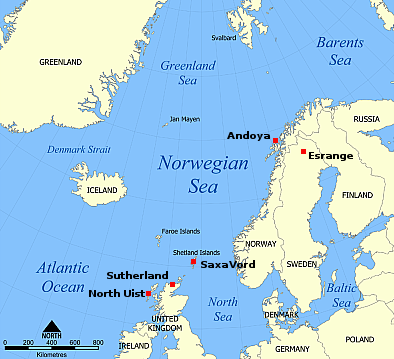
Proposed or active spaceports in North Europe

Though the German rocket startup Isar Aerospace is using Norway’s Andoya spaceport to launch its Spectrum rocket, it is now expanding significantly its testing facilities at Sweden’s Esrange spaceport to the east.

European space company Isar Aerospace is significantly expanding their testing operations with SSC Space at Esrange Space Center in Sweden, opening a second test site to support the development and production of its ‘Spectrum’ rocket. The new facility will enable testing of 30+ engines per month, along with expanded integrated stage testing capabilities, increasing testing capacity and enabling faster development.

Launching from Esrange is a problem because of its interior location, but testing engines there, close to Germany and the Andoya spaceport makes great sense.

Isar had hoped to make its second attempt to complete the first orbital launch of Spectrum in January, but postponed the launch until March to deal with a valve issue.

Hat tip to BtB’s stringer Jay.

0 comments

Midnight repost: Truth, Justice, and the American Way

Tonight Diane and I decided to watch again the 1978 Richard Donner movie, Superman. The overall film is lighthearted entertainment that captures the myth of this super-hero perfectly. However, it has two scenes that remain among the best moments in movie history (which you can watch here and here). The first captures the myth in every way. The second shows us that Superman truly stood for the best in America.

In watching the movie tonight again and reliving the myth I grew up with — that great things are possible if you believe and follow sincerely Superman’s motto of “truth, justice, and the American way” — I decided to repost my essay from 2020 where I attempted to explain what that motto really meant.

Enjoy!
———————

The heroic Superman as envisioned in the 1950s
George Reeves as the heroic Superman as envisioned
in the 1950s television show, emulated later by Richard
Donner in his 1978 movie. Click for show’s opening credits.

Truth, Justice, and the American Way

The words spoken during the opening credits of a 1950s children’s television show:

Faster than a speeding bullet.
More powerful than a locomotive.
Able to leap tall buildings in a single bound.
Look up in the sky!
It’s a bird.
It’s a plane.
It’s Superman!

Yes, it’s Superman, strange visitor from another planet who came to Earth with powers and abilities far beyond those of mortal men.

Superman, who can change the course of mighty rivers, bend steel in his bare hands, and who, disguised as Clark Kent, mild-mannered reporter for a great metropolitan newspaper, fights a never-ending battle for truth, justice, and the American Way.

That television show was obviously Superman, starring George Reeves, and these opening words expressed the mythology and basic ideals by which this most popular of all comic-book super-heroes lived.

I grew up with those words. They had been bequeathed to me by the American generation that had fought and won World War II against the genocidal Nazis, and expressed the fundamental ideals of that generation.

Much of the meaning of these fundamental ideals is outright and clear.
» Read more

12 comments

SpaceX wants revisions to federal rural grant program that has awarded it $733 million

SpaceX is presently asking for changes in the Broadband Equity Access and Deployment (BEAD) program that awards grants to companies that provide internet in rural areas and has already awarded the company $733 million in grants.

BEAD was part of the Biden administration’s bipartisan infrastructure act – originally a $42 billion program to bring broadband internet to areas of the country with little or no broadband access. The Trump administration eliminated other infrastructure act programs, and cut BEAD outlays to $21 billion, along with rule changes to allow satellite providers.

SpaceX applied for BEAD funds in 2025. The company won $733 million worth of BEAD projects nationwide, including $109 million in Texas.

Initially the Biden administration awarded SpaceX almost a billion dollar grant, because its Starlink constellation was the only broadband outlet actually doing the job. Then Musk began to campaign for Republicans, and suddenly the Biden administration pulled that grant, saying absurdly that SpaceX was failing to provide its service to rural areas, when that was exactly what it was doing.

Now SpaceX wants BEAD to ease some of its requirements, and wants these grant funds upfront.

I say, this whole BEAD program is a waste of taxpayer money and a perfect example of crony capitalism. I’m glad Trump cut it in half, but that wasn’t good enough. It should be shut down entirely. SpaceX doesn’t need this handout. It is making money hand-over-fist on its own.

14 comments

Commercial changes at France’s French Guiana spaceport

French Guiana spaceport
The French Guiana spaceport. The Diamant launchsite is labeled “B.”
Click for full resolution image. (Note: The Ariane-5 pad is now the
Ariane-6 pad.)

Once France’s space agency CNES regained control of its spaceport in French Guiana several years ago from the European Space Agency’s (ESA) commercial pseudo-company Arianespace, it has moved aggressively to make that spaceport attractive to the new European rocket startups.

Beginning in 2022, it began to sign deals with every one of those rocket startups to allow them to establish launch facilities at the spaceport using several long abandoned pads, including the French Diamant rocket site not used for decades as well as the Soyuz launch site unused due to Russia’s invasion of the Ukraine.

CNES decided to standardize Diamant for multiple rocket companies, while leasing the Soyuz site to one.

In a news story today, it appears the startup MaiaSpace, a wholly owned subsidiary of the much larger aerospace company ArianeGroupk, has shifted its launch plans at French Guiana. Initially it was going to launch its rocket from the Diamant pad. In 2024 however it won the contract to use the Soyuz pad, and it has now withdrawn its plans to use Diamant entirely.

CNES has therefore put out a call to the European rocket industry to fill this slot at Diamant. At present Isar Aerospace, PLD Space, Rocket Factory Augsburg, and Latitude have agreements to use Diamant, though only Latitude and PLD had done any development work on their facilities there.

As far as I know, these companies comprise the entire cadre of new European rocket startups, so I don’t know what other users CNES hopes to find. Furthermore, CNES had wanted to standardize the launch site for everyone, and the companies had balked at that idea. PLD got a deal to use its own pad at Diamant. I suspect the reason Isar and Rocket Factory have done little there is because they want their own facilities as well.

Either way, French Guiana is moving the direction of supporting competitive commercial operations, and that is a very good thing.

4 comments

Judy Garland -Trolley Song

An evening pause: From the 1944 film, Meet me in St. Louis. I posted this in July 2010 as one of the very first evening pauses. As I wrote then, “The last line of the song says it all, about life and love.”

Hat tip to Judd Clark, who suggested it, which convinced me it was time to post it again.

1 comment

Falcon 9 upper stage has issue preventing de-orbit burn; SpaceX pauses launches

According to a SpaceX tweet yesterday afternoon, the upper stage of the Falcon 9 rocket that successfully launched 25 Starlink satellites “experienced an off-nominal condition” when it was preparing to do its final de-orbit engine burn.

During today’s Falcon 9 launch of @Starlink satellites, the second stage experienced an off-nominal condition during preparation for the deorbit burn. The vehicle then performed as designed to successfully passivate the stage. The first two MVac burns were nominal and safely deployed all 25 Starlink satellites to their intended orbit.

Teams are reviewing data to determine root cause and corrective actions before returning to flight

It appears that SpaceX has temporarily paused its launch schedule while it reviews this incident, shifting a launch that was supposed to occur last night back three days to February 5th. While the launch itself was successful, the company likely wants to get a handle on what went wrong before resuming launches.

0 comments

Musk: I have merged xAI with SpaceX

Elon Musk today announced that he has merged the company xAI (which includes X) with SpaceX, because in his mind the needs of the two companies interlace perfectly.

The requirement to launch thousands of satellites to orbit became a forcing function for the Falcon program, driving recursive improvements to reach the unprecedented flight rates necessary to make space-based internet a reality. This year, Starship will begin delivering the much more powerful V3 Starlink satellites to orbit, with each launch adding more than 20 times the capacity to the constellation as the current Falcon launches of the V2 Starlink satellites. Starship will also launch the next generation of direct-to-mobile satellites, which will deliver full cellular coverage everywhere on Earth.

While the need to launch these satellites will act as a similar forcing function to drive Starship improvements and launch rates, the sheer number of satellites that will be needed for space-based data centers will push Starship to even greater heights. With launches every hour carrying 200 tons per flight, Starship will deliver millions of tons to orbit and beyond per year, enabling an exciting future where humanity is out exploring amongst the stars.

The basic math is that launching a million tons per year of satellites generating 100 kW of compute power per ton would add 100 gigawatts of AI compute capacity annually, with no ongoing operational or maintenance needs. Ultimately, there is a path to launching 1 TW/year from Earth.

My estimate is that within 2 to 3 years, the lowest cost way to generate AI compute will be in space. This cost-efficiency alone will enable innovative companies to forge ahead in training their AI models and processing data at unprecedented speeds and scales, accelerating breakthroughs in our understanding of physics and invention of technologies to benefit humanity.

Many sources online are speculating that this new merged company will make the company’s initial public offering (IPO) now rumored for this summer even more sky high. I remain puzzled however why Musk would want to do it, and this merger today illustrates why. He controls both SpaceX and xAI completely, as both are privately owned. He didn’t need to convince government regulators of anything. Once the company is public, with publicly traded stock, that will change. He will no longer have such freedom of action.

16 comments
1 26 27 28 29 30 897