
New Shepard makes its first test flight
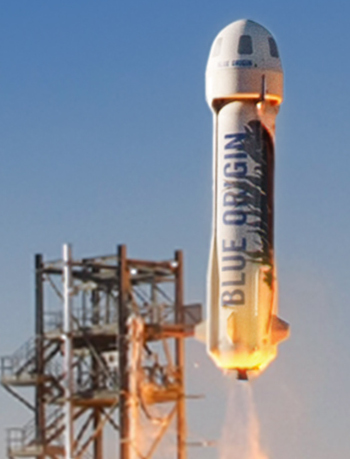
New Shepard launch

The competition heats up: Blue Origin completed on Wednesday its first test flight of its reusable suborbital spacecraft, New Shepard.

After reaching an altitude of 307,000 feet, or 58 miles, the capsule successfully separated from its first stage, what they call the propulsion module, and safely parachuted back to Earth. The first stage, designed to also be recoverable, was not recovered successfully. According to Jeff Bezos’s explanation, they “lost pressure in our hydraulic system” and that they were trying to land it vertically, like SpaceX’s Falcon 9 first stage.

The cropped image on the right of the full resolution image, gives us a close-up of the capsule and propulsion module. The small fins on the propulsion module suggest the capability for a vertical landing, but it is unclear from the image whether the module has legs, though other images and videos strongly suggest there are legs on this module.

The flight itself, getting above 50 miles, reached space according to most definitions. In fact, Blue Origin with this flight has accomplished what Virgin Galactic has been promising to do for more than a decade, a suborbital test flight of its spacecraft. Blue Origin’s flight was unmanned, but it demonstrated that their design works. They will of course have to re-fly the capsule as well as land that first stage successfully to prove the design’s re-usability, but this flight shows that they are off to a very good start. And their webpage clearly shows that they are almost ready to start selling tickets for suborbital flights.

The most significant success of this launch, however, is the performance of the BE-3 rocket engine. Blue Origin has convinced ULA to hire it to build the engines for its new Vulcan rocket. This success justifies that decision.

I have embedded their videos of the full flight below the fold.
» Read more

3 comments

Next Falcon 9 launch set for Monday

The competition heats up: The next commercial Falcon 9 launch is now set for tonight, Monday, less than two weeks after the last Falcon 9 launch.

The next two weeks will be especially busy for SpaceX, as they also have scheduled the first launch abort test of Dragon on May 5. The launch will also be the fifth for Falcon 9 this year, putting it in the lead as the busiest rocket in the world for 2015, ahead of the Russian Soyuz.

0 comments

Russians cancel effort to fly humans from Vostochny by 2019

The heat of competition? In order to meet a government deadline to launch humans from their new spaceport at Vostochny, the Russians had planned, though now cancelled, a single manned launch there in 2019, using a new rocket.

Their cancelled plans had included two prior test flights of the rocket with Progress freighters.

If cargo missions were successful, the one brave crew would ride into orbit from the new spaceport, knowing that in case of a serious problem with the rocket, the descent module of the spacecraft would parachute into deep forest of the Russian Far East or somewhere in the Pacific.

After “satisfying” this political goal with a single crew, all manned Soyuz and cargo Progress missions would then revert back to Baikonur for a safe ascent trajectory. The Soyuz spacecraft would continue flying two missions annually from Baikonur, until the veteran spacecraft’s final launch in 2025. In 2021, Soyuz spacecraft missions originating from Baikonur would switch from Soyuz-FG to Soyuz-2-1a rocket.

The Russians have now decided, rather than rush this first flight on the new rocket, to hold to the slower schedule.

This story is important to the United States. I think we must definitely end our dependence on the Russians before they make the switch to the new rocket. Based on the levels of poor quality control and corruption seen recently in Russia, I have grave doubts the new rocket will fly reliably at first. It would be a mistake to buy its use to put Americans in space.

0 comments

Seven big failed environmentalist predictions

Link here.

Like the author, I remember every single one of these doomsday predictions. I also remember how every single one of these predictions was wildly wrong. Until these fear-mongers can reliably predict things, I see no reason to believe them.

His article however does provide one entertaining tidbit:

You know how old I am? I’m so positively ancient that I remember when one of Jimmy Carter’s big answers to the impending shortage of oil was to increase federal funding for research on how to extract oil from shale. It ended the way you would expect: it went nowhere. But some decades later, private oil companies did find a way to more economically extract oil from shale—and environmentalists promptly made it public enemy #1.

All true. And just one more example of how the government fails at something while private enterprise, fueled by the profit motive, finds a way to make that exact same thing happen.

3 comments

Aerojet Rocketdyne faces the possible loss of most of its business

In the heat of competition: Because of a combination of increased competition, launch failures, political decisions, and quality control questions, the rocket company Aerojet Rocketdyne could lose almost all of its rocket customers in the next few years.

Link fixed! (Once again caused by trying to post while sitting in the passenger seat of the car and typing on a tiny tablet.)

3 comments

New Shepard test flights to begin within weeks

The competition heats up: Blue Origin is expected to begin regular test flights of its suborbital resusable manned spacecraft, New Shepard, within mere weeks.

This news came from a government FAA official involved in approving flight permits. The company itself has declined to comment.

Even if it is a few months rather than weeks, these flight tests will put more pressure on Virgin Galactic in the race to become the first commercial suborbital tourism company to sell and actually fly a passenger. And if I had to bet who’d win the race, I would no longer put my money on Virgin Galactic.

6 comments

NASA ISS cargo contracts delayed

The competition heats up: NASA has delayed, for the second time, when it will award its next round of cargo contracts to ISS, pushing the date back from June to September.

Though agency officials said they could not reveal why they had delayed the contract awards, they did say it was to gather more information. My guess is that the agency wants to see how SpaceX’s launch abort tests turn out this year before it makes a decision. If successful, they will then have the option of dropping SpaceX’s as a cargo carrier and pick someone else, possibly Dream Chaser, to provide up and down service to ISS. That way, they would increase the number of vehicles capable of bringing people and supplies up to ISS.

Delaying the award decision until September gives them time to evaluate the abort tests results, as well as give them a cushion in case those tests get delayed somewhat.

6 comments

Japan to the moon!

The competition heats up: Japan’s space agency has announced plans to send an unmanned lander to the Moon, as early as 2018, as part of a longer range plan to explore Mars.

They also intend to use their new Epsilon rocket to launch it.

Gee, I wonder if the successful efforts of India and China to send probes to both the Moon and Mars had some influence on this decision.

1 comment
1 442 443 444 445 446 540