NASA budget compromise

Congress has come up with a NASA budget compromise. More details here.

Overall, the NASA budget is cut by about a half billion dollars, the total matching what the agency got in 2009. The key figures are $406 million for commercial manned space, $3 billion for NASA’s in-house heavy-lift rocket and capsule, and $529 million to finish the Webb telescope.

I predict that the $3 billion will be a waste of money, the project getting cancelled before completion.

1 comment

NASA, the federal budget, and common sense

Let’s be blunt: the federal government is broke. With deficits running in the billions per day, there simply is no spare cash for any program, no matter how important or necessary. Nothing is sacrosanct. Even a proposal to cure cancer should be carefully reviewed before it gets federal funding.

Everything has got to be on the table.

Thus, no one should have been surprised when word leaked two weeks ago that the Office of Management and Budget in the Obama administration was proposing cutting the entire unmanned planetary program at NASA, while simultaneously eviscerating the space agency’s astronomy program. No more missions to Mars. No probes to Europa or Titan. Further and longer delays before the James Webb Space Telescope is completed. And Kepler’s mission to find Earth Like planets orbiting other stars would end mid-mission.

The Obama administration has to find ways to trim the budget, and apparently it is considering eliminating these programs as a way to do it.

Yet, the money spent on space astronomy and planetary research is a pinprick. Considering that the federal government overspends its budget by approximately $3.5 billion per day, and the total amount of money spent on these two science programs equals about $2.4 billion per year, it seems senseless at first to focus on these kinds of cuts. Quite clearly, even eliminating them entirely will not put the federal budget into the black.

Now I am not one to say, “Cut the budget, but please leave my favorite programs alone!” I recognize the serious financial state of the nation, and realize that any budget suggestions I make must include significant total cuts to NASA’s budget.

As a space historian and science journalist who knows a great deal about NASA, however, I also know that there is plenty of room for cuts in NASA’s budget. By picking our priorities carefully at a time when our options are limited, NASA might even be able to accomplish more, not less, with a smaller budget.

Moreover, if I, as a space junky, think it is possible to continue NASA’s most important programs and still trim its budget by 15% to 20%, in real dollars, doesn’t that suggest that the same could be done across the entire federal government?

All it takes is a little knowledge, some common sense, and the courage to say no.
» Read more

1 comment

NASA moves first flight test of Orion capsule up three years to 2014

NASA has moved the scheduled first flight test of the Orion capsule up three years to 2014.

This action, while good, was almost certainly triggered by the competition from the private space companies. The managers at NASA are finally realizing that if they don’t speed up deployment of their own spacecraft, they will certainly lose in the competition for government dollars. That they will have to use another rocket other than their heavy-lift vehicle for this launch, however, will not help that particular project’s lobbying effort.

Either way, I think this action is only further proof that the more competition we have, the quicker we will get into space. And the journey will cost less too, not only because it will take less time and therefore less money, but the competition between companies (or NASA) will force everyone — including NASA — to lower costs to show they can do it better.

2 comments

A breathtaking view of the Apollo 15 landing site

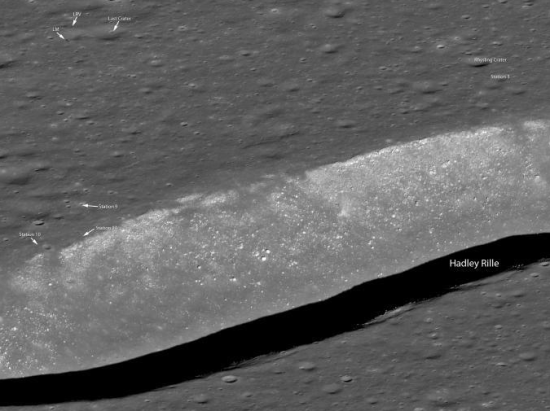
The Lunar Reconnaissance Orbiter team has released a wide angle side view image of the Apollo 15 landing site, showing the lunar module and the areas around Hadley Rille and the Apennine Mountain range that the astronauts explored using their lunar jeep. Below is a cropped close-up, showing the landing site near the top of the image with Hadley Rille near the bottom. Below the fold is a second image showing a wider view that includes the Apennine mountain slope that the astronauts drove their rover up.

Close up of Hadley Rille and Apollo 15 landing site

» Read more

0 comments

An inside look at NASA bureaucratic madness

An inside look at NASA’s bureaucratic madness.

Much of the time NASA appears to be a loose confederation of 10 quasi independent fiefdoms, each pretty much in charge of their own business. People often ask me what would I do if I were king of NASA for a day. They expect me to say something like: build this rocket, launch that satellite. Rather I think how I would standardize the procurement processes, or the human resources procedures, or the engineering standards used across the agency. But then I always was a dreamer, tilting at impossible windmills. Launching rockets is easy; getting engineers to agree on standards is hard.

And people wonder why I strongly oppose NASA’s heavy-lift rocket (which I think will never get built), or worry that NASA’s interference will choke to death the new independent commercial space companies.

1 comment

Herman Cain speaks out about NASA and space

Herman Cain speaks out about NASA and space:

When President Obama decided to cut, it put the United States in a position that we don’t like. We don’t like to have to thumb-ride with the Russians when we were the first ones and the leaders in space technology. It’s not just about getting to the moon and outer space. The space program inspires other technological advances to business and the economy. In the Cain presidency, it will be reversed back to where it should be.

As much as I might like Cain for some things, I could not help cringing when I read these words. They suggest a great deal of ignorance about what the Obama administration has done, a willingness on Cain’s part to pander to his audience (speaking as he was at the U.S. Space & Rocket Center in Huntsville), and a desire by this self-declared fiscal conservative to spend lots more money for a big government space program at a time when the federal government is broke.

I’d rather have Cain take a more thoughtful approach. Alas, this is a campaign. Moreover, whoever ends up as president after this election will probably be less important than the make-up of the next Congress. It is that part of the 2012 election that really counts.

10 comments
1 868 869 870 871 872 896