
America’s Iron Giants
An evening pause: Technology developed with slide rules and the English system of measurements, more than half a century ago, that still works today.
Hat tip Tom Biggar.
An evening pause: Technology developed with slide rules and the English system of measurements, more than half a century ago, that still works today.
Hat tip Tom Biggar.
The new colonial movement: Japan revealed yesterday that it plans to send unmanned probe to Mars’ moon Phobos, using the basic designs developed for the asteroid mission Hayabusa-2.
Like Hayabusa-2, they will attempt to grab a sample from Phobos, and will launch in September 2024, returning its sample in 2029.
The new colonial movement: China is now targeting mid-April for the maiden launch of its Long March 5B rocket, which will place in orbit China’s new manned capsule on its first unmanned demo flight.
The article at the link, from China’s normally reticent state-run press, actually provides a great deal of information. First, it outlines the launch schedule for their space station, using the Long March 5B rocket:
China aims to complete construction of the space station around 2022. According to the CMSA, more than 10 missions are planned in the next three years to complete the construction and master technologies for in-orbit assembly and construction of large complex spacecraft, long-term manned spaceflight in near-Earth space and large-scale space science experiments.
…The space station will be a T shape with the Tianhe core module at the center and a lab capsule on each side. The core module — at 16.6 meters long and 4.2 meters in diameter, with a takeoff weight of 22.5 tonnes — will be the management and control center.
Second, the article confirms that the Long March 5B rocket will be used to launch all of China’s manned missions. This means they are dependent on their biggest and possibly most expensive rocket to make things happen, suggesting that either they will have to go slow or they have made a very big commitment to space. The quote above suggests the latter.
Third, the article reveals that their new manned capsule, which will weigh almost as much as a single station module on either their station or ISS, will be capable of carrying six astronauts, and that the descent module is designed to be reusable.
Finally, they confirm once again that they will also be launching “a large optical telescope” that will fly in formation with their space station. An earlier news article indicated that this telescope would have a mirror 12 meters in diameter, which would be five times bigger than the mirror on the Hubble Space Telescope. That same article however also noted major design issues.
Overall, it appears China is about to step out as a major space power, with capabilities that in many ways will exceed anything from either the U.S. or Russia.
Capitalism in space: SpaceX has begun the assembly in Boca Chica of its next Starship test prototype, with a targeted launch date in April.
That first test flight is expected to be a 12-mile-high hop, using three Raptor engines.
Do not be surprised if that launch is delays by a few months. At the same time, do not be surprised if it occurs before the summer.
Today both China and Russia successfully placed satellites into orbit. China’s Long March 2D rocket placed four “technology test” satellites into orbit, while Russia used its Soyuz-2 rocket to launch a military communications satellite.
The leaders in the 2020 launch race:
4 China
3 SpaceX
2 Arianespace (Europe)
2 Russia
The U.S. continues to lead China 6 to 4 in the national rankings.
Arianespace’s Ariane 5 rocket today successfully launched a Japanese communications satellite and a South Korean landsat satellite.
The standings in the 2020 launch race:
3 China
3 SpaceX
2 Arianespace (Europe)
1 Rocket Lab
1 Russia
1 Japan
1 ULA
1 Northrop Grumman
The U.S. continues to lead China 6 to 3 in the national rankings.
Capitalism in space: SpaceX has signed a deal with the space tourism company Space Adventures to fly four tourists on a single crew Dragon flight.
The private spaceflight company founded by billionaire Elon Musk has signed an agreement with the U.S. space tourism company Space Adventures to launch up to four passengers on an orbital trip aboard a Crew Dragon space capsule. The mission would last up to five days and could launch as early as late 2021, Space Adventures representatives told Space.com.
The trip will not go to ISS, but remain free-flying in orbit.
Essentially, Space Adventures, which flew all its previous space tourists on Russian Soyuz capsules and has two more such flights scheduled in 2021 to ISS, is now adding the American company SpaceX to its staple. This gives them two places they can buy flights, which gives them some bargaining room to get prices down.
This is exactly what I hoped would happen if NASA stopped building spacecraft and instead bought its rides from privately built and owned capsules. Owned by SpaceX and built for profit, crew Dragon is not limited to only serving NASA’s needs. They can sell it to others to make more money. Here they are doing so.
I also would not be surprised if SpaceX reuses the Dragon capsules used on NASA flights for these tourist flights. NASA doesn’t want reused capsules, yet, so SpaceX will be accumulating once-used capsules capable of flying again. I bet they will use them here.
Capitalism in space: Blue Origin yesterday cut the ribbon on its main rocket engine factory in Huntsville, Alabama, while also announcing that production of their BE-4 engine for both ULA’s new Vulcan rocket and their own New Glenn rocket will begin in a few months.
In the meantime, made-in-Kent engines are being tested at Blue Origin’s West Texas site. Smith said two flight readiness engines will be delivered in May to United Launch Alliance. They’ll be used for integrated tests of ULA’s Vulcan first-stage booster, which is taking shape not far from Huntsville in Decatur, Ala.
This is excellent news. For the past year and a half the company has released little information about their progress with the BE-4 engine, suggesting that they might be experiencing issues. Yesterday’s news bursts that pessimistic balloon, indicating that both the Vulcan and New Glenn rockets will be flying, maybe as soon as next year.
The new colonial movement: Engineers have reactivated China’s Chang’e-4 lander and Yutu-2 rover for their 15th lunar day on the far side of the Moon.
As usual, the story in China’s state-run press reveals little. This time however it does mention that Yutu-2 will continue traveling to the west, first to the northwest and then to the southwest.
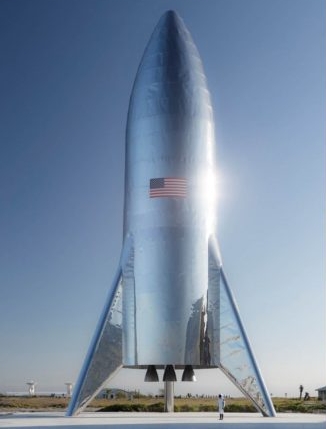
SpaceX’s first Starship prototype
Capitalism in space: Today’s launch by SpaceX of another sixty Starlink satellites in its planned constellation of thousands of satellites, designed to provide worldwide internet access, was significant in a way that is actually not obvious at first glance. To understand its significance, it is necessary to look at the launch in a wider context.
Below is the list of launches that have so far occurred in 2020. I keep track of this, and post an update here on Behind the Black after each new launch:
3 China
3 SpaceX
1 Arianespace (Europe)
1 Rocket Lab
1 Russia
1 Japan
1 ULA
1 Northrop Grumman
Notice anything? While the launches of every other nation in the world are centralized under one rocket company or agency, the United States has many different and independent companies competing for this business. Right now the U.S. has four different companies on this list, with one (SpaceX) now tied after today’s launch with China for the overall lead, and three (Rocket Lab, ULA, and Northrop Grumman) tied with Europe, Russia, and Japan for second place.
Only in America can you have individual private rocket companies competing head-to-head with whole nations, and beating them. (Some might argue that China’s rocket industry is also made up of competing companies, but that is a lie. While those companies might function somewhat independently, they are all under the strict supervision of the central communist government. They are not functioning as free and privately-owned companies.)
Nor is this pattern seen only in the launch market. Among airline companies it has been the norm since the beginnings of cheap passenger flight after World War II. While most other nations have a single national airline (British Airways, Aeroflot, El Al, Air Canada, Korean Air, Saudi Arabian Airlines, to name a few), the U.S. has a plethora of competing independent companies, with many flying many more passengers than these national airlines, sometimes even to their own countries.
How is this possible? Why does the U.S. so often dominate so many industries in this way?
» Read more
Capitalism in space: SpaceX this morning successfully launched sixty more Starlink satellites, raising the number in the constellation to 300.
However, though the launch was successful, the first stage, on its fourth flight, failed to land successfully on the drone ship in the Atlantic. Watching the live stream, it appeared from a whiff of smoke on the edge of the screen that the booster missed the target by only a short distance. This is the first time this has happened since 2015 2018 (correction from reader).
That this first stage landing failure is the news story illustrates how far they have come..
The standings in the 2020 launch race:
3 China
3 SpaceX
1 Arianespace (Europe)
1 Rocket Lab
1 Russia
1 Japan
1 ULA
1 Northrop Grumman
In the national rankings the U.S. now leads China 6 to 3.
Capitalism in space: Northrop Grumman’s Antares rocket today successfully launched it Cygnus unmanned cargo capsule on a supply mission to ISS.
This was Northrop Grumman’s first flight in 2020. The standings in the 2020 launch race:
3 China
2 SpaceX
1 Arianespace (Europe)
1 Rocket Lab
1 Russia
1 Japan
1 ULA
1 Northrop Grumman
The U.S. now leads China 5 to 3 in the national rankings. The U.S. will likely add to that lead with the planned SpaceX launch of another 60 Starlink satellites Monday.
Capitalism in space: NASA has awarded Rocket Lab the contract to launch the privately-built, for NASA, lunar orbiting cubesat CAPSTONE, designed to test technologies and the orbital mechanics required to build its Gateway lunar space station.
This quote says it all:
The firm-fixed-price launch contract is valued at $9.95 million. In September, NASA awarded a $13.7 million contract to Advanced Space of Boulder, Colorado, to develop and operate the CubeSat.
Using two different private companies, one to build the satellite and the other to launch it, NASA will get a lunar orbiter for just over $23 million. That total equals the rounding error for almost all NASA-built projects.
The launch is set for early 2021.
Capitalism in space: The rocket engine startup Rocket Crafters experienced what the company called “an anomaly” during an engine test yesterday, requiring the local fire department to put out brush fires surrounding the test site.
The company is trying to use 3D printing to build its engines, but appears to have had a string of engine failures, none quite so spectacular, during previous tests.
According to an earlier post about Rocket Crafters in 2018, they had hoped to launch a rocket in 2020. It does not appear they will. Moreover, they are testing the use of hybrid fuels in a somewhat radical design.
[T]he rocket fuel consisted of plastic tubes made from the same base materials as Legos, measuring two feet long and weighing about five pounds, that were stacked on shelves and safe to touch. Combined with nitrous oxide — commonly known as “laughing gas” — the small-scale test engine on Monday generated about 200 pounds of thrust firing at half-power.
They are not the first to try hybrids and have issues. Virgin Galactic has tried it to, and suffered probably a decade delay in development and a spaceship that does not have as much thrust as they would like.
Capitalism in space: In what appears to be preparation for the final tests before beginning commercial flights, Virgin Galactic yesterday used its carrier airplane WhiteKnightTwo to transport SpaceShipTwo Unity to New Mexico.
The relocation of VSS Unity to Spaceport America enables the Company to engage in the final stages of its flight test program. This will begin with a number of initial captive carry and glide flights from the new operating base in New Mexico, allowing the spaceflight operations team to familiarize themselves with the airspace and ground control. Once these tests are complete, the team will carry out a number of rocket-powered test flights from Spaceport America to continue the evaluation of VSS Unity’s performance. During this phase, the final spaceship cabin and customer experience evaluations will also be concluded in preparation for the start of commercial spaceflight operations.
They are aiming for a July 18, 2020 first flight, carrying Richard Branson on his 70th birthday. Whether they can meet that date remains open. Based on the company’s track record, don’t bet on it.
Capitalism in space: SpaceX yesterday shipped to Florida the Dragon capsule it will use for its first manned mission, now set for sometime between April and June.
No official word yet on any specific launch date, though there are reports that they are targeting May 7.
In that same story at the second link a NASA official admitted that one of the big issues is filling out the paperwork.
“Even though it sounds mundane, there is a load of paper that has to be verified, and signed off, and checked to make sure we’ve got everything closed out,” [said chief of human spaceflight Doug Loverro.] “It is probably one of the longest things in the tent to go ahead and do. It’s underappreciated but critically important. You’ve got to make sure you’ve done everything you need to do along the way.”
Properly documenting what you are doing is always essential, but if you over do it you raise costs unnecessarily while simultaneously delaying things. And isn’t it interesting that both of these issues — budget overruns and scheduling delays — have been systemic on all of NASA’s projects for decades?
Furthermore, while good documentation can help prevent problems and help you figure out what went wrong, when things go wrong, doing more of it will not further reduce problems or failures. If anything, too much paperwork will likely increase mistakes by focusing workers on the wrong things. This seems to be one of NASA’s problems in recent years.
Regardless, it does look like that first privately built launch will happen in mere months. The one decision remaining that could legitimately delay it would be if NASA decides to make it a longer mission, requiring more training for its astronauts.
SpaceX has hired NASA’s former manager of its human exploration program, Bill Gerstenmaier, as a consultant working with their “reliability team.”.
It appears that SpaceX wants to take advantage of Gerstenmaier’s expertise on human spaceflight as it is about to begin manned Dragon flights. It also appears that Musk wants to return a favor as well, as Gerstenmaier was likely the main person behind the decision to award SpaceX its initial Dragon cargo contract in December 2008. Musk has said repeatedly that this decision in many ways saved his company.
Overall, a wise decision by SpaceX. In his later years at NASA, Gerstenmaier lost sight of the importance of budget and schedule in his management of SLS and Orion, leading to his ouster. However, his knowledge of human spaceflight and the political mechanics needed to do it with NASA is unsurpassed. SpaceX will definitely benefit from this hire.
Capitalism in space: ULA tonight successfully launched a new solar science spacecraft Solar Orbiter.
For more information about Solar Orbiter, which will take the first high resolution images of the Sun’s poles, see the link above or video I’ve embedded below the fold.
Earlier today Northrop Grumman aborted the launch of its Cygnus cargo freighter to ISS only three minutes before launch because of an issue with a ground support sensor. Right now they are are targeting a new launch date of February 13, 2020.
The status in the 2020 launch race:
3 China
2 SpaceX
1 Arianespace (Europe)
1 Rocket Lab
1 Russia
1 Japan
1 ULA
In the national ranking, the U.S. now leads China 4-3. If Northrop Grumman had launched, that lead would have been 5-3, and the U.S. total would have been comprised of four different and completely independent competing launch companies, all capable of topping the efforts of entire nations. If that doesn’t illustrate the power of freedom, capitalism, competition, and private ownership, I don’t know what does. Moreover, this is only the start. The U.S. right now has numerous other new launch companies rushing to join the competition.
Even more startling, the way we do things is freely available to every other nation in the world. All they have to do is to embrace freedom and the reduction of control and power by their governments. Sadly, very few in these times are willing to do this. In fact, even the U.S. resisted this concept for the entire last half of the 20th century. Only in the past decade have we returned to our roots, and that decision is now beginning to bear abundant fruit.
» Read more
Iran today attempted and failed to launch a small technology text cubesat into orbit.
This continues a string of launch failures with their Simorgh rocket, numbering four, since their last successful orbital launch in 2015 using their smaller Safir ballistic missile.
Link here. The focus when discussing the epidemic, which continues to grow, should certainly not be on how it is slowing China’s space industry. At the same time, any slow down in their space effort will give us a good indicator on how the virus is effecting their entire economy.
Anyway, it appears, at least as this moment, that the biggest effect in space is the halt of operations for the Kuaizhou smallsat rocket.
Expace, a launch service provider for solid-propellant Kuaizhou rockets, has temporarily halted work due to its proximity to the epicenter of the outbreak. A new Kuaizhou-11 rocket, larger than the Kuaizhou-1A currently in service, was reportedly scheduled for a test flight late February.
Expace is situated in the Wuhan National Space Industry Base, a hub designed to facilitate commercial space activities. The firm is a spinoff from defense contractor CASIC and its subsidiary, China Sanjiang Space Group. The Kuaizhou launch vehicle series are understood to be derived from missile technology.
Other impacts probably won’t become obvious for months, when we can gauge whether there has been a slow down in Chinese launches below the predicted 40 for 2020.