
The plans for the first Arab probe to Mars revealed

The competition heats up: The United Arab Emirates (UAE) on Thursday unveiled its plans for its first unmanned mission to Mars, dubbed al-Amal (“Hope”).

They hope to launch by 2020.

Forgive me if I am skeptical. Unlike India, which just succeeded in doing this, the UAE has no history or background in space exploration. India has been building satellites for decades. It has its own rockets. It had already launched a successful mission to the Moon. The UAE has done none of this yet. They are starting from ground zero.

Then again, one has to start somewhere.

This UAE effort illustrates again what I call the new colonial movement, where nations across the globe are increasingly pushing to participate in the exploration of space, because they realize that if they don’t, they will get left behind by their neighbors. Whether or not UAE succeeds, their decision to enter the competition proves the competition exists, and such a competition can only add energy to the effort to colonize the solar system.
1 comment

A second experiment on the next X-37B flight revealed

NASA has outlined the materials research it will be conducting on the next X-37B flight, scheduled to launch on May 20.

Known as the Materials Exposure and Technology Innovation in Space, or METIS, the investigation on the X-37B will expose nearly 100 different materials samples to the space environment for more than 200 days, NASA says. METIS is building upon data obtained by several missions of the Materials on International Space Station Experiment (MISSE), which flew more than 4,000 samples in space from 2001 to 2013. For both MISSE and METIS, small samples the size of quarters are used. METIS will fly a variety of materials including polymers, composites and coatings.

Not only does this information, plus earlier information about an Air Force ion engine thruster experiment, probably describe a great deal of what the X-37B is carrying, it also tells us the probable duration of the flight.

I have no doubt there are other classified Air Force experiments on board, but like these, they are likely to be test articles, since the X-37B provides the perfect testbed for exposing new technology to space to see how it fares.

0 comments

Dragon launchpad abort test a success

The competition heats up: SpaceX’s first abort test of its Dragon capsule was completed successfully this morning.

The test not only demonstrated the capsule’s ability to escape the launchpad and land safely in the ocean nearby, it proved that its SuperDraco thrusters have the power to lift the spacecraft off the pad, which also means they have the power to lower the capsule to a soft landing on land.

Video embedded below.

5 comments

Five things to know about the Dragon launchpad abort test

The competition heats up: In anticipation of its Wednesday, May 6, launchpad abort test of its Dragon capsule, SpaceX has put out a press release providing an overview of the test and what will happen.

The launch window opens at 7 am (Eastern), but don’t be surprised if it doesn’t happen then. They have a very long launch window, and could do it almost anytime during the day.

0 comments

Indecision at Virgin Galactic over engine design

In the heat of competition: Sources at Virgin Galactic suggest that the company has still not made up its mind on the type of engine it will use on SpaceShipTwo.

Messier sums up the situation perfectly:

The lack of clarity about SpaceShipTwoโ€™s main propulsion system is highly unusual. Itโ€™s difficult if not impossible to think of another space project that was uncertain about its primary propulsion system after nearly a decade of development.

Increasingly I do not see this spaceship ever flying, which saddens me. They had a ten year head start over everyone else, and have squandered it.

1 comment

An update on Sarah Brightman’s astronaut training

The competition heats up: New detailed photos of Sarah Brightman’s training for her September tourist trip to ISS have been released.

The photos appear to dispel the rumors that Brightman might be replaced with her backup tourist for the flight to ISS.

Some might consider this flight nothing more than a publicity stunt. While it surely is that, for Brightman it also is a dream come true. And the publicity will not simply be good for her career, it will do wonders to sell the idea of space tourism and space exploration.

In fact, there is never really any downside to freedom and allowing people to follow their dreams, and this tourist flight to ISS will prove it.

0 comments

Furniture for space!

Students at Rice University have built a chair and table expressly designed for use in a low gravity environment like the Moon or Mars.

The students interviewed astronauts to get an idea of what was needed, and did the design under NASA supervision. Their design is clever in that it can be packed easily, but I still wonder about the weight of transport. I don’t see the first explorers to Mars being able to afford bringing their furniture with them. I expect they will instead figure out ways to improvise chairs and tables from the materials on hand.

2 comments

New Shepard makes its first test flight

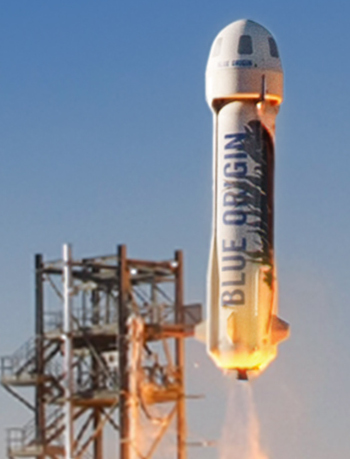
New Shepard launch

The competition heats up: Blue Origin completed on Wednesday its first test flight of its reusable suborbital spacecraft, New Shepard.

After reaching an altitude of 307,000 feet, or 58 miles, the capsule successfully separated from its first stage, what they call the propulsion module, and safely parachuted back to Earth. The first stage, designed to also be recoverable, was not recovered successfully. According to Jeff Bezos’s explanation, they “lost pressure in our hydraulic system” and that they were trying to land it vertically, like SpaceX’s Falcon 9 first stage.

The cropped image on the right of the full resolution image, gives us a close-up of the capsule and propulsion module. The small fins on the propulsion module suggest the capability for a vertical landing, but it is unclear from the image whether the module has legs, though other images and videos strongly suggest there are legs on this module.

The flight itself, getting above 50 miles, reached space according to most definitions. In fact, Blue Origin with this flight has accomplished what Virgin Galactic has been promising to do for more than a decade, a suborbital test flight of its spacecraft. Blue Origin’s flight was unmanned, but it demonstrated that their design works. They will of course have to re-fly the capsule as well as land that first stage successfully to prove the design’s re-usability, but this flight shows that they are off to a very good start. And their webpage clearly shows that they are almost ready to start selling tickets for suborbital flights.

The most significant success of this launch, however, is the performance of the BE-3 rocket engine. Blue Origin has convinced ULA to hire it to build the engines for its new Vulcan rocket. This success justifies that decision.

I have embedded their videos of the full flight below the fold.
» Read more

3 comments

Progress freighter declared lost

The Russians have declared lost the Progress freighter that had been launched to ISS yesterday.

They never could regain control of the craft, plus it was in an incorrect orbit. Moreover, the U.S. Air Force has detected debris nearby, suggesting a significant failure of some kind.

The Russians are now considering delaying the next manned launch, scheduled for May 26, while they investigate this failure. Both Soyuz and Progress use some of the same systems, including the radar system that failed on Progress, and they want to make sure the problem won’t pop up on the manned mission.

At the same time, they are also considering advancing the launch date of the next Progress to ISS from August 6.

Based on these reports, I think they might swap the launch dates for the two flights. A Dragon is scheduled to go to ISS in between these missions, though that schedule could be changed as well to accommodate the Russian plans.

2 comments

Progress freighter in big trouble

A Progress freighter launched by Russia to ISS on Tuesday was placed in the wrong orbit, has not deployed its radar antennas needed for rendezvous, and is not responding properly to commands on the ground.

Whether it is in the wrong orbit might be an incorrect report, but other sources demonstrate clearly that the spacecraft is tumbling out of control. Based on all these reports, it does not look good for this vehicle. The crew on ISS, including the two astronauts on a year-long mission there, might have to do without these supplies.

Meanwhile Russia is proceeding with its plans to consolidate control of all aspects of its aerospace industry under the banner of a single government “super-corporation” run by Roscosmos. Considering the number of technical failures they have had with spacecraft and rockets in the past five years, it seems to me that this is the worst approach for solving these problems. Then again, Russian culture strongly favors a top-down authoritarian approach, so it might work better under this Soviet-style approach.

I don’t believe it, but we are going to find out in the coming decades.

2 comments

Next Falcon 9 launch set for Monday

The competition heats up: The next commercial Falcon 9 launch is now set for tonight, Monday, less than two weeks after the last Falcon 9 launch.

The next two weeks will be especially busy for SpaceX, as they also have scheduled the first launch abort test of Dragon on May 5. The launch will also be the fifth for Falcon 9 this year, putting it in the lead as the busiest rocket in the world for 2015, ahead of the Russian Soyuz.

0 comments

Russians cancel effort to fly humans from Vostochny by 2019

The heat of competition? In order to meet a government deadline to launch humans from their new spaceport at Vostochny, the Russians had planned, though now cancelled, a single manned launch there in 2019, using a new rocket.

Their cancelled plans had included two prior test flights of the rocket with Progress freighters.

If cargo missions were successful, the one brave crew would ride into orbit from the new spaceport, knowing that in case of a serious problem with the rocket, the descent module of the spacecraft would parachute into deep forest of the Russian Far East or somewhere in the Pacific.

After “satisfying” this political goal with a single crew, all manned Soyuz and cargo Progress missions would then revert back to Baikonur for a safe ascent trajectory. The Soyuz spacecraft would continue flying two missions annually from Baikonur, until the veteran spacecraft’s final launch in 2025. In 2021, Soyuz spacecraft missions originating from Baikonur would switch from Soyuz-FG to Soyuz-2-1a rocket.

The Russians have now decided, rather than rush this first flight on the new rocket, to hold to the slower schedule.

This story is important to the United States. I think we must definitely end our dependence on the Russians before they make the switch to the new rocket. Based on the levels of poor quality control and corruption seen recently in Russia, I have grave doubts the new rocket will fly reliably at first. It would be a mistake to buy its use to put Americans in space.

0 comments

Seven big failed environmentalist predictions

Link here.

Like the author, I remember every single one of these doomsday predictions. I also remember how every single one of these predictions was wildly wrong. Until these fear-mongers can reliably predict things, I see no reason to believe them.

His article however does provide one entertaining tidbit:

You know how old I am? Iโ€™m so positively ancient that I remember when one of Jimmy Carterโ€™s big answers to the impending shortage of oil was to increase federal funding for research on how to extract oil from shale. It ended the way you would expect: it went nowhere. But some decades later, private oil companies did find a way to more economically extract oil from shaleโ€”and environmentalists promptly made it public enemy #1.

All true. And just one more example of how the government fails at something while private enterprise, fueled by the profit motive, finds a way to make that exact same thing happen.

3 comments

Russia launches criminal investigation at Vostochny

The Russian government has launched a large-scale investigation into the disappearance of 300 million rubles ($6 million) at their new Vostochny spaceport.

The criminal case was opened on the charges of large-scale embezzlement, the interior department said. According to a pre-investigation check, an agreement was signed in October 2014 between the client represented by the state special construction company and a contractor on fulfilling contractual work for building roads as part of the Vostochny cosmodrome infrastructure development, the interior department said. “The client under the contract made an advance payment of 300 million rubles to the contractor. However, the contractor did not start work and did not return the advance payment,” the interior department said, adding the investigation was continuing.

It appears the Russian government is finally tightening the screws at what appears to be widespread corruption at Vostochny.

I suspect the real problem here is not that the contractor pocketed some money illegally, it is that the contractor pocketed too much money illegally. Had he simply skimmed off a bit off the top but made sure construction proceeded, Putin and his gang would have gladly looked the other way. They skim off enough of their own too y’know, on numerous other projects. Skimming off so much that the project isn’t even built, howver, is unacceptable!

0 comments
1 400 401 402 403 404 478