Social Sciences Face Uphill Battle Proving Their Worth to Congress

Some squealing from the journal Science: NSF faces uphill budget battle in Congress.

When he asked the witnesses for ideas on shrinking the government’s $1.6 trillion deficit, Mo Brooks (R-Alabama) [chairman of the research panel of the House of Representatives Science and Technology Committee] made it clear he was talking about possible cuts to NSF’s entire $7 billion budget, not simply its SBE directorate.

Note that in 2008 the NSF budget was a $6.1 billion. Cutting it back to that number would hardly destroy social science research in this country.

2 comments

House torpedoes unconditional hike to $14.3 trillion debt ceiling

Good news indeed: The House tonight overwhelmingly voted down an unconditional hike to $14.3 trillion debt ceiling.

The vote was 318-97, with 82 Democrats joining every Republican in rejecting legislation that would have authorized $2.4 trillion in additional borrowing by the federal government. Seven Democrats voted present on the legislation.

Now comes the business of tying the increase in the debt ceiling to some real spending reduction.

0 comments

Vote on “clean” debt ceiling increase set for tonight

The next budget battle begins: A vote on a “clean” debt ceiling increase has been set for tonight by the House Republican leadership.

More than 100 House Democrats recently signed a letter demanding that Speaker John Boehner bring forward a vote for an increase in federal debt levels without any conditions for cuts or future spending curbs. Imagine their surprise when Boehner agreed and will serve up a bill that would provide enough borrowing to cover all of president Obama’s spending requests for next year without any preconditions.

It is expected that the legislation will be defeated soundly in a very bipartisan vote. To quote the article again:

The political reality is that increasing the nation’s swollen $14.3 trillion debt is a political loser. Voters hate it and lawmakers don’t even get anything new to give away since the money is going to cover existing obligations.

If the bill is defeated as predicted, it will be very good news, as that defeat will bolster the efforts of those who want big cuts in spending to go with any debt ceiling increase.

2 comments

Obama budget receives zero votes in Senate

Obama’s budget request for 2012 received zero votes today when it came up for a vote in the Democratic controlled Senate. Meanwhile, the House budget, proposed by Paul Ryan (R-Wisconsin) was also rejected, but by the much closer vote of 40-57.

I’m not sure if this is good or bad. It suggests that there is increasing recognition in the Senate that cuts must happen, and that Obama’s budget failed in this regard. It also suggests that the Senate is also not ready to make those cuts.

0 comments

“We stand for freedom.”

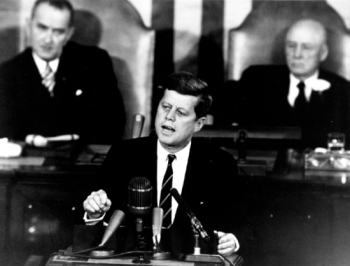
Kennedy's speech

Fifty years ago today, John Kennedy stood before Congress and the nation and declared that the United States was going to the Moon. Amazingly, though this is by far the most remembered speech Kennedy ever gave, very few people remember why he gave the speech, and what he was actually trying to achieve by making it.

Above all, going to the Moon and exploring space was not his primary goal.

The Context

For Kennedy — whose presidential campaign included an aggressive anti-communist stance against the Soviet Union — the months before the speech had not gone well. Five weeks earlier, for instance, the CIA-led attempt to invade Cuba and overthrow Castro’s communist government had ended in total failure. When Kennedy refused to lend direct military support to the Bay of Pigs invasion, the 1,200 man rebel force was quickly overcome. “How could I have been so stupid as to let them go ahead?” Kennedy complained privately to his advisors.

In Berlin, the tensions between the East and the West were continuing to escalate, and would lead in only a few short months to Khrushchev’s decision to build the Berlin Wall, sealing off East Berlin and the citizens of East Germany from the rest of the world.

In the race to beat the Soviets in space, things were going badly as well. NASA had announced the United States’ intention to put the first man into space sometime in the spring of 1961. The agency hoped that this flight would prove that the leader of the capitalist world still dominated the fields of technology, science, and exploration.

Originally scheduled for a March 6, 1961 launch, the short fifteen minute sub-orbital flight was repeatedly delayed. The Mercury capsule’s first test flight in January, with a chimpanzee as test pilot, rose forty miles higher than intended, overshot its landing by a hundred and thirty miles, and when the capsule was recovered three hours later it had begun leaking and was actually sinking. Then in March another test of the Mercury capsule included the premature firing of the escape rocket on top of the capsule, the unplanned release of the backup parachutes during descent, and the discovery of dents on the capsule itself.

These difficulties caused NASA to postpone repeatedly its first manned mission. First the agency rescheduled the launch to late March. Then early April. Then mid-April. And then it was too late.
» Read more

4 comments

Dear Congress: Your credit application has been turned down

Dear Congress: Your credit application has been turned down.

You may also wish to contact a consumer credit counseling agency. The National Foundation for Credit Counseling can help you locate a reputable counseling agency in your area. You may also wish to visit the NFCC’s website for helpful tips on such subjects as

•drawing up a budget
•living within your means
•saving during tough economic times
•steps to take when your finances get out of control

1 comment
1 84 85 86 87 88 105