Europe’s Euclid optical space telescope discovers 31 new quasars in the very early universe

The uncertainty of science: The Europe Space Agency’s (ESA) Euclid optical space telescope — with a mirror half the size of Hubble’s — has now identified 31 new quasars in the very early universe, all of which really shouldn’t be there based on present theories as to how long it should take for them to form.

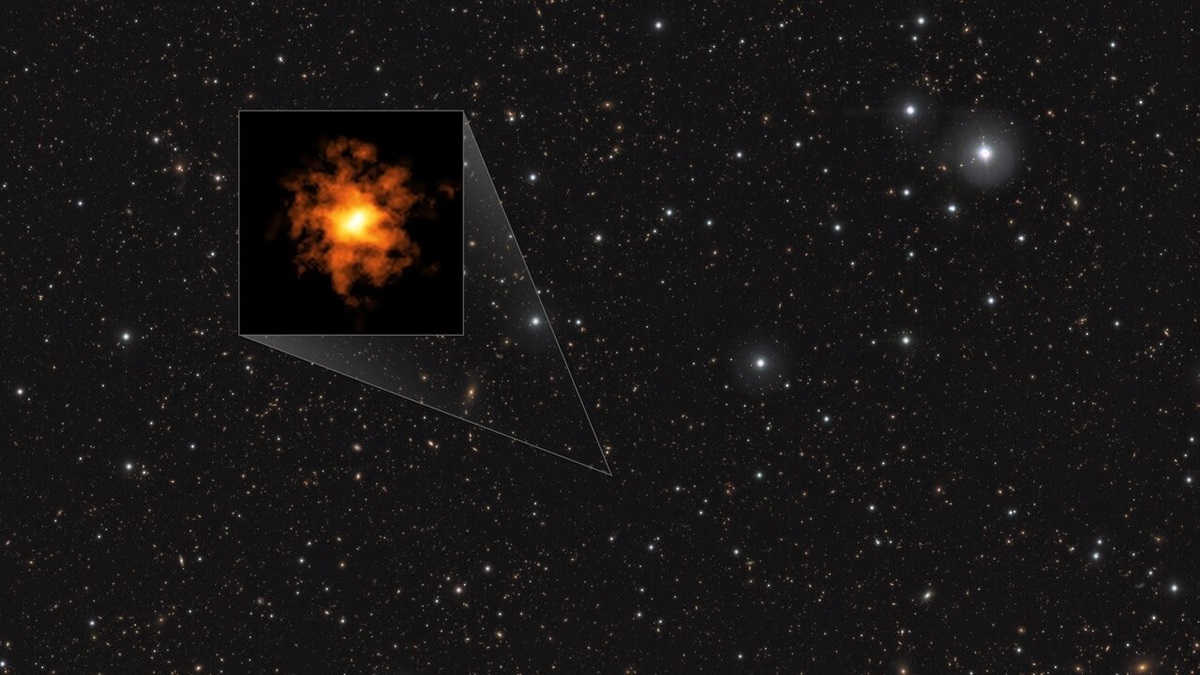
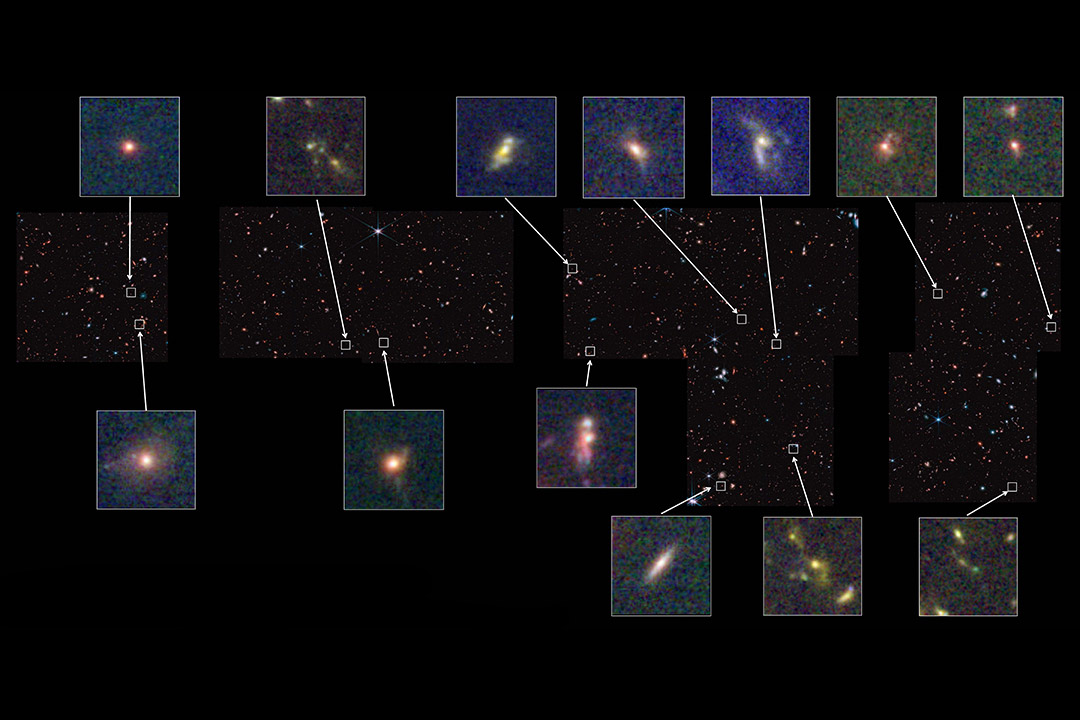
The European Space Agency’s Euclid space telescope has discovered 31 of the most ancient quasars ever found. Two of these giant and dazzling galaxy cores, powered by gargantuan black holes, are the earliest quasars yet observed in cosmic history. They shone with the light of a trillion Suns back when the Universe was 670 million years old – just 5% of its current age.

UPDATE: Astronomers using the Keck telescopes in Hawaii have now confirmed 21 of the 31 one quasars identified by Euclid.

The scientific problem is that, according to most theories on the evolution and formation of galaxies and black holes and quasars, it takes billions of years for such large supermassive black holes to accrete their mass. Yet, these exist less than a billion years after the Big Bang. The numbers do not compute.

Euclid doesn’t get the publicity of Hubble, partly because ESA does not do as good a job of selling its work as NASA, partly because it is a European project and the American propaganda press is thus generally uninterested, and partly because it is simply smaller and a later telescope, thus not ground-breaking. Nonetheless, with a mirror 1.2 meters across, it is capable of truly spectacular optical astronomy, being above the atmosphere as well as above the many satellite constellations now in orbit. It is placed in the Lagrange point 2, a million miles from Earth.

In fact, Euclid is exactly the kind of space telescope the astronomy community should be building, in huge numbers, rather than whining about those satellite constellations blocking its big ground-based telescopes. The future of astronomy is in space, and it is high time astronomers recognized this.

12 comments

Scientists skeptical of dark energy fight back!

Will cosmologists every enter?
Will cosmologists ever enter?

The uncertainty of science: In apparent direct response to the June 11, 2026 press release by cosmologists claiming that their data is correct and that the universe’s expansion is accelerating in the early universe and thus dark energy must exist, a different team of scientists today issued their own press release and research paper stating that the evidence of that acceleration is faulty and based upon a false assumption about supernovae.

The original discovery of dark matter and the acceleration was based on the brightness of a certain type of supernova in the early universe, which also assumed that brightness was always the same for every explosion. The new research says otherwise.

The team analysed the supernovae from the Pantheon+ dataset, one of the most comprehensive catalogues of its kind, and incorporated a recently proposed correction that takes into account the age of the stars that eventually produce these supernova explosions. They also checked whether the inferred acceleration of the expansion rate is indeed the same in every direction, as is assumed in the standard cosmological model. “There is increasing evidence that the brightness of Type Ia supernovae depends on the age of the stars they come from,” said Professor Sarkar, a co-author of the study. “If this effect is not accounted for, it can lead to the erroneous conclusion that the expansion rate is accelerating.”

After applying the correction, the researchers found that the data no longer support a picture of a uniformly accelerating universe. Instead, their analysis suggests that cosmic expansion is overall slowing down rather than speeding up.

Their conclusion is blunt: “There is thus no evidence for isotropic accelerated expansion of the Universe, which can be ascribed to either a Cosmological Constant or more general dark energy.”

In other words, there is solid disagreement within the cosmological community about the existence of dark energy. Some believe it exists, based on the supernova data. Some do not, because the data depends on too many assumptions about those supernovae that further observations suggest are wrong.

6 comments

Astronomers find another quasar in the early universe that really shouldn’t be there

The uncertainty of science: Using archival data from the WISE space telescope, astronomers have now identified another unexpected quasar in the early universe, only 850 million years after the Big Bang, that also flickers in several wavelengths.

The quasar’s flicker enabled the researchers to determine that, surprisingly, the ancient quasar’s whirlpool of gas and dust, known as an accretion disk, resembled a flat pancake, similar in shape to that of more modern-day quasars.

Their findings add to a longstanding mystery in cosmology: Why do supermassive black holes exist so early in the universe’s history? Physicists have assumed that a flat accretion disk reflects a relatively mature black hole that is in a calm and stable state. Black holes that are just starting to form, like those in the very early universe, should be more unsettled systems, with accretion disks that appear more puffy and chaotic.

The flat accretion disk around this very early quasar heightens the mystery of how supermassive black holes can grow and mature in a very short amount of cosmic time.

They estimate the quasar energy output is equivalent to about 12 trillion suns. Its flickering, ranging about 20% in power, makes it the first such flickering quasar found this early in time. Such early quasars however are not unique. Astronomers have found about 200, all of which should not exist, based upon present Big Bang cosmology. There simply hasn’t been enough time for them to evolve, based on present theories of galactic formation.

6 comments

Webb finds another unexpected galaxy in the very early universe

Unexpected galaxy
Click for original image.

The uncertainty of science: Using the Webb Space Telescope, astronomers have discovered another galaxy in the very early universe that appears too bright and developed for it to even exist so soon after the Big Bang.

MoM-z14 is one of a growing group of surprisingly bright galaxies in the early universe – 100 times more than theoretical studies predicted before the launch of Webb, according to the research team. “There is a growing chasm between theory and observation related to the early universe, which presents compelling questions to be explored going forward,” said Jacob Shen, a postdoctoral researcher at MIT and a member of the research team.

…With galaxy MoM-z14 existing only 280 million years after the big bang, there was not enough time for generations of stars to produce such high amounts of nitrogen in the way that astronomers would expect. One theory the researchers note is that the dense environment of the early universe resulted in supermassive stars capable of producing more nitrogen than any stars observed in the local universe.

All theories about the Big Bang and the early universe did not predict the existence of this galaxy, or a bunch of others that Webb has now detected.

The false color infrared Webb image is to the right, cropped and reduced to post here. The full image covered a much larger area, so this tiny galaxy was not easy to find. Scientists identified it by the very high red shift of its light, due to the expansion of the universe and it being so far away. That expansion away from us causes the wavelengths of its light to stretch into the infrared so that only Webb can see it.

0 comments

Scientists: We think the little red dots in the early universe are supermassive stars

The uncertainty of science: Using the Webb Space Telescope, scientists now believe that the mysterious little red dots that Webb had previously detected in the early universe are actually supermassive stars, the predicted first stars to form after the Big Bang that also might produce the universe’s first black holes.

In 2022 the first deep images from Webb, a telescope designed to see longer wavelengths of light, revealed little red dots in the distant universe. The new results gave scientists more context into what these mysterious, compact, and very old objects could be. Past theories explaining little red dots required complicated explanations involving black holes, accretion disks and dust clouds, but the new model shows that a single massive star can also naturally produce all of the key signatures in little red dots: extreme brightness, a distinctive V-shaped spectrum, and the rare combination of one bright hydrogen emission.

Now, for the first time, astronomers have created a detailed physical model of a rare, metal-free, rapidly growing supermassive star about a million times the mass of the Sun, and showed that its unique features are a perfect match for little red dots.

Models outlining the early stages of the universe had predicted that the first stars formed after the Big Bang would be much more massive than the stars seen today. This hypothesis fits that model.

At the same time, no one should take any theory to the bank. The data remains very slim, so that all conclusions remain based on a very weak foundation.

1 comment

The growing mystery of the little red dots in the early universe

The uncertainty of science: A review of the population of what scientists call “Little Red Dots” (LRDs) — discovered in the early universe by the Webb Space Telescope — has found that 30% do not appear to be compact objects when viewed in ultraviolet wavelengths.

The team studied 99 LRDs, and found that about 30% are not simply compact dots when observed in the ultraviolet.Instead, they reveal disturbed or clumpy structures, in stark contrast to their smooth, point-like appearance at optical wavelengths. Because these galaxies are so far away, their optical light is stretched, or “redshifted,” into the long-wavelength channel of JWST, where the resolution is not sharp enough to see structure, so they look like simple dots.

Rinaldi: ‘But their ultraviolet light is shifted into JWST’s short-wavelength channel, where the telescope has much finer resolution, and there we suddenly see clumps, asymmetries, and signs of interaction. On top of this, in the spectra of some of our LRDs we directly detect the fingerprints of active black holes, with gas moving at thousands of kilometres per second.’ This shows that at least part of this population is powered by growing black holes, while others seem to be dominated by star formation, making LRDs a mixed and diverse family of sources. This is a crucial clue, suggesting that mergers and galaxy interactions may be the trigger for the “LRD phase”.

In other words, astronomers don’t really know what these dots are at present. If some are supermassive black holes, this poses a problem for Big Bang cosmology, as there should not have been enough time since the Big Bang for these black holes to have formed.

That 70% still appear to be compact single objects might mean that’s what they are, but it could also mean that our present observations tools don’t yet have the ability to resolve them.

1 comment

Webb detects unexpected “little red dots” in the early universe

The uncertainty of science: Using the Webb Space Telescope astronomers have begun to compile a small catalog of what they call “little red dots” [LRDs], objects in the very early universe that are very small, too small to be galaxies and are thus a mystery.

A team of astronomers recently compiled one of the largest samples of LRDs to date, nearly all of which existed during the first 1.5 billion years after the big bang. They found that a large fraction of the LRDs in their sample showed signs of containing growing supermassive black holes.

“We’re confounded by this new population of objects that Webb has found. We don’t see analogs of them at lower redshifts, which is why we haven’t seen them prior to Webb,” said Dale Kocevski of Colby College in Waterville, Maine, and lead author of the study. “There’s a substantial amount of work being done to try to determine the nature of these little red dots and whether their light is dominated by accreting black holes.”

The present most popular theory to explain the dots, based on the available data, is that the dots are newly formed black holes, their red light caused by material falling into the hole at millions of miles per hour. That theory has of course problems. For example, it doesn’t explain why we don’t see these dots in more recent times. Nor does it explain why the dots are dim in X-rays, a radiation expected from accreting black holes.

As always, the press release claims that this discovery does not “break” the present cosmological theories for the formation of the universe, but at the same time, it does illustrate our overall lack of knowledge about that early universe. We really don’t know very much, which means any theories we have are likely wrong simply due to our present ignorance.

3 comments

Webb spots a new record-setting galaxy, only 280 million years after the Big Bang

MoM Z14
The galaxy MoM z14, as seen in the infrared
by Webb. Click for original image.

The uncertainty of science: Using the Webb Space Telescope, astronomers have now identified a galaxy that formed only 280 million years after the Big Bang, far earlier than their theories of the origins of the universe had predicted.

“The broader story here is that JWST was not expected to find any galaxies this early in the history of the universe, at least not at this stage of the mission,” van Dokkum said. “There are, very roughly, over 100 more relatively bright galaxies in the very early universe than were expected based on pre-JWST observations.”

The data suggests MoM z14 is 50 times smaller than the Milky Way, contains nitrogen and carbon, and appears to be forming stars. The data also found little neutral hydrogen surrounding the galaxy, which also contradicts those same cosmological theories. According to those theories, the early universe should be filled with neutral hydrogen.

The nitrogen and oxygen are also there earlier than expected, and suggest there will be more such galaxies, including some even closer to the Big Bang.

Hat tip BtB’s stringer Jay.

0 comments

Astronomers discover a well-developed spiral galaxy too soon after the Big Bang

The early spiral galaxy
Click for original image.

Using the Webb Space Telescope, astronomers have discovered the earliest known well-developed spiral galaxy, dubbed Zhúlóng (meaning torch dragon in Chinese), that exists only about one billion years after the Big Bang and much too soon for such a spiral galaxy to have formed.

The false-color infrared Webb image to the right, cropped to post here, shows clearly the galaxy’s spiral structure.

Zhúlóng has a surprisingly mature structure that is unique among distant galaxies, which are typically clumpy and irregular. It resembles galaxies found in the nearby Universe and has a mass and size similar to those of the Milky Way. Its structure shows a compact bulge in the center with old stars, surrounded by a large disk of younger stars that concentrate in spiral arms.

This is a surprising discovery on several fronts. First, it shows that mature galaxies that resemble those in our neighborhood can develop much earlier in the Universe than was previously thought possible. Second, it has long been theorized that spiral arms in galaxies take many billions of years to form, but this galaxy demonstrates that spiral arms can also develop on shorter timescales. There is no other galaxy like Zhúlóng that astronomers know of during this early era of the Universe.

You can read the peer-review research paper here. The scientists posit a number of theories to explain this spiral galaxy, none of which have much merit at this time because so little data exists from that time period. That only one such spiral galaxy is presently known does not mean such galaxies were rare at that time. It merely means our census of galaxy populations in the early universe remains woefully incomplete.

3 comments

Webb finds more elements not possible so soon after the Big Bang

A galaxy that shouldn't be there
Click for original image.

The uncertainty of science: Using the Webb Space Telescope, astronomers have now detected emissions of hydrogen from a galaxy that exists only 330 million years after the Big Bang that simply shouldn’t be possible, based on present cosmological theory.

The false-color infrared image of that galaxy is to the right, cropped to post here. At that distance, 13.5 billion light years away, all Webb can really see is this blurry spot. From the press release:

In the resulting spectrum, the redshift was confirmed to be 13.0. This equates to a galaxy seen just 330 million years after the big bang, a small fraction of the universe’s present age of 13.8 billion years old. But an unexpected feature stood out as well: one specific, distinctly bright wavelength of light, known as Lyman-alpha emission, radiated by hydrogen atoms. This emission was far stronger than astronomers thought possible at this early stage in the universe’s development.

“The early universe was bathed in a thick fog of neutral hydrogen,” explained Roberto Maiolino, a team member from the University of Cambridge and University College London. “Most of this haze was lifted in a process called reionization, which was completed about one billion years after the big bang. GS-z13-1 is seen when the universe was only 330 million years old, yet it shows a surprisingly clear, telltale signature of Lyman-alpha emission that can only be seen once the surrounding fog has fully lifted. This result was totally unexpected by theories of early galaxy formation and has caught astronomers by surprise.”

In more blunt terms, the theory that the haze would clear only one billion years after the Big Bang appears very wrong. This result is also similar to the story earlier this week about the detection of oxygen in a similarly early galaxy, oxygen that could not possibly be there only a few hundred million years after the Big Bang. Not enough time had passed for the number of star generations needed to produce it.

You can read the peer-reviewed paper here. While the Big Bang theory is hardly dead, the data from Webb continues to suggest it either needs a major rethinking, or there is something fundamentally wrong with it.

13 comments

Oxygen found in the most distant known galaxy, too soon after the Big Bang

The uncertainty of science: Astronomers studying the most distant galaxy so far discovered, 13.4 billion light years away and existing only 300 million years after the Big Bang, have now detected the existence of oxygen, an element that simply should not have had the time to develop in such a short time span.

The new oxygen detection with ALMA, a telescope array in Chile’s Atacama Desert, suggests the galaxy is much more chemically mature than expected. “It is like finding an adolescent where you would only expect babies,” says Sander Schouws, a PhD candidate at Leiden Observatory, the Netherlands, and first author of the Dutch-led study, now accepted for publication in The Astrophysical Journal. “The results show the galaxy has formed very rapidly and is also maturing rapidly, adding to a growing body of evidence that the formation of galaxies happens much faster than was expected.”

Galaxies usually start their lives full of young stars, which are made mostly of light elements like hydrogen and helium. As stars evolve, they create heavier elements like oxygen, which get dispersed through their host galaxy after they die. Researchers had thought that, at 300 million years old, the Universe was still too young to have galaxies ripe with heavy elements. However, the two ALMA studies indicate JADES-GS-z14-0 has about 10 times more heavy elements than expected.

The spectroscopy that confirmed the oxygen also allowed the scientists to confirm the galaxy’s distance, which also confirmed the fact that there is something seriously wrong with the present theories of cosmologists about the formation of the universe. Present theory requires at least several generations of star birth followed by star death, with each forming heavier and heavier atoms. Such a process is expected to take far more than 300 million years.

Either that theory is very wrong, or the theory of the Big Bang has problems. The facts don’t fit the theories, and when that happens, it is the theories that must be abandoned.

9 comments

Astronomers find another galaxy that shouldn’t be there in the early universe

REBELS-25
Click for original image.

The uncertainty of science: Using ground-based telescopes, astronomers have identified a galaxy only 700 million years after the Big Bang that is far more organized and coherent in shape and structure than thought possibly that soon after the theorized creation of the universe.

The galaxy in question is dubbed REBELS-25. It is at a red shift of z=7.31, which means that it is from a time when the universe was only 700 million years old. The earliest galaxies ever seen are only a few hundred million years older.

REBELS by name rebel by nature. This odd galaxy has stumped astronomers because it shows evidence of an ordered structure and rotation. It may even have a central elongated bar and spiral arms, though further observation is needed to confirm these structures.

This is in contrast to the small, messy, lumpy and chaotic norm for galaxies of a similar age. “According to our understanding of galaxy formation, we expect most early galaxies to be small and messy looking,” says co-author Jacqueline Hodge, an astronomer at Leiden University in the Netherlands.

You can read the published paper here [pdf]. The picture to the right shows this galaxy as seen by the Atacama Large Millimeter/submillimeter Array (ALMA) in Chile.

The consensus view of the early universe said there would not have been enough time for such a structured galaxy to form. And yet as astronomers use the improved astronomical instrumentation of our time to look deeper and deeper at that early universe, they keep finding things — like this galaxy — that defy that consensus view.

The answer to this mystery remains unknown, and is likely not yet answerable with the data we presently have. The data we do have however is beginning to suggest that scientists might have to begin looking at fundamentally different theories as to the inital formation of the universe. The Big Bang might still work, but if so it might require a major rewrite.

6 comments

Software patch saves Europe’s Euclid space telescope

Engineeers have successfully saved Europe’s new recently launched Euclid space telescope by installing a software patch that fixed the telescope’s inability to orient itself properly for long periods.

Shortly after launching on 1 July, the European space observatory Euclid started performing tiny, unexpected pirouettes. The problem revealed itself during initial tests of the telescope’s automated pointing system. If left unfixed, it could have severely affected Euclid’s science mission and led to gaps in its map of the Universe.

Now the European Space Agency (ESA) says that it has resolved the issue by updating some of the telescope’s software. The problem occurred when the on board pointing system mistook cosmic noise for faint stars in dark patches of sky, and directed the spacecraft to reorient itself in the middle of a shot.

The new software essentially reduces the amount of light that enters the pointing system, so that the noise is no longer detected. This means that observations however will have to be longer to obtain the same data, extending the mission.

Euclid’s goal is a follow-up on Europe’s Gaia mission, to map 1.5 billion galaxies in three dimensions. Gaia did it with the stars in the Milky Way. Euclid is looking deeper, requiring far greater precision and accuracy in pointing.

1 comment

Astronomers make first radio observations of key type of supernova

The uncertainty of science: Using a variety of telescopes, astronomers have not only made the first radio observations of key type of supernova, they have also detected helium in the data, suggesting that this particular supernova of that type was still atypical.

This marks the first confirmed Type Ia supernova triggered by a white dwarf star that pulled material from a companion star with an outer layer consisting primarily of helium; normally, in the rare cases where the material stripped from the outer layers of the donor star could be detected in spectra, this was mostly hydrogen.

Type Ia supernovae are important for astronomers since they are used to measure the expansion of the universe. However, the origin of these explosions has remained an open question. While it is established that the explosion is caused by a compact white dwarf star that somehow accretes too much matter from a companion star, the exact process and the nature of the progenitor is not known. [emphasis mine]

The highlighted sentences are really the most important take-away from this research. Type Ia supernovae were the phenomenon used by cosmologists to detect the unexpected acceleration of the universe’s expansion billions of years ago. That research assumed these supernovae were well understood and consistently produced the same amount of energy and light, no matter how far away they were or the specific conditions which caused them.

This new supernovae research illustrates how absurd that assumption was. Type Ia supernovae are produced by the interaction of two stars, both of which could have innumerable unique features. It is therefore unreasonable as a scientist to assume all such supernovae are going to be identical in their output. And yet, that is what the cosmologists did in declaring the discovery of dark energy in the late 1990s.

It is also what the scientists who performed this research do. To quote one of the co-authors: “While normal Type Ia supernovae appear to always explode with the same brightness, this supernova tells us that there are many different pathways to a white dwarf star explosion.”

Forgive me if I remain very skeptical.

4 comments

Webb spots massive galaxies in the early universe that should not exist at that time

The uncertainty of science: Astronomers using the Webb Space Telescope have identified six galaxies that are far too massive and evolved to have formed so quickly after the Big Bang.

The research, published today in Nature, could upend our model of the Universe and force a drastic rethink of how the first galaxies formed after the Big Bang. “We’ve never observed galaxies of this colossal size, this early on after the Big Bang,” says lead researcher Associate Professor Ivo Labbé from Swinburne University of Technology.

“The six galaxies we found are more than 12 billion years old, only 500 to 700 million years after the Big Bang, reaching sizes up to 100 billion times the mass of our sun. This is too big to even exist within current models.

You can read the paper here [pdf]. The “current models” Labbé is referring to are all the present theories and data that say the Big Bang occurred 13.7 billion years ago. These galaxies, however, found less than a billion years after that event, would have needed 12 billion years to have accumulated their mass.

If confirmed, these galaxies essentially tell us that the Big Bang is wrong, or very very VERY incomplete, and that all the data found that dates its occurrence 13.7 billion years ago, based on the Hubble constant, must be reanalyzed.

It is also possible these galaxies are actually not galaxies, but a new kind of supermassive black hole able to form very quickly. Expect many scientists who are heavily invested in the Big Bang to push for this explanation. It might be true, but their biases are true also, which means that Webb is presenting us with new data that calls for strong skepticism of all conclusions, across the board.

16 comments

Webb finds “wide diversity of galaxies in the early universe”

Webb galaxies in the early universe
Click for full image.

New data from the Webb Space Telescope and presented this week at an astronomy conference has found that galaxies in the early universe exhibit much of the same range of shapes and morphologies seen in the recent universe, a result that was not expected.

The image to the right comes from the press release. You can read the research paper here [pdf].

The study examined 850 galaxies at redshifts of z three through nine, or as they were roughly 11-13 billion years ago. Associate Professor Jeyhan Kartaltepe from Rochester Institute of Technology’s School of Physics and Astronomy said that JWST’s ability to see faint high redshift galaxies in sharper detail than Hubble allowed the team of researchers to resolve more features and see a wide mix of galaxies, including many with mature features such as disks and spheroidal components.

“There have been previous studies emphasizing that we see a lot of galaxies with disks at high redshift, which is true, but in this study we also see a lot of galaxies with other structures, such as spheroids and irregular shapes, as we do at lower redshifts,” said Kartaltepe, lead author on the paper and CEERS co-investigator. “This means that even at these high redshifts, galaxies were already fairly evolved and had a wide range of structures.”

The results of the study, which have been posted to ArXiv and accepted for publication in The Astrophysical Journal, demonstrate JWST’s advances in depth, resolution, and wavelength coverage compared to Hubble. Out of the 850 galaxies used in the study that were previously identified by Hubble, 488 were reclassified with different morphologies after being shown in more detail with JWST. Kartaltepe said scientists are just beginning to reap the benefits of JWST’s impressive capabilities and are excited by what forthcoming data will reveal.

“This tells us that we don’t yet know when the earliest galaxy structures formed,” said Kartaltepe. “We’re not yet seeing the very first galaxies with disks. We’ll have to examine a lot more galaxies at even higher redshifts to really quantify at what point in time features like disks were able to form.”

In other words, it appears galaxies of all shapes, as we see them today, already existed 11-13 billion years ago, shortly after the universe was born. This defies most theories about the formation of the universe, which predict that these early galaxies would be different than today’s.

The data however at this point is sparse. Webb has only begun this work, and as Kartaltepe notes, they need to look a lot more galaxies.

5 comments

Astronomers confirm Webb galaxies from the early universe

Astronomers using Webb have now confirmed with spectroscopy the age of at least four galaxies from the very very early universe, existing only a short time after the theorized Big Bang.

Four of the galaxies studied are particularly special, as they were revealed to be at an unprecedentedly early epoch. The results provided spectroscopic confirmation that these four galaxies lie at redshifts above 10, including two at redshift 13. This corresponds to a time when the universe was approximately 330 million years old, setting a new frontier in the search for far-flung galaxies. These galaxies are extremely faint because of their great distance from us.

The scientists had aimed Webb at Hubble’s Ultra Deep Field, doing a long infrared exposure lasting 28 hours over three days in order to gather the faintest infrared radiation (that Hubble could not see) and thus the most distant galaxies. The spectrum of individuals stars was then measured, which indicating their redshift and their estimated age.

The astronomers will next aim Webb at the more famous Hubble Deep Field, the first such long exposure that optical telescope took back in the late 1990s.

1 comment

Webb finding more galaxies in early universe than expected

The uncertainty of science: Astronomers using the Webb Space Telescope are finding in very early universe many more galaxies that are also far more developed then had been predicted.

The Webb observations nudge astronomers toward a consensus that an unusual number of galaxies in the early universe were so much brighter than expected. This will make it easier for Webb to find even more early galaxies in subsequent deep sky surveys, say researchers.

“We’ve nailed something that is incredibly fascinating. These galaxies would have had to have started coming together maybe just 100 million years after the big bang. Nobody expected that the dark ages would have ended so early,” said Garth Illingworth of the University of California at Santa Cruz, a member of the Naidu/Oesch team. “The primal universe would have been just one hundredth its current age. It’s a sliver of time in the 13.8 billion-year-old evolving cosmos.”

Erica Nelson of the University of Colorado in Boulder, a member of the Naidu/Oesch team, noted that “our team was struck by being able to measure the shapes of these first galaxies; their calm, orderly disks question our understanding of how the first galaxies formed in the crowded, chaotic early universe.”

The galaxies are smaller, more compact than present day galaxies, and appear to be forming stars at a tremendous rate. Because their distances, presently estimated, still need to be confirmed by spectroscopy, these conclusions remain somewhat tentative though quite alluring.

We should not be surprised if in the next two years data from Webb will overturn almost all the theories that presently exist about the Big Bang and its immediate aftermath.

2 comments

Initial Webb results revised because telescope wasn’t yet fully calibrated

The uncertainty of science: Though it appears that no results will have to be abandoned, the scientists who published some of the very first results from the Webb Space Telescope have been scrambling to adjust and revise their papers because the telescope is only now getting fully calibrated.

“This caused a little bit of panic,” says Nathan Adams, an astronomer at the University of Manchester, UK, who, along with his colleagues, pointed out the problem in a 9 August update to a preprint they had posted in late July3. “For those including myself who had written a paper within the first two weeks, it was a bit of — ‘Oh no, is everything that we’ve done wrong, does it all need to go in the bin?’”

To try to standardize all the measurements, the STScI is working through a detailed plan to point Webb at several types of well-understood star, and observe them with every detector in every mode for every instrument on the telescope4. “It just takes a while,” says Karl Gordon, an astronomer at the STScI who helps lead the effort.

In the meantime, astronomers have been reworking manuscripts that describe distant galaxies on the basis of Webb data. “Everyone’s gone back over and had a second look, and it’s not as bad as we thought,” Adams says. Many of the most exciting distant-galaxy candidates still seem to be at or near the distance originally estimated. But other preliminary studies, such as those that draw conclusions about the early Universe by comparing large numbers of faint galaxies, might not stand the test of time. Other fields of research, such as planetary studies, are not affected as much because they depend less on these preliminary brightness measurements.

Overall, it does not appear the more precise calibrations will change much of signficance, since most of the earliest observations were simply that, observations, not theoretical. Because the distance estimates remain largely unchanged however the theorists are left with the same conundrum: The age and apparent nature of the most distant objects does not seem to fit with what the theories had predicted Webb would see.

1 comment

Today’s blacklisted American: Scientists questioning Big Bang theory protest censorship of their work

Webb's first deep field image
Nothing in Webb’s first deep field image shall be questioned, by anyone!

While the blacklisting described in today’s column has little to do with left vs right politics, it demonstrates clearly that the desire to silence dissent is now culturally pervasive across many fields. In science it has become especially toxic, as this story clearly shows:

Twenty-four astronomers and physicists from ten countries have signed a petition protesting the censorship of papers that are critical of the Big Bang Hypothesis by the open pre-print website arXiv. Run by Cornell University, arXiv is supposed to provide an open public forum for researchers to exchange pre-publication papers, without peer-review. But during June, 2022, arXiv rejected for publication on the website three papers by Dr. Riccardo Scarpa, Instituto de Astrofisica de Canarias, and Eric J. Lerner, LPPFusion, Inc. which are critical of the validity of the Big Bang hypothesis.

…[quoting the petition] “Without judging the scientific validity of the papers, it is clear to us that these papers are both original and substantive and are of interest to all those concerned with the current crisis in cosmology. It plainly appears that arXiv has refused publication to these papers only because of their conclusions, which both provide specific predictions relevant to forthcoming observations and challenge LCDM cosmology [the standard dark matter/dark energy Big Bang hypothesis]. Such censorship is anathema to scientific discourse and to the possibility of scientific advance.

“We strongly urge that arXiv maintain its long-standing practice of being an “open-access archive” of non-peer reviewed “scholarly articles” and not violate that worthy practice by imposing any censorship. Instead, we encourage arXiv to abide by its own principles, and publish these three papers and others like them that clearly provide ‘sufficient original or substantive scholarly research’ results and are of obvious great interest to the arXiv audience.”

Lerner and Scarpa had attempted to get their papers published in a peer review journal and had been stymied, apparently because the topic of their paper was inappropriate for that journal. They then decided to publish on arXiv, which has for almost three decades been open to the publication of all scientific papers written by credentialed scientists, as noted at the website:
» Read more

17 comments
1 2