
The UAE wants to go to Mars

The competition heats up: The United Arab Emirates (UAE) announced today that it is creating a space agency to build and launch an unmanned mission to Mars by 2021.

The announcement included this statement by his Highness Sheikh Mohammed bin Rashid Al Maktoum, Vice-President and Prime Minister of the UAE and Ruler of Dubai:

Despite all the tensions and the conflicts across the Middle East, we have proved today how positive a contribution the Arab people can make to humanity through great achievements, given the right circumstances and ingredients. Our region is a region of civilisation. Our destiny is, once again, to explore, to create, to build and to civilise. We chose the epic challenge of reaching Mars because epic challenges inspire us and motivate us. The moment we stop taking on such challenges is the moment we stop moving forward.

I wish them luck, since building spaceships and exploring the heavens is a far better occupation that trying to kill Jews. I remain skeptical however. They will have to show real achievement before I will believe this is something more than a simple feel-good public relations stunt by the UAE’s leaders.
2 comments

Another update on ISEE-3

Dennis Wingo has written a detailed report on the engineering analysis of ISEE-3, including what they plan to do on Wednesday to troubleshoot the problem and possible fix it.

The bottom line is that there is still a good chance they can get the spacecraft thrusters to fire and change the spacecraft’s trajectory. We will know more tomorrow.

0 comments

More images from Rosetta

67P

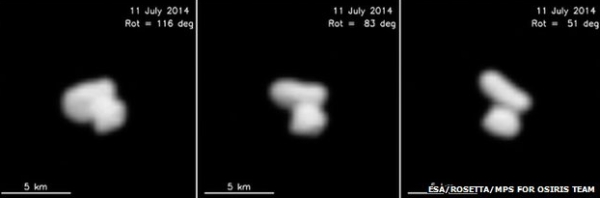
The comet that Rosetta will orbit is getting stranger and stranger, with new images suggesting that it is really two objects stuck together.

The pictures show that 67P/Churyumov-Gerasimenko appears to be not one but two objects joined together. It is what scientists call a “contact binary”. How the comet came to take this form is unknown. It is possible that 67P suffered a major fracture at some point in its past; it is also possible the two parts have totally different origins.

What is clear is that the European Space Agency (Esa) mission team now has additional and unexpected considerations as it plans how to land on the comet later this year – not least, which part of the comet should be chosen for contact?

1 comment

DARPA awards contracts for XS-1 spaceplane

The competition heats up: DARPA has announced contract awards to three companies for the construction of its experimental XS-1 spaceplane, designed to take off and land like a airplane.

The contracts go to Boeing, Northrop Grumman, and Masten Space Systems, and have them each respectively partnered with Blue Origin, XCOR, and Virgin Galactic. More details on the Boeing contract can be found here.

The description of the XS program is quite exciting:
» Read more

6 comments

Great Britain’s proposed suborbital spaceport locations

The competition heats up: More information was released today describing Great Britain’s suggested spaceport locations.

These spaceports are specifically aimed at the suborbital space tourism market, for American companies like Virgin Galactic or XCOR, or for the developing British company Skylon.

It is interesting that 6 of 8 are located in Scotland, which might very well not be part of the United Kingdom after a vote on separation this fall.

1 comment

The next Proton and Angara launches

The competition heats up: Russia has set September 28 as the next launch date for its troubled Proton rocket.

The most interesting detail gleaned from this article however is this:

The Proton-M carrier rocket previously launched on May 16 from Baikonur space center collided with communications satellite Express АМ4R and burned up in the atmosphere above China, leaving Russia without its most powerful telecommunications satellite.

Previous reports had not been very clear about the causes of the May launch failure. All they would say is that “a failed bearing in the steering engine’s turbo pump” had caused the failure about nine minutes into the flight. This report suggests that this failure occurred after separation of the payload and that it then caused the upper stage to collide with the satellite.

Russia is also about to ship its new Angara 5 rocket to the launch site for a planned December launch. This will be the first launch of the Angara configuration that is expected to replace the Proton rocket, and is expected to place a dummy payload into geosynchronous orbit.
» Read more

2 comments

The darkest material ever made

Scientists have developed a material so dark it is difficult to discern the shape of any object it coats.

The material absorbs all but 0.035 per cent of light, a new world record, and is so dark the human eye struggles to discern its shape and dimension, giving the appearance of a black hole. Named Vantablack, or super black, it also conducts heat seven and half times more effectively than copper, and is ten times stronger than steel. It is created by Surrey NanoSystems using carbon nanotubes, which are 10,000 thinner than human hair and so miniscule that light cannot get in but can pass into the gaps in between.

The pictures at the website are especially amazing. They coated half of a sheet of aluminum foil with the material and then crinkled the foil. You can see the crinkles in the uncoated material, but the coated material just looks black.

This will be very useful for astronomical instruments, as well as many other technical applications. For example, if you coat the body of your telescope with this material it will help eliminate stray light, which means that you will increase the efficiency of your observations.

5 comments

Falcon 9 launch

The competition heats up: SpaceX’s Falcon 9 has successfully launched six Orbcomm commercial satellites into orbit.

The six satellites still must be deployed. We will know if this is successful sometime in the next hour or so. Also, no news yet on SpaceX’s effort to recover the rocket’s first stage after a soft splashdown in the ocean.

Update: All 6 Orbcomm satellites have successfully deployed.

Update 2: From Elon Musk as to the first stage recovery: “Rocket booster reentry, landing burn & leg deploy were good, but lost hull integrity right after splashdown (aka kaboom).”

1 comment

A spaceport for Great Britain?

The competition heats up: The government of the United Kingdom today outlined its intention to build its first spaceport by 2018.

The announcement listed eight potential sites, six of which were in Scotland, which is presently threatening to break away from the United Kingdom. This announcement I suspect is less a call for British space exploration and instead a political effort to encourage Scotland to remain in the UK.

3 comments

Cygnus launch

All is go for a 12:52 pm launch of Cygnus’s second operational cargo flight to ISS.

If you live on the east coast of the U.S. you should be able to see some part of this launch when it happens.

Cygnus has lifted off.

The main engine has cut off and the first stage has successfully separated.

The second stage has ignited successfully. It has now completed its burn and has separated from the spacecraft. Cygnus is in orbit.

0 comments
1 1,102 1,103 1,104 1,105 1,106 1,354