
Endeavour Caught Fire During Landing
There was a small fire in Endeavour’s landing gear when it landed last week.
There was a small fire in Endeavour’s landing gear when it landed last week.
NASA has finally released the photos of Endeavour docked to ISS, taken from a departing Soyuz.
And still no one has died from this particular failure: Japan confirms that all three nuclear reactors melted down after the quake and tsunami.
In new research at CERN physicists now have captured atoms of antimatter for more than 15 minutes.
An evening pause: More here.
The first test flight of the Copenhagen Suborbitals rocket, designed to carry one passenger, launched successfully today, though there were problems with the parachutes.
The Russian/ESA Mars 500 mission has completed a year of its 520-day simulated flight to Mars.
The crew, who spent 250 days working on maintenance and scientific experiments before a 30-day stint performing tasks on a simulated Martian surface, are currently on their “return trip” to Earth.
This simulated all-male flight is going better than the last:
In 1999, an experiment in the same Moscow warehouse fell to pieces after a Russian team captain forced a kiss on a Canadian woman, and two Russian crewmembers had a bloody fistfight.
Oil money in Azerbaijan, Turkmenistan and Venezuela is fueling their modest space efforts.
Opportunity’s travels on Mars have now exceeded 30 kilometers.
And this is good? The TSA is testing a sensor system for detecting terrorists before they act.
The Future Attribute Screening Technology (FAST) security programme is designed to spot people who are planning to commit a terrorist act. The U.S. government system can ‘sense’ when you are planning and measures physiological factors such as heart rates and eye movements.
This week there was a bit of a political kerfuffle during House hearings over a House report [pdf] that stated that the cost per pound for launching cargo to ISS was much cheaper using the shuttle versus the new commercial companies under the COTS program. This is shown in this table from page 5 of the report:
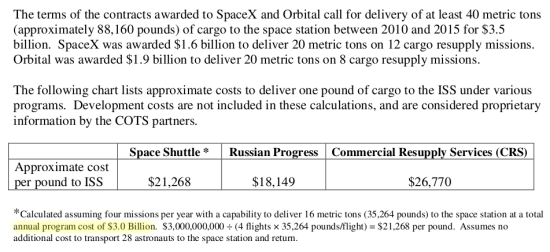
The problem is that these numbers are a complete lie, as they are based on a yearly cost of $3 billion to operate the shuttle (highlighted in yellow). I have been following NASA budget battles now for decades, and the shuttle operational budget has never, ever been that low. Routinely, NASA figures the cost to operate the shuttle per year, regardless of number of flights, to be about $4 billion per year.
» Read more