
Sotheby’s – Two impossible watches that shouldn’t exist
A evening pause: The subject of watches and time, possibly linked to astronomy, seems fitting on this first day of the new year, when we start a new number in our lives.
Hat tip Cotour.
A evening pause: The subject of watches and time, possibly linked to astronomy, seems fitting on this first day of the new year, when we start a new number in our lives.
Hat tip Cotour.

Click for original.

Click for original.
The two images to the right, both downloaded today (here and here) from the Mars rovers Curiosity (top) and Perseverance, illustrate quite clearly the beginning of the three-week-long communications blackout from Mars caused every two years when the orbits of Earth and Mars places the Sun in-between. As the Curiosity science team noted in a December 22, 2025 update:
This holiday season coincides with conjunction — every two years, because of their different orbits, Earth and Mars are obstructed from one another by the Sun; this one will last from Dec. 27 to Jan. 20. We do not like to send commands through the Sun in case they get scrambled, so we have been finishing up a few last scientific observations before preparing Curiosity for its quiet conjunction break.
Apparently engineers were able to squeeze data and images from Mars for a few extra days, but the incomplete nature of these two pictures — combined with the lack of any other new images today — tells us that the blackout has definitely begun. That they were able to get these additional images after conjunction began suggests the blackout might also end a bit earlier than expected.
Though there is always a concern that something could go wrong while communications are blocked, the risks are small. The science teams for all the Mars orbiters and rovers have dealt with this situation now almost a dozen times since operations became routine there more than a quarter century ago.
The only spacecraft at real risk this conjunction is Maven. Contact was lost from it in early December for unknown reasons, and all efforts to regain communications have so far failed. All engineers know from the little data they have gotten back is it appears to be tumbling. This three week blackout will make any chance of recovery extremely unlikely.
In 2025 the worldwide revolution in rocketry that began about a decade ago continued. Across the globe new private commercial rocket companies are forming, not just in the United States. And across the globe, the three-quarters-of-a century domination by government space agencies is receding, though those agencies are right now pushing back with all their might to protect their turf.
Dominating this revolution in 2025 in every way possible however were two entities, one a private American company and the second a communist nation attempting to imitate capitalism. The former is SpaceX, accomplishing more in this single year than whole nations and even the whole globe had managed in any year since the launch of Sputnik. The latter is China, which in 2025 became a true space power, its achievements matching and even exceeding anything done by either the U.S. or the Soviet Union for most of the space age.
» Read more
Archeologists have found a Neanderthal campsite from 400,000 years ago that shows strong evidence of the ability to make fire.
The researchers found two fragments of pyrite, a mineral that can produce sparks when struck against flint, indicating that the early Neanderthals used them as “a fire-making kit.” These ancient deposits mark the earliest known evidence of fire-making, roughly 400,000 years ago.
…The Barnham site lies in a disused clay pit in Suffolk, UK, preserving traces of the period around 427,000 to 415,000 years ago. In this area, the team found a small patch of reddened sediment, about the size of a modest campfire, surrounded by two pyrites, 19 flints, and four broken hand axes, showing clear signs of heating. Pyrites are rare locally, and the early Neanderthals likely carried them in from elsewhere.
Previously, the earliest known evidence of the ability to make fire had been dated from 50,000 years ago, and was done by homo sapiens, not Neanderthals.
Analysis of the sediment said the heat there matched that of a campfire, not a wildfire. The data also said the spot had been used repeatedly.
This one campsite suggests Neanderthals in general had the knowledge and tools to make fire, but it also could simply show the work of one particularly smart Neanderthal.
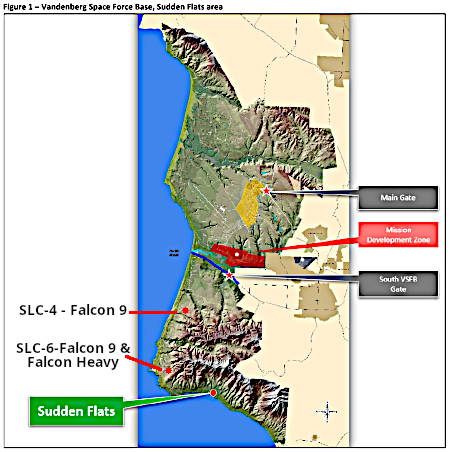
The Space Force on December 29, 2025 released a request for information (RFI) from the private sector for building a new launchpad at the southern-most tip of Vandenberg Space Force Base, for use by “new” heavy and super-heavy rockets.
The Space Force said it prefers to use the site for new vehicles rather than ones that already have launch sites at Vandenberg, to “increase launch diversity” at the base. The service is also interested in vehicles with “unique capabilities,” such as point-to-point transportation or the ability to return payloads.
The RFI emphasizes the need for “technically mature” vehicles capable of operating from SLC-14 within five years of signing a lease agreement. Companies must also provide details about their operations to address safety concerns and minimize impacts on other launch operators at the base.
You can read the actual RFI here. The map to the right, taken from the RFI and annotated to post here, labels the area under consideration as “Sudden Flats”. SpaceX’s two launchpads are indicated, with SLC-6 presently under development.
Though the description of the request appears to favor SpaceX, it could also apply to Blue Origin’s New Glenn as well as the company’s proposed larger versions of that rocket.
The request asks for proposals within 30 days.
China today successfully launched two technology test satellites designed to do “space target detection”, its Long March 7A rocket lifting off from its coastal Wenchang spaceport.
China’s state-run press provided no other information. It also appears the drop zones for the rocket’s lower stages were once again in Philippino waters, requiring that government to warn its citizens to avoid those zones and subsequent any rocket debris.
The leaders in the 2025 launch race:
168 SpaceX
90 China (a new record)
18 Rocket Lab
17 Russia
SpaceX still leads the rest of the world in successful launches, 168 to 150.
At this moment no other launches are scheduled before the end of the year, thus closing out the 2025 year in rocketry. I will publish my annual global report in the next few days. Stay tuned.

Jim Cantrell at Vector in 2017, shown in front of
one of his side businesses, fixing and refurbishing race
cars and rare luxury sports cars (located then at Vector).
The tales of rocket startups are often fraught with ups and downs of all kinds, often traveling in circles that no one can ever predict. This is one such tale.
In the mid-2010s there was a rocket startup called Vector, based here in Tucson, founded by a guy named Jim Cantrell. At that time Cantrell pushed the company in the style of Elon Musk, going very public for publicity and to raise investment capital.
He was remarkable successful at both. Unfortunately, his engineers were not as successful at engine building. After years of effort they all realized that their rocket engines were under-powered, and wouldn’t be able to get the rocket into orbit. In 2019 the company’s biggest investor backed out, Cantrell left the company, and new owners took over, hoping to rebuild.
Flash forward to 2021, and Jim Cantrell has reappeared with a new rocket company, Phantom Space, also based in Tucson, raising $6 million in seed capital. In the next four years he obtained a small development contract from NASA, completed two more investment rounds raising first $22 million and then around $37 million, and began development of a new orbital rocket, dubbed Daytona. The company also began work on its own small satellite constellation, PhantomCloud (more on this later).
As for Vector, there was little to report during those four years. The only update said the company was buying engines from the rocket engine startup Ursa Major, the same company Phantom was using.
It is now the end of 2025, and the fate of these two companies has once again intertwined, in a most ironic manner. Last week I learned from Jim Cantrell that Vector had closed shop, and that its last remaining assets, some of which Cantrell himself had helped develop when he headed Vector, had been bought by Phantom. This includes several unused rocket stages, the vertical rocket test stands, a lot of computers, and hardware.
» Read more

Click for original image.
Today’s cool image illustrates how beautiful images of heavenly objects don’t always have to be in wavelengths our eyes can see. With the wonders of modern technology, we can now see wondrous things in wavelengths that are invisible to us.
The picture to the right, cropped and reduced to post here, is a perfect illustration. It was released on December 1, 2025, and combines X-ray data from the Chandra X-ray Observatory with infrared data from the Webb Space Telescope. From the caption:
This view of NGC 2207 and IC 2163 takes a James Webb mid-infrared image (white, gray, and red) and adds the X-ray view from Chandra (blue). Together, it is quite an eye-catching result.
…Here, both spirals are shown face on, with the smaller of the two galaxies, IC 2163, at the upper left of the larger galaxy, NGC 2207, which dominates the center and lower right of the image. Both galaxies have long, spiraling, silver blue arms, dotted with specs of blue and red. Toward our upper left, the curving arms overlap, and bend toward their neighbors’ core.
In optical wavelengths the gossamer lines of structure would be lost, overwhelmed by the light of each galaxy’s stars.
China yesterday successfully placed what it called a “geographic mapping” satellite, its Long March 4B rocket lifting off from its Jiuquan spaceport in northwest China.
Its state-run press provided no additional information about the satellite, nor did it provide any information about where the rocket’s lower stages, using very toxic hypergolic fuels, crashed inside China.
The leaders in the 2025 launch race:
168 SpaceX
89 China (a new record)
18 Rocket Lab
17 Russia
SpaceX still leads the rest of the world in successful launches, 168 to 149.

Click for original image.
Cool image time! The picture to the right, rotated, cropped, reduced, and sharpened to post here, was taken on October 24, 2025 by the high resolution camera on Mars Reconnaissance Orbiter (MRO).
The science team labels this simply as “irregular terrain.” It is far more than that. We are looking at a three-mile-wide shallow canyon, with what appear to be eroding glacial features on the canyon floor.
The location is at 35 degrees north latitude, so finding glacial features here is entirely unsurprising, especially because this location is the southern edge of the 2,000-mile-long mid-latitude strip in Mar’ northern hemisphere I label glacier country, because almost every picture shows such glacial features.
In this case, the channel also suggests a much more complex geological history, that could involve flowing water though flowing glaciers are increasingly becoming an alternative explanation.
» Read more
SpaceX has now withdrawn the Starlink services it informally had provided customers in Papua New Guinea after a volcano eruption in 2021 due to regulatory demands by the government there.
It’s been two and a half years since a volcano eruption tore apart Tonga’s underwater internet cables, and a sympathetic Kiwi MP pleaded to Elon Musk for help on their behalf. Musk, CEO of SpaceX, would answer Shane Reti’s call, offering his Starlink technology in aid of their reconnection to the world.
Starlink’s Pacific debut came with limited trials in American-owned Guam and the Northern Marianas, followed by the Cooks in April 2021. But for the wider Pacific community, its deployment in Tonga captured hearts and minds. The service, provided by a special satellite network, has been hailed as “transformational” in numerous island nations, broadening internet coverage to remote areas, some for the first time.
That is, unless, you’re in Papua New Guinea. Starlink’s attempts to gain licensing in PNG have been tied up since December 2023, with the Ombudsman Commission challenging the government over Starlink’s reliability. The Commission blocked licensing efforts in February 2024, and have argued that existing regulations may not be adequate to manage potential risks to public interest and safety.
In-fighting within Papua New Guinea’s government continues to block Starlink license approval, so it appears SpaceX has decided the best way to get a positive decision is to walk away, hoping the ensuing pressure from its customers might force action from the government.

In what might be a larger decision by the European Space Agency (ESA) to pull back from support to ISS, the agency has cancelled a call for proposals that asked private commercial startups to provide cargo to ISS.
On 3 October, ESA published a call for proposals under its CSOC Cargo Commercially Procured Offset (3CPO) initiative, seeking commercial transport services to the ISS to deliver between 4,900 and 5,000 kilograms of pressurised cargo to the orbiting laboratory. According to the call, the mission was intended to act as a “strategic offset’ to secure flight opportunities for ESA astronauts. It did, however, stipulate that the prospective procurement would only proceed if member states agreed to fund the initiative at the agency’s Ministerial Council meeting on 26 and 27 November 2025.
Following the late November meeting, ESA announced that member states had “agreed to implement short-term actions to guarantee European astronauts’ access to the International Space Station until its planned end of exploitation in 2030.” While this initially appeared to signal a favourable decision on the 3CPO initiative, the agency formally cancelled the call on 17 December, citing “the implementation of programmatic adjustments.”
What makes me speculate that this decision is part of a larger strategy to pull back from ISS is based on other statements by ESA officials cited in the article. It appears ESA is also delaying the mission of one astronaut to ISS that had originally been planned for ’26, possibly by as much as two years.
Though that official said ESA had fully funded its commitments to ISS at its recently concluded ministerial council meetings, both of the above decisions suggest it is shifting its support elsewhere. It could very well be that ESA is beginning the process of transferring its support from ISS to the new commercial private stations, most especially Starlab, which it already has signed a partnership agreement. By delaying funding to ISS, it reserves that money for later use at the new stations.

Australian spaceports: operating (red dot) and proposed (red “X”)
Click for original image.
The American orbital capsule company Lux Aeterna has now signed a deal with the Australian spaceport startup Southern Launch to allow its capsules to land at its Koonibba Test Range in southern Australia.
Under the agreement, two Lux Aeterna Delphi satellites will return to the Koonibba Test Range with Southern Launch. The first mission is targeted to return in 2027.
Lux Aeterna, based in Denver, Colorado, USA, is developing a reusable satellite platform designed to operate in Low Earth Orbit and support defense, intelligence, and commercial missions such as technology demonstrations, hypersonic and materials testing, in-orbit servicing, and in-space manufacturing. The Delphi platform and its core components are engineered to withstand the thermal and structural demands of atmospheric re-entry, enabling routine return and recovery of both the satellite bus and payload to support expedited technology development.
…Under the partnership, Southern Launch will provide end‑to‑end services for each orbital re-entry, including regulatory approvals, range operations, air and maritime coordination, and recovery operations.
This is the second American orbital capsule company to sign with Southern Launch. Varda was the first, and it did so because red tape in the U.S. made use of an American drop zone impractical. It appears Lux Aeterna has come to the same conclusion, and thus went to Australia instead.
This is an issue that needs to be addressed by the Trump administration. It is absurd that red tape is forcing American capsules to land in another country on the other side of the globe.
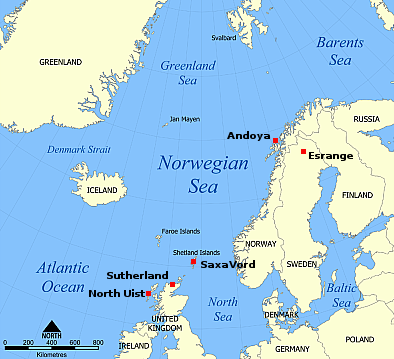
Spaceports surrounding the Norwegian Sea
In a press release earlier this week, the German rocket startup Isar Aerospace announced that it has successfully completed static fire tests of both stages of its Spectrum rocket, and is now prepared for a second attempt to reach orbit, nine months after the first attempt failed seconds after liftoff.
Though its press release made no mention of a launch date, rocketlaunch.live is listing that attempt for January 13, 2026, taking place at Norway’s Andoya spaceport.
If successfully, the launch will achieve a number of milestones. First, Isar will be the first German rocket company ever to launch a rocket into orbit. Germany’s government has for decades been a partner in Arianespace, the commercial arm of the European Space Agency, but no private company has ever built and launched its own rocket.
Isar’s success will also beat out the German startup Rocket Factory Augsburg and Spanish startup PLD, both of which are getting close to a first launch as well.
Second, the launch from Andoya will make that spaceport the first in Europe to place a satellite into orbit, despite coming to this commercial spaceport competition years after two of Great Britain’s proposed spaceports in northern Scotland. While Norway’s government has greased the rails, removing red tape to allow Andoya to become operational quickly (and thus attracting rocket startups like Isar, Firefly, and Astrobotic), Great Britain’s red tape has delayed its spaceports for years, while putting one rocket company, Virgin Orbit, out of business.
Russia today successfully launched more than fifty satellites, its Soyuz-2 rocket lifting off from its Vostochny spaceport in far eastern Russia.
The main payloads were two Russian Earth imaging satellites, both dubbed Aist-2T
In addition to the launch of the Aist-2T pair, the same Soyuz-2-1b rocket was also booked to carry 50 dual-purpose secondary payloads, ranging from light-weight experimental satellites down to an assortment of educational cubesats and a small carrier platform, itself designed to release the tiniest satellites known as pikosats. A total of 33 payloads were to be deployed from 17 launch containers provided by Moscow-based Aerospeis Kapital.
The most notable secondary payloads on the mission were two Marafon-IoT experimental satellites, developed at ISS Reshetnev and intended for paving the way to the so-called Internet-of-Things satellite system, however, by the time they reached the launch pad, the main project was facing cancellation due shrinking Russian space budget.
The most significant foreign payload on the Aist-2T mission was a trio of Iranian dual-purpose satellites all intended for remote-sensing of the Earth’s surface. Other small foreign payloads were ordered by various institutions in Montenegro, Kuwait, Qatar, Ecuador and Belarus. [emphasis mine]
Russia continues to show an inability to get anything of substance into orbit due to a lack of capital, caused by Putin’s policies of squelching competition and invading other countries.
The leaders in the 2025 launch race:
168 SpaceX
88 China (a new record)
18 Rocket Lab
17 Russia
SpaceX still leads the rest of the world in successful launches, 168 to 148.
China today (December 27 in China) successfully placed a new Fengyun-4 satellite into orbit, its Long March 3B rocket lifting off from its Xinchang spaceport in southwest China.
China’s state-run press provided no information about where the rocket’s lower stages and four strap-on boosters, all using very toxic hypergolic fuels, crashed inside China. This Fengyun-4 satellite is the third in a new constellation of seven upgraded weather satellites.
The leaders in the 2025 launch race:
168 SpaceX
88 China (a new record)
18 Rocket Lab
16 Russia
SpaceX still leads the rest of the world in successful launches, 168 to 147.
Last night China successfully placed nine more satellites for the Guowang (or Satnet) internet-of-things constellation, its Long March 8A rocket lifting off from its Wenchang coastal spaceport, The constellation now has 128 satellites in orbit out of a planned 13,000. Though the rocket’s lower stages all fell in the ocean, some landed within the Philippines, once again requiring that government to warn its citizens to avoid the drop zones.
China’s last night also scrubbed a launch of its solid-fueled Smart Dragon-3 (also Jielong-3) rocket, set to lift off from a launch platform off the coast of northeastern China. The launch was rescheduled for December 28th. China also had a Long March 3B launched scheduled for this morning, but no news about that launch as yet been published.
The leaders in the 2025 launch race:
168 SpaceX
87 China (a new record)
18 Rocket Lab
16 Russia
SpaceX still leads the rest of the world in successful launches, 168 to 146.
In a tweet on X, Blue Origin today announced that former ULA CEO Tory Bruno is now working for them, acting as president for its “newly formed National Security Group.”
Blue Origin’s CEO, David Limp, quickly chimed in with his own tweet, endorsing the hire.
My guess is that Limp felt Blue Origin needed someone with experience dealing with the military, and Bruno brings that capability, having managed ULA’s military launch contracts for years. It also means Blue Origin is very serious about grabbing a larger market share of those launches once its New Glenn rocket begins launching regularly.
I also wonder if Bruno grew tired of the culture at ULA, which has appeared resistant to building reusable rockets. Bruno sold Vulcan initially with the idea of quickly upgrading it to recover its engines for reuse, but by all signs the company has been very unenthusiastic about the idea. (The idea itself might not be viable, but overall ULA has shown no interest in developing a reusable rocket of any sort.) Bruno might have decided he’d rather work with a company enthused by reusability, especially as this is the future. Once ULA completes its large Amazon Leo launch contract it faces a bleak future, with many newer cheaper reusable rockets coming on line.
It could also be that Bruno was made an offer he couldn’t refuse. Money is always a powerful incentive.

The Starlab design in 2025. Click
for original image.
The consortium building the Starlab space station today announced that the Sumitomo Mitsui Trust Bank of Japan has invested in the project.
Through this investment, SuMi TRUST Bank will support Starlab’s efforts to develop and commercialize space station technologies, while exploring opportunities for collaboration that contribute to the advancement of space-related industries and broader industrial development in Japan and globally.
The press release provided no other information, other than this boilerplate PR jargon. The amount invested was not mentioned.
Regardless, the investment tells us two things: First, Starlab has now raised more than $400 million in investment capital, and appears in a solid position to begin work on its large single module station to be launched on Starship.
Second, the investment in this American-based space project by this Japanese bank speaks volumes about the sad state of Japan’s own commercial space industry. Other than the lunar lander Ispace, Japan has seen little success from any other major rocket startups. One rocket startup, Interstellar, has obtained some investment capital, but the development of its rocket seemingly stopped for the past five years. Another, Space One, has had one launch failure. And though Honda has completed a successful vertical take-off and landing of a small rocket prototype, it doesn’t expect to attempt an orbital launch until 2030.
Meanwhile, the two rockets owned by Japan’s space agency JAXA, the H3 and Epsilon, are grounded because of launch failures.
It appears this bank believes it is more likely to earn profits from this American project than from these other Japanese space efforts.
The Italian rocket company Avio has won a $81 million launch contract from Taiwan’s space agency TASA to use its Vega-C rocket to launch four Earth observation satellites.
FORMOSAT-8 will be a constellation of six high-resolution optical Earth observation satellites. The first was launched aboard a SpaceX Falcon 9 rocket in November. The next, FORMOSAT-8B, which does not yet have a publicly announced launch services provider, is, according to TASA, slated for launch in December 2026. The FORMOSAT-9 constellation will be made up of two synthetic aperture radar (SAR) satellites, which are expected to be launched in 2028 and 2030, respectively.
All four satellites will be launched aboard Vega C rockets from the Guiana Space Centre in French Guiana.
It is not clear if this contract involves four separate launches, or two (one for Formosat-8A and B, and a second for Formosat-9A and B). It is also not clear if this contract is one of the two launch contracts Avio had previously announced, without revealing the customers.