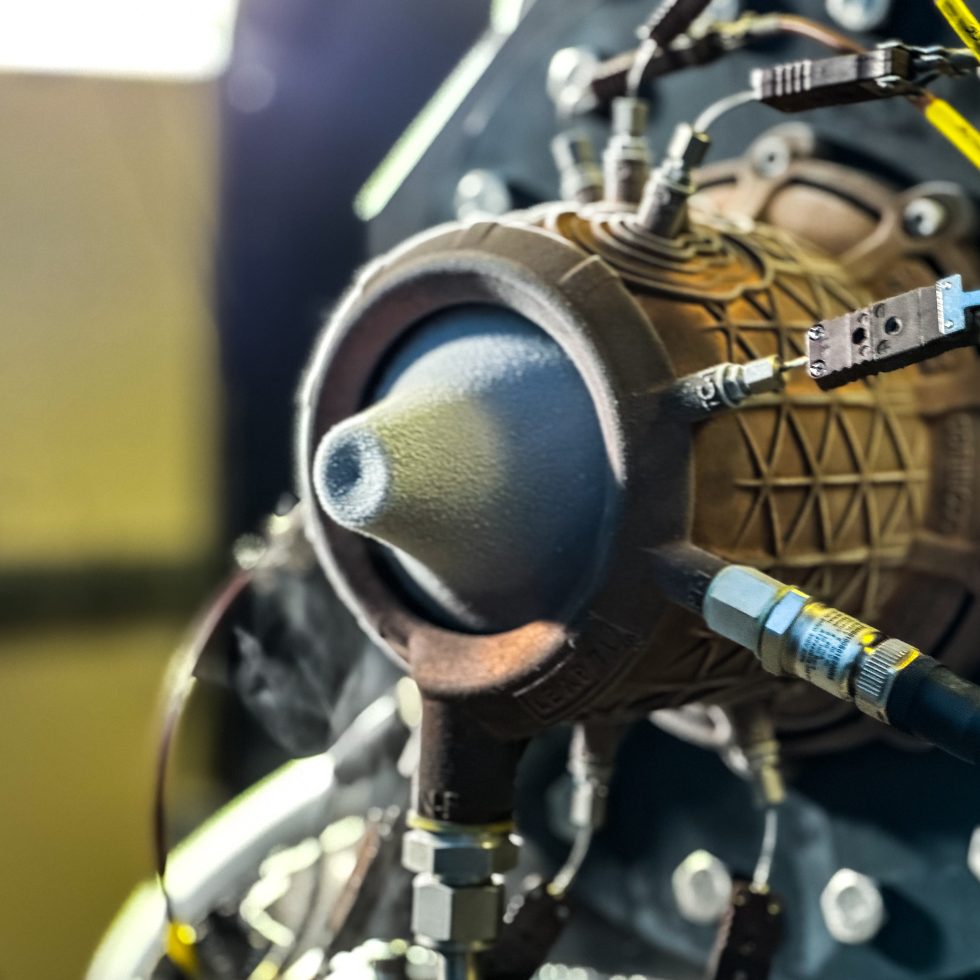
AST SpaceMobile signs up Verizon to use its constellation for phone-to-satellite service

The startup AST SpaceMobile, which is building a constellation of satellites able to act as cell towers for smart phones, has now signed an agreement with Verizon to give its subscribers access to the service.

AST SpaceMobile’s shares closed up more than 8% Oct. 8 after Verizon joined AT&T in signing a definitive agreement to use its planned space-based cellular network, easing investor concerns about SpaceX’s aggressive push into the fledgling direct-to-device (D2D) market.

The deal enables Verizon to provide D2D connectivity to its customers from some point in 2026, building on a strategic partnership announced in May 2024 that included plans for a $100 million investment in AST.

As noted above, AST has now signed both Verizon and AT&T, two of the largest cellphone companies, strengthening its position considerably in its competition with SpaceX’s Starlink cell-to-satellite alternative. Both deals appear to allow these companies the ability to sign contracts with both AST and Starlink, so it is possible the competition won’t be as fierce initially as it appears. It is also possible that eventually they will pick one or the other, so neither company should be complacent.

AST presently has five of its BlueBird satellites in orbit out of its planned 45-60 satellite constellation, and hopes to have at least half the constellation in orbit by the end of ’26. So even if it wins its cellphone competition with SpaceX that rocket company will still likely make some money launching AST’s satellites.

0 comments

Martian winds are faster than expected

According to an analysis of pairs of 300 hundred orbital images taken seconds apart, scientist have found that Martian winds can reach speeds of 100 miles per hour (160 kilometers per hours), much faster than previously expected.

The results show that the dust devils and the winds surrounding them on Mars can reach speeds of up to 44 m/s, i.e. around 160 km/h, across the entire planet, which is much faster than previously assumed (previous measurements on the surface had shown that winds mostly remain below 50 km/h and – in rare cases – can reach a maximum of 100 km/h). The high wind speed in turn influences the dust cycle on the Red Planet: “These strong, straight-line winds are very likely to bring a considerable amount of dust into the Martian atmosphere – much more than previously assumed,” says Bickel. He continues: “Our data show where and when the winds on Mars seem to be strong enough to lift dust from the surface. This is the first time that such findings are available on a global scale for a period of around two decades.”

You can read the paper here. The study also found dust devils favor the spring and summer in both the north and south hemispheres, and tended to be concentrated in the mid-latitudes.

What is most interesting about this data, which because it is somewhat sparse has a lot of uncertainties, is that it suggests the candidate landing zone for SpaceX’s Starship is a region with one of the most intense dust devil seasons every spring and summer. This is not really a threat to settlement, because the atmosphere is so thin even these high winds would hardly be felt, but it does indicate an environmental condition that must be considered for any future settlement there.

14 comments

Fresh slope streak on Mars

Fresh slope streak on Mars
For original images go here and here.

Cool image time! One of the geological mysteries on Mars seen no where on Earth is something scientists have dubbed “slope streaks.” Though they at first glance appear to be avalanches, they do nothing to change the topography, have no debris pile at their base, and sometimes even travel up and over rises on their way downhill. They can also appear randomly throughout the year, can be bright or dark, and fade with time.

No theory as to their cause has yet been accepted, though recent research suggests they are dry events, dust avalanches triggered by dust devils, wind, or the accumulation of dust.

To better understand this geology, scientists repeatedly monitor known slope streak locations looking for changes. The two images to the right are an example, downloaded from the high resolution camera on Mars Reconnaissance Orbiter (MRO) on July 2, 2024 and September 1, 2025. In the fourteen months that passed between the first and second images, two distinct and large slope streaks occurred next to each other, near the bottom of the picture. All the other streaks merely faded.
» Read more

0 comments

Canadian rocket startup Nordspace obtains expanded ground station contract

Proposed Canadian spaceports

The Canadian rocket startup Nordspace has signed an agreement with the ground station company C-Core to establish more tracking and communication facilities in conjunction with Nordspace’s launch plans at its Atlantic spaceport in Newfoundland.

NordSpace and C-CORE have signed a Memorandum of Understanding (MOU) that will see the companies work together in developing new ground stations across Canada with initial locations planned for the Atlantic Spaceport Complex (ASX) in St. Lawrence, Newfoundland and Labrador, and Inuvik, Northwest Territories.

With C-CORE being based in St. John’s, Newfoundland, and already established in providing ground station services, it seems like a natural collaboration that could benefit both companies. For NordSpace, which owns and is developing the Atlantic Spaceport Complex, this collaboration provides the potential for another type of revenue source as the company tries to diversify.

Nordspace has not yet launched, though its first suborbital test launch several weeks ago was scrubbed twice due to ground equipment fuel leaks. It has not yet announced another date for that suborbital test, but plans a static fire test in October of the engine it is building for its orbital Tundra rocket.

This company is only three years old, and appears to have leap-frogged past Canada’s other spaceport operation in Nova Scotia, which has been trying to get off the ground for almost a decade.

0 comments

Stoke Space said to be raising as much as $500 million in private investment capital

Stoke's Nova rocket
Stoke’s Nova rocket, designed to be
completely reusable.

UPDATE: Stoke Space confirms the story, announcing today that it has raised $510 million in new capital.

According to anonymous sources, the rocket startup Stoke Space is in the process of raising as much as $500 million in private investment capital, with new $2 billion valuation for the company.

Stoke Space, one of the Seattle area’s up-and-coming space startups, is said to be raising hundreds of millions of dollars in a funding round that it hasn’t yet publicly acknowledged. A report about the round, based on two unidentified sources, was published today by The Information.

The Information quoted its sources as saying that the funding round could total as much as $500 million, and would value Stoke at nearly $2 billion. That figure would be roughly twice as much as the $944 million valuation that was cited by Pitchbook as of January. The round’s lead investor is said to be Thomas Tull’s United States Innovative Technology Fund.

Earlier this year Stoke raised $260 million, bringing its available capital to almost a half billion. If this story is confirmed, it means the company will have almost a billion in available cash on hand.

The design of Stoke’s Nova rocket is unique in that both the lower and upper stages will be reusable. The first stage will land vertically, like SpaceX’s Falcon 9. The upper stage meanwhile uses a radical nozzle design, a ring of tiny nozzles around the perimeter of a heat shield, to protect it during re-entry.

The company has said it plans the first launch in 2026, but has not been more specific as to when. If successful, this rocket will certainly become a major player, as it will be able to offer even lower prices than SpaceX because none of the rocket will be expendable.

11 comments

Japanese satellite company extends its launch contract with Rocket Lab

The Japanese satellite company Q-shu Pioneers of Space, Inc. (iQPS) has purchased three more launches from Rocket Lab, for a total of seven planned.

The multi-launch contract includes three dedicated Electron missions that will launch no earlier than 2026 from Rocket Lab Launch Complex 1 in New Zealand. With four dedicated missions already booked by iQPS on Electron, these three additional missions bring the total number of upcoming launches for iQPS to seven.

Each dedicated launch will deploy a single synthetic aperture radar (SAR) satellite from a Rocket Lab Motorized Lightband separation system – demonstrating Rocket Lab’s vertical integration across launch and space systems that improves reliability and streamlines the launch process for its customers.

Rocket Lab has already completed four successful launches for iOPS, so with this deal means that it will complete eleven launches total for the satellite company. Essentially iQPS has made Rocket Lab its prime launch provider.

This is also the second major launch contract for Rocket Lab in the past week. On September 30, 2025 Synspective purchased its second multi-launch contract with the company, buying ten more launches. Its first contract was for eleven launches, with six already completed. Synspective hopes to have its entire radar constellation of 30 satellites in orbit by the late 2020s.

Both contracts tell us that Rocket Lab’s Electron rocket is going to have a very busy launch schedule for the next few years, even as the company initiates its larger Neutron rocket.

0 comments

Martian boxwork on the flanks of Mount Sharp

The boxwork on Mars
Click for original image.

Cool image time! The picture to the right, cropped, reduced, and sharpened to post here, was taken on October 5, 2025 by the left navigation camera on the Mars rover Curiosity.

The picture looks north and downhill from the lower flanks of Mount Sharp, inside Gale Crater. In the far distance on the horizon can be seen the crater’s northern rim, about 20 to 30 miles away. As it is now moving into the dusty season on Mars, the haze has increased from only a month ago, making it hard to see many distant details.

In the foreground can be seen clearly the light-colored ridges of the boxwork that the rover has been traversing for the past three months, with one rover track visible on the nearest ridge. Unlike the very rocky and boulder-strewn terrain the rover has seen in most of its travels on Mount Sharp, this boxwork seems smoother.
» Read more

2 comments

A galaxy with a starburst ring within its nucleus

A galaxy with a starburst ring
Click for full image.

Cool image time! The picture to the right, cropped, reduced, sharpened, and annotated to post here, was released today by the science team of the Hubble Space Telescope as the picture of the week. This crop focuses on the central regions of this barred spiral galaxy, about 70 million light years away, with an unusual extra feature, a starburst ring encircling its nucleus. From the caption:

NGC 6951’s bar may be responsible for another remarkable feature: a white-blue ring that encloses the very heart of the galaxy. This is called a circumnuclear starburst ring — essentially, a circle of enhanced star formation around the nucleus of a galaxy. The bar funnels gas toward the centre of the galaxy, where it collects in a ring about 3800 light-years across. Two dark dust lanes that run parallel to the bar mark the points where gas from the bar enters the ring.

The dense gas of a circumnuclear starburst ring is the perfect environment to churn out an impressive number of stars. Using data from Hubble, astronomers have identified more than 80 potential star clusters within NGC 6951’s ring. Many of the stars formed less than 100 million years ago, but the ring itself is longer-lived, potentially having existed for 1–1.5 billion years.

This galaxy has also seen about a half dozen supernova, which raises the question: Does intense star formation trigger more supernovae? That is a question that can’t be answered with the data presently available.

2 comments

Firefly Aerospace buys defense contractor SciTec

Firefly Aerospace yesterday announced that it is buying the defense contractor SciTec for $300 million in cash plus $555 million in Firefly shares.

The shares go to SciTec’s owners at an agreed-to value of $50 per share, essentially making those individuals part owners of Firefly.

The acquisition will advance Firefly’s comprehensive space services by adding mission-proven defense software analytics, remote sensing, and multi-phenomenology data expertise. SciTec’s core capabilities – which include missile warning, tracking and defense, intelligence, surveillance and reconnaissance, space domain awareness, and autonomous command and control – will supplement Firefly’s launch, lunar, and in-space services. SciTec further adds ground and onboard data processing as well as AI-enabled systems designed for low latency operations to support advanced threat tracking and response across multiple domains.

In other words, this acquisition is aimed at improving Firefly’s ability to win defense contracts, thus diversifying its business beyond outer space. This suggests its managers believe there isn’t enough business in outer space to put the company in the black. It needs defense contracts, and adding SciTech increases the odds it will win those contracts.

The stock price in this sale, $50, I think tells us something of the motives of SciTec’s owners. At present Firefly’s stock is selling at about $30 on Wall Street, and the price has not changed much today after this announcement. It appears the stock obtained by SciTec’s owners is thus not as valuable as listed in the intended sale price. This in turn suggests that those owners also needed this deal to diversify the company, and were willing to take a loss in the value of their stock to get it.

Then again, my understanding of how Wall Street and stocks function is limited, and my analysis on this point could be completely wrong.

5 comments

Space Force awards SpaceX and ULA seven launches worth more than a billion dollars

The U.S. Space Force (USSF) yesterday awarded multi-launch contracts to both SpaceX and ULA for seven launches beginning in 2027 worth more than a billion dollars.

SpaceX received $714 million for five launches and ULA was awarded $428 million for two launches, USSF said in an Oct. 3 news release.

The awards are part of the Space Force’s National Security Space Launch Program, which it uses to launch services for military space missions. In April, it chose SpaceX, ULA, and Blue Origin to launch a total of 54 missions scheduled between fiscal 2027 and 2032, with SpaceX responsible for just over half, with 28 launches. Individual missions will be awarded in batches through fiscal 2029.

Though Blue Origin was included in this program and its New Glenn rocket has finally launched once successfully, its not yet been certified to launch military satellites, and to get certified the company is going to have to launch at least one more time. That launch is expected before this month is out. Moreover, it will soon have to compete against more companies, and the Pentagon will be adding Rocket Lab and Stoke Space to its approved list as soon as both successfully launch their respective Neutron and Nova rockets by next year.

7 comments

Gilmour to attempt first launch again next year

Eris rocket launch and failure
Eris rocket falling sideways from launchpad
(indicated by red dot). Click for video, cued
to just before launch.

According to a presentation by the CEO and founder of Australian rocket startup Gilmour Space, the company now sufficiently understands what caused the failure on its first launch attempt on July 30 to plan a second attempt in 2026.

The company is still investigating the root cause of the failure. “It looks like what went wrong on the launch is something we’ve never tested close enough to the launch conditions before,” he said, but didn’t elaborate.

One factor in the launch was the long delay between shipping the rocket to the launch site, known as the Bowen Orbital Spaceport, and the launch itself. “Rockets aren’t designed to be at the launch site for 18 months,” he said. The launch site, he noted, is just a kilometer from the ocean, creating salty conditions that can be corrosive.

That extended time at the launch site stemmed from delays securing regulatory approvals for the launch. That included not just a launch license from the Australian Space Agency but also airspace, maritime and environmental permits. “We had to get 24 different permits from the Queensland government,” Gilmour said. “All of these things take a long time to do.” He acknowledged that the company had not put enough resources into those regulatory processes. “The approval processes just took way too long.”

What is ironic is that as bad as Australia appears to be in terms of red tape, it is far better that it mother country, Great Britain. At least in Australia spaceports have been approved and at least one launch has taken place. And it only took eighteen months! In Great Britain the permitting process for its two proposed rocket spaceports has taken almost a decade, and still no vertical launches have occurred at either.

2 comments

SpaceX launches 28 Starlink satellites

SpaceX this morning successfully launched another 28 Starlink satellites, its Falcon 9 rocket lifting off from Vandenberg Space Force Base in California.

The first stage completed its second flight, landing on a drone ship in the Pacific.

The leaders in the 2025 launch race:

127 SpaceX
58 China
13 Russia
12 Rocket Lab

SpaceX still leads the rest of the world in successful launches, 127 to 98.

4 comments

Satellite propulsion startup Portal successfully tests new and radical thruster design

The satellite propulsion startup Portal has become the first commercial company to test successfully a thruster that uses concentrated sunlight to ionize a fuel.

The concept has been studied several times by NASA and other government entities, but never tested to a point where it could be used on a mission. According to this report:

For the vacuum chamber test at Portal’s Bothell lab, engineers used an electrical induction system to simulate the sun’s heating power. The apparatus reached temperatures in the range of 1,500 degrees Celsius (2,700 degrees Fahrenheit), and the performance of the thruster validated Portal’s propulsion architecture for integration with future flight hardware.

The concept is similar to an ion engine, but appears to produce more thrust, allowing it to move satellites more quickly to different orbits. Portal hopes to do an in orbitat test by next year. The company has raised $17.5 million in private funding, and $45 million from an Air Force grant.

2 comments

Update on the plans to observe interstellar Comet 3I/Atlas using interplanetary spacecraft

Link here. The key take-away is that nothing is being repurposed to attempt to fly to Comet 3I/Atlas. Instead, as expected the science teams for all the Mars orbiters will turn their instruments to the comet when it is at its closest point to Mars, about 19 million miles away.

Don’t expect any Earth-shattering revelations:

The cameras on these spacecraft were designed to photograph the surface of Mars from Mars orbit, and won’t be able to pick out much detail on such a relatively small comet 30 million km away. But the cameras may be able to capture images of its long tail and also gather data that scientists can use to find out more about what 3I/ATLAS is made of.

Some spectroscopic data will be obtained, but it likely will not be much better than what Webb and other Earth-based telescopes have gotten already.

Similarly, the science team for Europe’s Juice mission, on its way to Jupiter, will take a look, but the distances and orbital positioning will likely limit what it can detect as well.

3 comments

The growing mystery of the little red dots in the early universe

The uncertainty of science: A review of the population of what scientists call “Little Red Dots” (LRDs) — discovered in the early universe by the Webb Space Telescope — has found that 30% do not appear to be compact objects when viewed in ultraviolet wavelengths.

The team studied 99 LRDs, and found that about 30% are not simply compact dots when observed in the ultraviolet.Instead, they reveal disturbed or clumpy structures, in stark contrast to their smooth, point-like appearance at optical wavelengths. Because these galaxies are so far away, their optical light is stretched, or “redshifted,” into the long-wavelength channel of JWST, where the resolution is not sharp enough to see structure, so they look like simple dots.

Rinaldi: ‘But their ultraviolet light is shifted into JWST’s short-wavelength channel, where the telescope has much finer resolution, and there we suddenly see clumps, asymmetries, and signs of interaction. On top of this, in the spectra of some of our LRDs we directly detect the fingerprints of active black holes, with gas moving at thousands of kilometres per second.’ This shows that at least part of this population is powered by growing black holes, while others seem to be dominated by star formation, making LRDs a mixed and diverse family of sources. This is a crucial clue, suggesting that mergers and galaxy interactions may be the trigger for the “LRD phase”.

In other words, astronomers don’t really know what these dots are at present. If some are supermassive black holes, this poses a problem for Big Bang cosmology, as there should not have been enough time since the Big Bang for these black holes to have formed.

That 70% still appear to be compact single objects might mean that’s what they are, but it could also mean that our present observations tools don’t yet have the ability to resolve them.

1 comment

Analysis of archived Cassini data finds a new slate of carbon-based molecules in the plumes of Enceladus

Enceladus at 77 miles
The tiger strip vents on Enceladus, seen
from 77 miles during 2015 fly-by. Resolution is
50 feet per pixel.

A new analysis of the archived Cassini data taken when the spacecraft flew through the plumes of the Saturn moon Enceladus in 2008 has revealed a number of new organic molecules (not life but carbon-based) that suggest the chemistry of the moon of Saturn is far more complex that expected.

You can read the paper here. From the abstract:

Here we present a comprehensive chemical analysis of organic-bearing ice grains sampled directly from the plume during a Cassini fly-by of Enceladus (E5) at an encounter speed of nearly 18 km [per second]. We again detect aryl and oxygen moieties in these fresh ice grains, as previously identified in older E-ring grains. Furthermore, the unprecedented high encounter speed revealed previously unobserved molecular fragments in Cosmic Dust Analyzer spectra, allowing the identification of aliphatic, (hetero)cyclic ester/alkenes, ethers/ethyl and, tentatively, N- and O-bearing compounds. These freshly ejected species are derived from the Enceladus subsurface, hinting at a hydrothermal origin and involvement in geochemical pathways towards the synthesis and evolution of organics.

In other words, this data further suggests there exists an underground ocean inside Enceladus, and that ocean has a lot of complex organic chemistry energized by the planet’s internal heat and the tidal forces imposed by Saturn’s gravity.

This is not the first time scientists have reviewed archived Cassini data of these plumes and found new molecules. It is simply a closer look at earlier analyses in 2018 and 2019.

This data has not discovered life, but it suggests that life is certainly possible within that proposed underground ocean. At a minimum, the chemistry there will be very complex and alien.

1 comment

Astronomers snap picture of a baby exoplanet

Baby planet
Click for original image.

Cool image time! The picture to the right, cropped to post here, was taken using Magellan Telescope in Chile and the Large Binocular Telescope in Arizona. The exoplanet is the small purple dot to the right of the star and the accretion ring that surrounds it.

This exoplanet is very young, only about five million years old, and is thus still accumulating material. Even so, its mass is presently estimated to be five times that of Jupiter.

Following [the first] observations of the system, researchers looked at WISPIT 2, and spotted the planet WISPIT 2b for the first time, using the University of Arizona’s MagAO-X extreme adaptive optics system, a high-contrast exoplanet imager at the Magellan 2 (Clay) Telescope at Las Campanas Observatory in Chile. This technology adds another unique layer to this discovery. The MagAO-X instrument captures direct images, so it didn’t just detect WISPIT 2b, it essentially captured a photograph of the protoplanet.

…In addition to discovering WISPIT 2b, this team spotted a second dot in one of the other dark ring gaps even closer to the star WISPIT 2. This second dot has been identified as another candidate planet that will likely be investigated in future studies of the system.

You can read the paper here [pdf]. The other candidate exoplanet is the bright spot below the star, inside the ring.

The technology of astronomy continues to advance.

0 comments

Varda signs deal for more capsule landings in Australia

Proposed Australian spaceports
Australian spaceports: operating (red dot) and proposed (red “X”)
Click for original image.

The recoverable capsule company Varda has now signed a new deal that will allow it to land up to 20 more capsules at the commercial spaceport/range Southern Launch in Australia through 2028.

It has already landed capsules there twice. This new contract suggests that Varda has enough expected customers and products to place in its capsules to pay for about six or seven capsules launched per year. If so, this manufacturing model in space is going to bloom very quickly, and will likely become a major profit center for the commercial space stations now under development.

The deal also illustrates the utter failure of the U.S. government’s red tape, especially during the Biden administration.

The company landed its first mission, W-1, at the Utah Test and Training Range in February 2024. But difficulties securing licenses and other approvals for that mission prompted Varda to look elsewhere. “Through that experience, it became pretty clear that the U.S. was not going to be the location for high-cadence reentry operations in the near term,” Eric Lasker, Varda’s chief revenue officer, said at an IAC event announcing the new agreement.

Hopefully the anti-regulatory policies of Trump will change this, but for the moment our government has driven this American company away from the U.S.

1 comment

Belgium company joins Starlab space station consortium

Starlab design in 2025
The Starlab design in 2025. Click
for original image.

The Starlab consortium, proposing to build its single-module large Starlab space station that will be launched on Starship, has now added the Belgium company Space Applications Services (SpaceApps) as both a partner and investor.

SpaceApps contributes deep experience in space systems, mission operations and payload integration with capabilities that include avionics, payload development, the end-to-end International Commercial Experiment Cubes (ICECubes) service, as well as mission integration and operations control software. The company also works closely with the European Space Agency and international partners, broadening Starlab’s access to global markets and research communities.

The Starlab consortium already includes the American companies Voyager Space and Northrop Grumman and the European company Airbus. It also has a partnership agreement with the European Space Agency. This new Belgium partnership further cements its place as Europe’s potential future space station after ISS is retired.

This deal is only one of several news stories in the past week signaling progress by this consortium. It has signed the American company Vivace to build the station’s main structure and its partner Northrop Grumman has successfully tested the rendezvous and docking technology its Cygnus cargo capsule will use to dock with Starlab. All in all this station appears to be assembling the pieces its needs.

Below is my updated rankings of the four commercial stations under development:
» Read more

0 comments
1 43 44 45 46 47 814