SpaceX donates $4.4 million to upgrade beach access at Boca Chica

Even as leftist politicians and anti-Musk haters rage incoherently against SpaceX’s growing facility at Boca Chica, the company this week donated $4.4 million to upgrade the beach access and facilities at South Padre Island, near Starbase at Boca Chica.

Beachgoers visiting South Padre Island will soon be able to enjoy a surfside park with a smorgasbord of family-friendly amenities paid for by a $4.4 million contribution from Elon Musk’s SpaceX. Previously, MySA reported that the project was expected to cost $4.5 million, according to Texas Department of Licensing and Regulation records.

Cameron County Beach Access #3, a currently undeveloped pedestrian beach access located just outside the South Padre Island city limits, will soon begin construction on the latest phase of a multimillion-dollar improvement project that will transform it into a destination beach access. To that end, Cameron County leaders celebrated with a groundbreaking ceremony on Monday, August 11, at the access, located at 28495 State Park Road 100-North, on South Padre Island.

In other words, SpaceX is paying almost the entire bill for this work. It might now have the power to close these beaches when necessary, but it is also acting like a good citizen, improving those beaches for everyone when they are open.

It is expected this work will be completed by next year.

10 comments

Update on next Starship/Superheavy launch

Superheavy after its flight safely captured at Boca Chica
Superheavy after the October 2024 flight,
safely captured during the very first attempt

Link here.

SpaceX now appears to have completed the prelaunch testing of Starship prototype #37, having tested the ship again after swapping out an engine after the first static fire test. It is now moving to put Superheavy on the launchpad for its own static fire tests.

The bottom line is that SpaceX appears moving successfully towards a launch of the next test flight of Superheavy/Starship, its tenth, for sometime between August 22nd and August 28th.

The report also describes the company’s work to preserve Superheavy prototype #12, the first to be captured and recovered during the fifth orbital test flight in October 2024.

The picture to the right shows that Superheavy booster, hanging from the chopsticks just after it was captured.

4 comments

SpaceX completes two launches, reaching 100 successful orbital launches in 2025

Having successfully completed two Starlink launches last night, putting a total of 52 satellites into orbit, SpaceX has now accomplished 100 successful orbital launches in 2025.

First, in the early evening last night the company launched 24 satellites from Vandenberg in California, its Falcon 9 rocket first stage completing its fifth flight, landing on a drone ship in the Pacific.

Seven hours later it placed another 28 Starlink satellites into orbit, its Falcon 9 rocket lifting off from Cape Canaveral in Florida. The first stage on this flight completed its tenth flight, landing on a drone ship in the Atlantic.

The leaders in the 2025 launch race:

100 SpaceX
44 China
11 Rocket Lab
9 Russia

SpaceX now leads the rest of the world in successful launches, 100 to 77.

SpaceX’s launch rate has become so routine that it is important to note the truly amazing nature of its achievement. Until 2018, the entire world had trouble completing 100 launches in a year. In fact, prior to SpaceX’s arrival it only happened because the Soviet Union in the ’70s and ’80s launched many short term small reconnaissance satellites that only stayed in orbit for a few months. When the Soviet Union fell the launch rate fell below 100 and did not recover until SpaceX began increasing its launch rate.

In other words, this one American private company has fueled a renaissance in space exploration. And it has done so by being efficient, innovative, and most important of all, profitable. And it all happened under the banner of freedom.

3 comments

When Martian lava meets a Martian mountain

When Martian lava meets a Martian mountain
Click for original image.

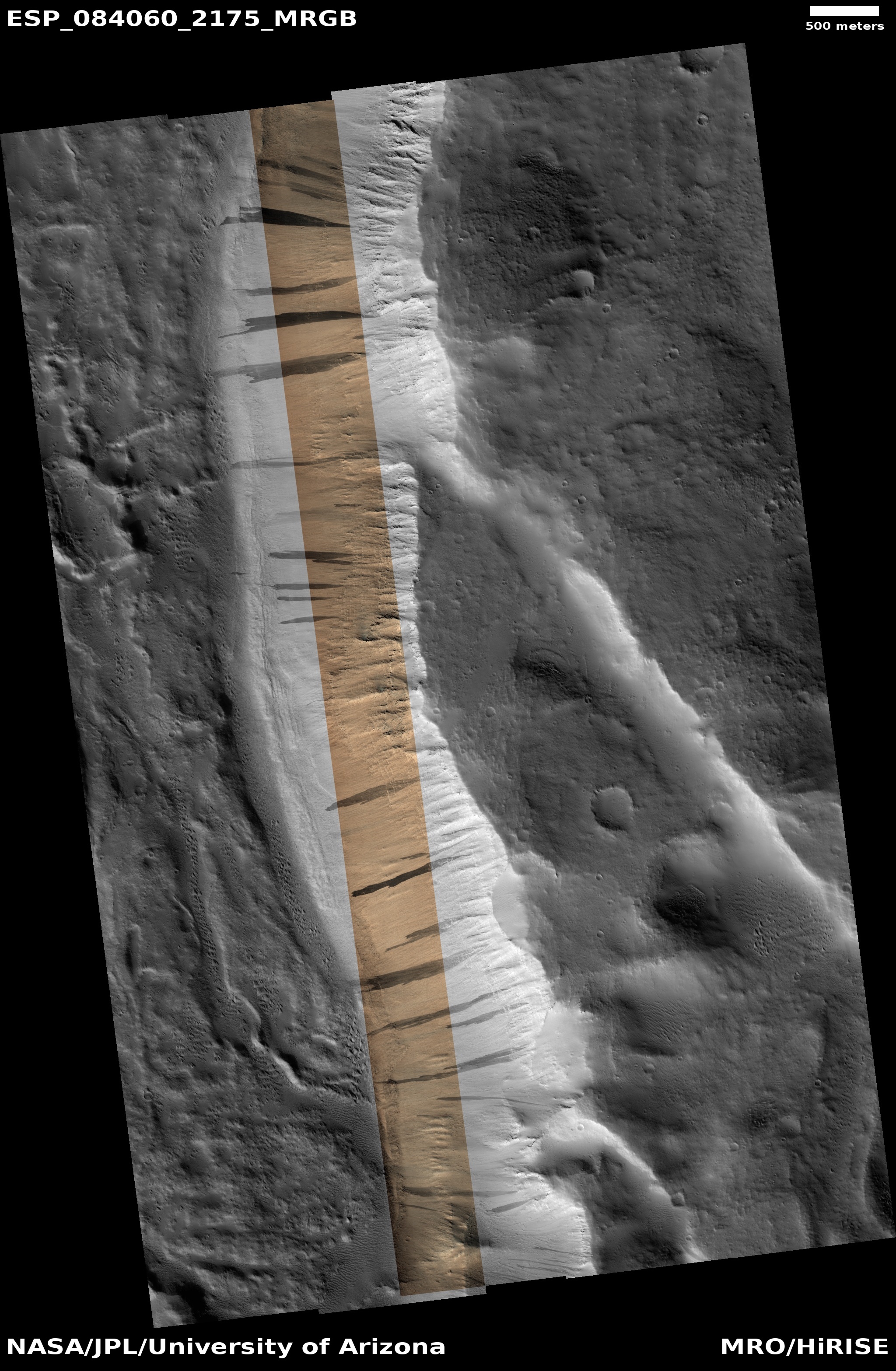
Cool image time! The picture to the right, rotated, cropped, reduced, and sharpened to post here, was taken on April 24, 2025 by the high resolution camera on Mars Reconnaissance Orbiter (MRO), and was posted yesterday by the science team to illustrate the vast lava flows that cover much of Mars. From the caption:

This image captures the edge of a lava flow that partially buries older terrain in the Martian Southern Highlands. Where the edge of the lava flow made contact with the higher-standing topography, it formed a rumpled and ridged surface.

This lava flow is one of many massive flows that extend southwest from Arsia Mons, one of the largest shield volcanoes on Mars.

The mountain to the south rises about 3,700 feet above that rumpled lava ocean at its base.
» Read more

0 comments

Axiom completes first set of underwater tests of its commercial spacesuit

Axiom's moonsuit
Click for original image.

Axiom, in partnership with the company KBR, has successfully now completed its first set of manned underwater tests of its commercial spacesuit, being built for NASA but owned by Axiom and available for use by others.

These initial crewed tests involved an astronaut being fully submerged in the NBL’s 6.2-million-gallon pool while wearing Axiom Space’s next-generation spacesuit, the AxEMU, which is being developed for use on NASA’s Artemis III mission. The goal was to evaluate the suit’s integrity in an environment that closely simulates the weightlessness of space.

Throughout the tests, the suit remained completely sealed and airtight, signifying it’s ready for more advanced evaluations, and ultimately, future missions.

For Axiom, having its own spacesuit makes its space station project more viable. None of the other proposed stations presently have suits, though Vast’s Haven project is closely tied with SpaceX, and thus would likely work with that company to upgrade SpaceX’s spacesuit used on Jared Isaacman’s last private orbital mission.

The four commercial stations under development, ranked by me based on their present level of progress:
» Read more

4 comments

Founder of SaxaVord spaceport passes away

Frank Strang, who first proposed the SaxaVord spaceport on the island of Unst in the Shetland Islands in 2017, died yesterday at 67 from cancer, having never seen a single launch from the spaceport almost entirely due to the odious red tape of the United Kingdom.

When Strang announced last month that he had cancer, he also said he hoped to live long enough to see the first launch. The German rocket startup Rocket Factory Augsburg plans its first launch later this year, though this schedule is not firm. Its launch attempt last year was cancelled when the first stage failed during its last static fire test on the launchpad. Whether the UK’s Civil Aviation Authority will issue a launch permit on time remains decidedly unclear.

1 comment

China completes eighth launch of its Guowang internet satellite constellation

China yesterday successfully placed 10 more Guowang satellites into orbit, its Long March 5b rocket lifting off from its coastal Wenchang spaceport.

The Guowang constellation, also called Satnet, will eventually have 13,000 satellites in orbit, providing services comparable to Starlink and Kuiper. At present it has completed eight launches since December 2024, placing 67 satellites into orbit.

Because the Long March 5B, China’s most powerful rocket at present, used a new more powerful upper stage, its core stage did not reach orbit, and thus fell harmlessly into the ocean soon after launch.

The leaders in the 2025 launch race:

98 SpaceX (with another Starlink launch scheduled for later today)
44 China
11 Rocket Lab
9 Russia

SpaceX still leads the rest of the world in successful launches, 98 to 77.

0 comments

New developments at Canada’s two competing spaceport projects

Proposed Canadian spaceports

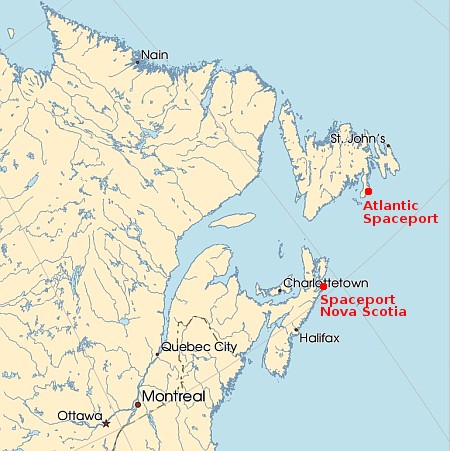
It appears things are beginning to happen at the two proposed Canadian spaceports, as shown on the map to the right.

First, the long struggling Nova Scotia spaceport project by Maritime Launch Services, first proposed in 2016, has finally sealed its $1.7 million deal with the Canadian rocket startup Reaction Dynamics. That deal was first announced in October 2024, but apparently was not finalized until now. Reaction will not only do a suborbital launch from the spaceport, it will invest about $1 million in the spaceport itself.

Whether this Nova Scotia spaceport finally begins operating remains to be seen. It has been promising orbital launches since 2016, without any actually happening.

Second, the Canadian rocket startup Nordspace announced that it has begun construction of its own launch site, dubbed the Atlantic Spaceport Complex, in Newfoundland.

The Atlantic Spaceport Complex (ASX) is a cornerstone of NordSpace’s mission to deliver sovereign and assured space access for Canada through an end-to-end space missions capability. The initial $10M phase of development for the Atlantic Spaceport Complex will feature two sites. SLC-01 will feature two launch pads for orbital missions including NordSpace’s Tundra vehicle and international launch partners from the U.S. and Europe. SLC-02 will consist of at least one smaller launch pad for suborbital missions, radar systems for vehicle tracking and space domain awareness, and other ground support equipment to enable all launch operations at the ASX.

The company hopes to complete a suborbital launch with what it calls its Taiga rocket later this month.

Nordspace only announced its existence in July 2024, almost a decade after the Nova Scotia project. Yet it appears it will be first to complete a commercial suborbital launch. Nova Scotia did have a suborbital launch in 2023, but it was a student project, not a commercial rocket.

2 comments

Portugal issues spaceport license to Santa Maria Island

Santa Maria spaceport

Portugal today issued a spaceport license to the Atlantic Spaceport Consortium (ASC) that wishes to build an orbital spaceport on the island of Santa Maria in the Azores, located about 900 miles west of the mainland.

On 13 August, ASC and the Portuguese Space Agency announced in a joint statement that the consortium had received a licence to operate a launch site on the island. The licence was issued by the country’s Autoridade Nacional de Comunicações (ANACOM), the entity acting as Portugal’s space authority. The licence is valid for five years and does not cover the launch operations themselves, which will be subject to a separate licensing process on a per-launch basis.

ASC has already conducted two demonstration suborbital launches there. In addition, it has signed a deal with the Polish rocket startup SpaceForest for additional suborbital launches.

This location is excellent for orbital launches, though getting rockets to it is an extra cost that will at least initially limit its appeal. Either way, it appears the Portuguese government does not wish to stand in the way of progress, and has been moving fast to clear away the red tape.

3 comments

Two launches today less than 20 minutes apart

Arianespace and ULA both successfully completed launches today, less less than 20 minutes apart.

First Arianespace placed in orbit a new European weather satellite, its Ariane-6 lifting off from French Guiana in South America on its second commercial launch and third launch overall.

Next, ULA launched a Space Force national security classified payload, its Vulcan rocket lifting off from Cape Canaveral in Florida. This was the Vulcan’s third launch, and the first in 2025. It is also its first commercial launch, and the first since the military certified the rocket for its use. It was also the first since a nozzle fell off a strap-on booster during its last launch in October 2024. On this launch it used four boosters, all of which functioned as planned.

For Arianespace (and Europe) this was its fourth launch in 2025 so it does not make the leader board for the 2025 launch race. Similarly, this was ULA’s third this year, so it also does not make the leader board.

The leaders in the 2025 launch race:

98 SpaceX (with another Starlink launch scheduled for later today)
43 China
11 Rocket Lab
9 Russia

SpaceX still leads the rest of the world in successful launches, 98 to 76.

3 comments

France’s military awards orbital tug startup contract for transporting its “inspector” satellites

France’s Directorate General of Armament (DGA) has awarded the orbital tug startup Infinite Orbits a $58.3 million contract to develop a tug that can transport its military “inspector” technology to geosynchronous orbit when it can rendezvous and inspect other satellites.

Under the PALADIN framework agreement, Infinite Orbits will develop a dedicated spacecraft capable of delivering the geostationary orbit inspection and monitoring service that will be utilized by the country’s Commandement de l’Espace (CDE – Space Command). The spacecraft is expected to be ready for launch as early as 2027 and will be based on Infinite Orbits’ Orbit Guard offering.

Infinite Orbits is based in France, though it also has offices in the U.S. and Singapore. It has also flown one demo mission of its Orbit Guard tug, and won a contract for a later mission from France’s space agency CNES. It is also developing a satellite servicing robot dubbed Endurance.

Overall, Europe (and France surprisingly) has latched onto the capitalism model with amazing enthusiasm in the past two years, to a point that it might actually be doing it better than NASA. Europe doesn’t have a giant money-sucking government program like Artemis (though it is partnering on Artemis). Thus, it can spend its money in buying many different but needed space products from its private sector. And it has more money available for these purposes.

NASA can’t do this as effectively, because a much larger portion of its budget is trapped financing the ineffective SLS rocket and Orion capsule.

4 comments

Two Japanese shipping companies are developing floating landing platforms for rockets

Two different Japanese shipping companies are now developing floating ship platforms that rocket companies could use to land their rocket’s first stages.

Japan’s Nippon Yusen Kaisha (NYK) is following compatriot Mitsui OSK Lines in targeting space exploration as a new source of revenues.

NYK has obtained an approval in principle from ClassNK for the conceptual design of an offshore recovery system for reusable rockets, an initiative developed through the Space Strategy Fund at the Japan Aerospace Exploration Agency (JAXA). NYK now aims to carry out a demonstration test of this new vessel type in 2028 working with multiple partners including Mitsubishi Heavy Industries.

Since JAXA and Mitsubishi own and build Japan’s new H3 rocket, JAXA’s funding here suggests both are considering upgrading the H3 for reusability. It is also possible Mitsubishi is mulling plans to build its own new commercial rocket.

1 comment

Two companies to study ways for extending the life of the Gehrels Swift space telescope

NASA yesterday announced that it has awarded two companies, Cambrian Works in Virginia and Katalyst Space Technologies in Arizona, each $150K study contracts for reviewing whether it makes sense to send a robotic servicing mission to Gehrels Swift space telescope to raise its orbit and extend its life.

Since its launch in 2004, NASA’s Swift mission has led the agency’s fleet of space telescopes in investigating changes in the high-energy universe. The spacecraft’s low Earth orbit has been decaying gradually, which happens to most satellites over time. Because of recent increases in the Sun’s activity, however, Swift is experiencing additional atmospheric drag, speeding up its orbital decay. This lowering orbit presents an opportunity for NASA to advance a U.S. industry capability, while potentially extending the science lifetime of the Swift mission. The concept studies will help determine whether extending Swift’s critical scientific capabilities would be more cost-effective than replacing those capabilities with a new observatory.

According to this paper [pdf], the telescope’s orbit will decay before the end of 2029, so speed is of the essence. Why NASA is thus spending time and money on a “study” contract from companies that don’t do orbital servicing or have orbital tugs is very curious. Wouldn’t make more sense to request bids from the many orbital servicing and tug companies that now exist (D-Orbit, Astroscale, Northrop Grumman, Firefly, Blue Origin, Rocket Lab, Impulse) to see if any can do the job at a reasonable cost and are willing?

Gehrels Swift has proven to be one of the most valuable and useful high energy space telescopes ever launched. First of all its cost was relatively low. Second, it is designed to quickly observe a gamma ray burst (GRB) location in multiple other wavelengths (optical especially). That ability helped solve the mystery of GRBs, as well as numerous other high energy events. It would be a tragedy to lose it.

It would also be far more expensive to build a replacement.

1 comment

Radar images of near Earth asteroid as it zipped past the Earth

Radar images of near Earth asteroid
Click for original. Go here for movie made from these images.

Using the Goldstone radar antenna in California, astronomers have produced a series of 41 radar images of the near Earth asteroid 2025 OW as it made a close pass of the Earth on July 28, 2025.

Those images, cropped, reduced, and sharpened to post here, are to the right.

The asteroid safely passed at about 400,000 miles (640,000 kilometers), or 1.6 times the distance from Earth to the Moon.

The asteroid was discovered on July 4, 2025, by the NASA-funded Pan-STARRS2 survey telescope on Haleakala in Maui, Hawaii. These Goldstone observations suggest that 2025 OW is about 200 feet (60 meters) wide and has an irregular shape. The observations also indicate that it is rapidly spinning, completing one rotation every 1½ to 3 minutes, making it one of the fastest-spinning near-Earth asteroids that the powerful radar system has observed. The observations resolve surface features down to 12 feet (3.75 meters) wide.

The asteroid’s fast rotation suggests it is a solid object, structurally strong, rather than a rubble pile held together loosely by gravity. It would thus be very damaging if it should ever hit the Earth.

No worries however. The refined orbital data says this asteroid will not come this close again in the foreseeable future.

8 comments

SpaceX launches 24 more Kuiper satellites for Amazon

SpaceX this morning successfully placed another 24 Kuiper satellites into orbit, its Falcon 9 rocket lifting off from Cape Canaveral in Florida.

The Falcon 9 first stage was new, completing its first flight by landing on a drone ship in the Atlantic. The two fairings completed their 5th and 28th flights respectively.

This was SpaceX’s second of three launches for Amazon, which now has 102 satellites in orbit. It needs to get another 1,498 in orbit by July 2026 in order to meet its licence requirements by the FCC. While ULA seems poised to begin regular launches for Amazon, having a contract for 46 launches (having so far completed two in 2025), the contracts for Blue Origin’s New Glenn (27 launches), and ArianeGroup’s Ariane-6 (18 launches) are more uncertain. Neither company has achieved any launches on their contracts, and it is not clear when either company, especially Blue Origin, will ever begin regular launches.

The leaders in the 2025 launch race:

98 SpaceX (with another Starlink launch scheduled for later today)
43 China
11 Rocket Lab
9 Russia

SpaceX now leads the rest of the world in successful launches, 98 to 74.

7 comments

Toyota extends its partnership with Japanese rocket startup Interstellar

In a deal last week Toyota extended its partnership with the Japanese rocket startup Interstellar Technologies from its earlier announcement in January 2025 that it would invest $44 million in the company.

As part of the new agreement, Toyota will dispatch personnel starting in August 2025 to support Interstellar in a wide range of manufacturing efforts, from the development of ZERO’s first flight unit to broader business commercialization. Additionally, Interstellar became the first startup to join “Toyota Woven City” as an Inventor, leveraging Toyota’s decades of manufacturing expertise and strengths. The development of ZERO will continue to be based on Interstellar’s facilities.

Zero is Interstellar’s proposed smallsat rocket. The company, which was founded in 2005, attempted a suborbital launch in 2018 that failed. Until Toyota’s commitments this year, it had done almost nothing since.

2 comments

Starlink now available in Israel

After a year of regulatory paperwork, the Israel government has finally allowed SpaceX to offer Starlink to customers in Israel proper, but not in the West Bank or Gaza.

The company received an operating license from the Communications Ministry last year, following lengthy negotiations and regulatory procedures, but its launch was delayed until now. The restriction on coverage in the West Bank and Gaza is likely due to security concerns over potential use by hostile actors.

Expect the usual leftist anti-Semites to accuse Israel of bigotry for excluding access to Palestinians, but until those Palestinians show some willingness to live with Israel in peace (something they so far show no signs in doing, especially in Gaza), this policy makes perfect sense.

20 comments

Endurance capsule splashes down safely, returning four astronauts from ISS

SpaceX’s Endurance Dragon capsule successfully splashed down off the coast of California this morning, returning four astronauts from ISS after a five month mission.

I have embedded the live stream below. As of posting the capsule was about to be lifted from the water and placed in its nest on the recovery ship.

Once again it is important to note that this recovery is being done entirely by a private company and its employees. Once Endurance undocked from ISS NASA had no part to play. It purchased the ride from SpaceX, and SpaceX is providing the service.
» Read more

6 comments

China launches another 11 satellites for one of its mega-constellations

China's spaceports

China today successfully placed another 11 satellites into orbit for one of its internet satellite constellations designed to compete with Starlink, its Smart Dragon-3 rocket lifting off from a launch platform off the eastern coast of China.

This was the fourth launch of satellites for Geely constellation. Though the rocket’s lower stages dropped into the South China Sea as well as the Pacific, doing no harm to habitable areas (as China routinely does when it launches from its interior spaceports), earlier this week the president of the Philippines, Ferdinand Marcos Jr., complained about China’s habit of not giving its neighbors sufficient warning prior to its coastal launches.

Marcos issued the statement after China launched its Long March 12 rocket on Monday [from its coastal Wenchang spaceport], which left debris within Philippine maritime territory. During an interview with the Philippine media delegation covering his state visit to India, the President said this was not the first time suspected Chinese rocket debris had ended up in Philippine waters.

“Well, it’s not the first time that this has happened. And, actually, if you look at the incidents, they did not commit any violations. There have been no casualties,” Marcos said. “We just wish that perhaps they could warn us a little earlier so that we know the path of the rocket, where the path is, and if they will release stages, where they will fall,” he added.

All par for the course for China. It not only doesn’t really care if it crashes rocket stages on the heads of its own people, it cares even less about dropping stages on neighboring countries.

The leaders in the 2025 launch race:

97 SpaceX
43 China
11 Rocket Lab
9 Russia

SpaceX still leads the rest of the world in successful launches, 97 to 74.

4 comments
1 51 52 53 54 55 814