Mars’ interior is more chaotic than Earth’s

Martian quake map as seen by InSight
The largest quakes detected by InSight, indicated
by the red dots.

Using archival quake data from the Mars lander InSight, scientists now believe that the upper layers in the interior of the red planet are not as coherently layered as the Earth’s, that its mantle is broken up in a much more chaotic manner. From the paper’s abstract:

We report the discovery of kilometer-scale heterogeneities throughout Mars’ mantle, detected seismically through pronounced wavefront distortion of energy arriving from deeply probing marsquakes. These heterogeneities, likely remnants of the planet’s formation, imply a mantle that has undergone limited mixing driven by sluggish convection. Their size and survival constrain Mars’ poorly known mantle rheology, indicating a high viscosity.

These “heterogeneities” are large blocks of material, some as large as two to three miles wide, that are thought left over from the planet’s initial formation. These initial pieces of the mantle were layered like the Earth, but subsequent impacts during the accretion process cracked them and shifted them about.

These results have some uncertainty, as so far only one seismometer, InSight’s, has be placed on Mars. It will require more sensors and years of data to fully map the interior with greater precision and reliability.

2 comments

SpaceX launches 28 more Starlink satellites while setting a new reuse record for a Falcon 9 1st stage

SpaceX earlier today launched another 28 Starlink satellites, its Falcon 9 rocket lifting off from the Kennedy Space Center in Florida.

The first stage completed its 30th flight, landing on a drone ship in the Atlantic. This is a new reuse record for a Falcon 9 first stage. At this moment only the space shuttles Discovery (39 flights) and Atlantis (33 flights) have flown more often.

The leaders in the 2025 launch race:

108 SpaceX
48 China
12 Rocket Lab
11 Russia

SpaceX now leads the rest of the world in successful launches, 108 to 84.

4 comments

Another great hiking location on Mars

Another great hiking location on Mars
Click for original image.

In honor of our just completed visit to the south rim of the Grand Canyon, today’s cool image takes us to another location on Mars that to me appears a perfect place to install some hiking trails. The picture to the right, cropped, reduced, and sharpened to post here, was taken on June 30, 2025 by the high resolution camera on Mars Reconnaissance Orbiter (MRO).

The image shows a two-mile wide canyon with a number of scattered narrow mesas within. The north and south rims rise about 550 feet above the canyon floor. The two mesas labeled “A” and “B” rise about 200 and 100 feet respectively.

The hiker in me immediately imagines what a great hike it would be to go up the western nose of either ridge and walk along its crest. The knife-edge nature of ridge “A” would mean that for a large majority of the hike you’d be at the north and south edges at the same time.
» Read more

2 comments

Sand dunes inside the Martian north polar icecap

Sand dunes inside the Martian north polar icecap
Click for original image.

Today’s cool image returns to the Martian north pole. The picture to the right, rotated, cropped, reduced, and enhanced to post here, was taken on July 3, 2025 by the high resolution camera on Mars Reconnaissance Orbiter (MRO). It shows the top of a ridge near the edge of that icecap, with dunes visible in the hollow several thousand feet below.

The angle of this picture does not show us the many layers on the cliff leading down to those dunes. It does show evidence, however, of the top few layers on the flat crest of that ridge. The white lines delineate those layers, each line marking the edge of a series of wide terraces.

The dunes in the canyon below are of interest because their source is likely the dust that is mixed into thick icecap’s ice. As that ice sublimates away on the face of the cliff, the dust falls into the canyon, where it is trapped.
» Read more

1 comment

The beauty of Mars’ many-layered northern icecap

The beauty of Mars' ice cap
Click for original image.

Cool image time! The picture to the right, rotated, cropped, reduced, and sharpened to post here, was taken on July 1, 2025 by the high resolution camera on Mars Reconnaissance Orbiter (MRO).

The science team labels it clumsily as “North Polar layered deposits structural geology in icy layers”. What we see are the many layers that make up the north polar cap, produced by the red planet’s many climate cycles that scientists think Mars has undergone over the eons as the red planet’s rotational tilt, or obliquity, rocked back and forth from 11 degrees inclination to as much as 60 degrees. At the extremes, the ice cap was either growing or shrinking, while today (at 25 degrees inclination) it appears to be in a steady state.

These layers are a mixture of ice and dust. The variations from dark to light likely indicate changes in the amount of dust in the atmosphere. Dark layers suggest the atmosphere was more dusty due to volcanic eruptions. Light layers suggest the planet’s volcanic activity was more subdued.

At least that’s one hypothesis.
» Read more

0 comments

Wind-eroded terrain on the edge of Mars’ largest volcanic ash field

Wind-eroded terrain in Mars' largest volcanic ash field

Cool image time! The picture to the right, cropped and sharpened to post here, was taken on July 2, 2025 by the high resolution camera on Mars Reconnaissance Orbiter (MRO).

Labeled simply as “wavy terrain” by the MRO science team, it shows a relatively flat plain of hollows and terraced ridges that suggest the prevailing winds come from the west-southwest. As they blow, they slowly cause the layers of material to peel away, exposing those terraces.

This wavy landscape extends for many miles to the west, covering a region 135 by 160 miles in area. The layering and wavy nature of the terrain suggests the material here is fragile and easily peeled away by the winds of Mars’ very thin atmosphere. Think of the sandstone that forms Monument Valley and Canyonlands in the southwest United States, shaped almost entirely by wind.

And in fact, the overview map below confirms this.
» Read more

0 comments

SpaceX gets major tax credit for the jobs its new Starship factory will create.

Because SpaceX’s new Starship factory, dubbed Gigabay, will create more than 500 new jobs in the Boca Chica region, the Starbase city commission this week awarded the company a sales tax refund valued as much as $3.75 million.

Gigabay will create about 630 new jobs, according to information Barrera showed the City Commission. That number included 315 entry-level jobs, which pay nearly $50,000 a year; 277 staff jobs, which pay nearly $90,000 a year; and 26 manager positions, which pay about $164,000 a year. … At least 25% of the jobs must be filled by veterans, residents of the enterprise zone or people who are considered economically disadvantaged.

SpaceX may receive a sales tax refund of $7,500 per job if the company invests $250 million. The program is capped at 500 jobs, allowing SpaceX to receive a maximum of $3,750,000.

Once again, the opposition to SpaceX does not come from the general public, which overwhelming supports what the company is doing in south Texas because of the wealth it is bringing to the region. The only opposition comes from fringe and very tiny leftist activist groups who oppose anything new, and specifically hate Elon Musk because he backed Donald Trump in last year’s election.

Sadly, those fringe groups are also backed by the propaganda press, which gives them a loud bullhorn they don’t deserve. It is imperative that Texas politicians recognize these facts, and not let that bullhorn bully them into actions detrimental to their constituents.

1 comment

Texas brewery tries brewing beer and growing barley on ISS

A Texas brewery dubbed Starbase Brewing (no connection to SpaceX) has just completed an experiment on ISS where it tried to brew beer in weightlessness as well as grow barley in simulated Martian soil.

Starbase Brewing — unrelated to Elon Musk’s space company or its South Texas city of Starbase — sent its MicroBrew-1 and OASIS experiments to the International Space Station aboard a SpaceX mission Aug. 1. They came back aboard a SpaceX Dragon spacecraft that splashed down eight days later off the coast of California.

…OASIS, short for “Optimizing Agriculture in Simulated Interplanetary Soils,” is the result of a partnership between the beer maker, Texas A&M AgriLife and Jaguar Space, a Colorado bioastronautics firm. According to Argroves, who launched the company in 2020, the goal was to grow barley in a mixture of Martian soil simulant with a byproduct of beermaking called Brewer’s Spent Grain and microbes.

The MicroBrew-1 experiment attempted to ferment beer, mixing “eight containers loaded with half wort — the sugary liquid extracted from malted grains — and half yeast.”

The company is far from manufacturing space-grown beer, but its founder seems focused on being the first brewery selling beer on Mars.

11 comments

Study: Car design has worsened, increasing blindspots which cause accidents

The view out of a modern car

Our present dark age: According to a study by the Insurance Institute for Highway Safety (IIHS), in the past two decades the design of cars has drastically decreased the visibility for drivers so that blindspots are larger, resulting in an increase in accidents.

Puzzled by traffic accident data showing that fatalities for cyclists and pedestrians had risen over the past 25 years, while car passenger deaths had come down, IIHS researchers wondered whether drivers might be finding it harder to see those more vulnerable road users.

And they discovered that successive versions of long-running popular cars had obstructed, more and more, a driver’s view of the 10 meters (33 ft) of space they were about to drive into. That near-car view, from the eye point of the average male driver, had shrunk on every one of six long-running models tested, IIHS testing showed, when an early (1997-plus) version was compared with the version on sale in 2023.

In the case of traditional cars, the near-car viewable area had contracted only slightly, the 7-8% reductions from the Honda Accord and Toyota Camry possibly even attributable to measurement error.

When it came to SUVs, however, the shrinkage was dramatic. The driver of a 1997 Honda CR-V could see 68% of a forward half-circle whose perimeter was 10 meters (33 ft) from their eye point – slightly more, in fact, than from the sedans that were tested. The driver of a 2023 CR-V could see just 28% of that semi-circle. In relative terms, the driver of the 2023 CR-V could see only 42% of what they would see from a 1997 model.

You can read the IIHS study here.

Why are designers doing this? One theory is that they are increasingly relying on cameras and software to replace the driver’s sight, and thus feel free to add obstructions to the car body that make it look cool. The problem is that these mechanical non-human solutions simply don’t work as well as the human brain, and thus drivers are hitting things more often.

But don’t worry. Soon AI will soon make it possible for cars will drive themselves! We will even be able to eliminate the windows entirely so that car travel will be an utterly private thing!

20 comments

SpaceX launches X-37B for Space Force

SpaceX tonight successfully launched the Space Force’s X-37B mini-shuttle, its Falcon 9 rocket lifting off from the Kennedy Space Center in Florida.

This is the eighth mission for the Space Force’s two X-37Bs. It appears this flight is fourth for this particular X-37B, but this is not confirmed. Nor do we know how long this particular will last in orbit.

SpaceX’s first stage completed its sixth flight, landing back at Cape Canaveral. The fairing halves completed their first and second flights respectively.

The leaders in the 2025 launch race:

102 SpaceX
47 China
11 Rocket Lab
11 Russia

SpaceX now leads the rest of the world in successful launches, 102 to 82.

0 comments

Using Webb astronomers have for the first time identified the source of a fast radio burst

Fast Radio Burst source

Astronomers using the Webb Space Telescope have now successfully pinpointed a specific object that appears to be the source for a fast radio burst (FRB), extra-galactic short bursts of radio energy whose cause and origin have up-to-now been unexplained.

Blanchard and his team used a discovery of an FRB in a nearby galaxy made with the CHIME Outriggers array, a radio telescope in Canada, which was recently upgraded to enable FRB detections with precise positions. The researchers then turned to NASA’s James Webb Space Telescope to look for an infrared signal from the same location.

…The infrared data revealed an object, dubbed NIR-1, that is likely a red giant star or possibly a middle-aged massive star. A red giant is a Sun-like star near the end of its life that has expanded and brightened, while the other possibility is a star much more massive than the Sun.

Although these stars are unlikely to directly produce FRBs, the scientists say, they may have an unseen companion, such as a neutron star, pulling material away from the red giant or massive star. This process of transferring mass

The burst itself occurred on March 16, 2025 about 130 million light-years away in the galaxy NGC 4141. You can read the discovery paper here [pdf].

There remain of course great uncertainties. For one, NIR-1 is itself not likely the cause of the FRB, but related to its source in some manner. The scientists posit a number of explanations, from either an unseen magnetar (a pulsar with a powerful magnetic field), or a flare from this massive star reflecting off that unseen magnetar.

Regardless, this discovery helps narrow the theories considerably.

0 comments

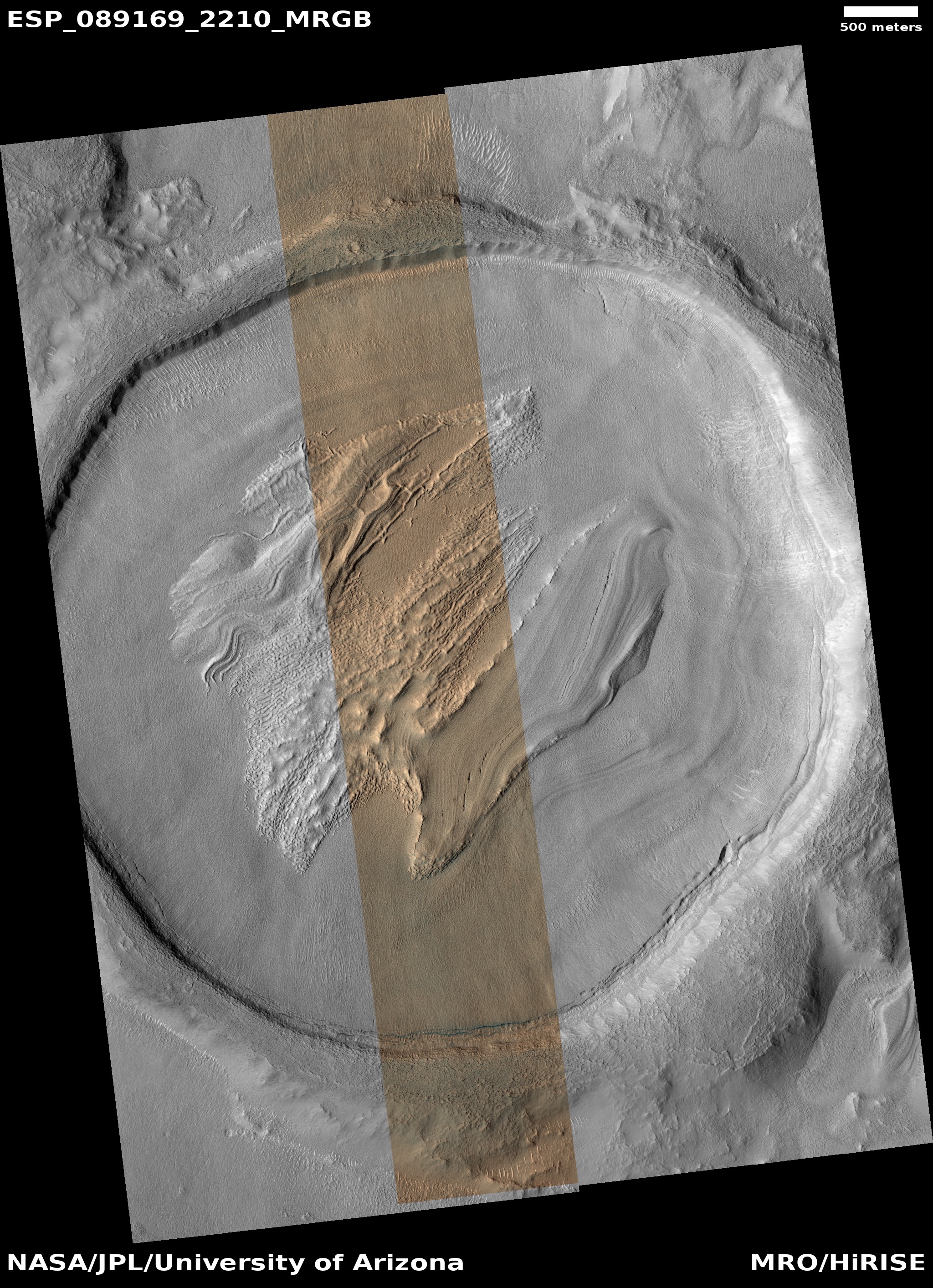
Slumping landslide in Mars’ glacier country

Overview map

Slumping landslide in Mars' glacier country
Click for original image.

Cool image time! The picture to the right, rotated, cropped, reduced, and sharpened to post here, was downloaded on July 1, 2025 from the high resolution camera on Mars Reconnaissance Orbiter (MRO).

Labeled by the science team as a “flow,” it shows what appears to be a major collapse of the canyon’s south wall. The white dot on the overview map above marks the location, near the center of the 2,000-mile-long strip in the northern mid-latitudes of Mars that I label “glacier country” because almost every single high resolution image of this region shows glacial features.

This picture is no exception. First, the canyon appears filled with a glacial material, though its flow direction is unclear. Orbital elevation data suggests that this collapse is actually at the canyon’s high point, with the drainage going downhill to the east and west.

Second, the collapse itself doesn’t look like an avalanche of rocks and bedrock, but resembles more a mudslide. Since liquid water cannot exist in Mars’ thin atmosphere and cold climate, the soft nature of the slide suggests it is dirt and dust impregnated with ice. At some point, either because of the impacts that created the craters on its southern edge or because the sun warmed the ice causing it sublimate away thus weakening the ground structurally, the entire cliff wall slumped downward to the north.

The canyon itself is about 800 feet deep. It likely formed initially along a fault line, with ice acting over time to widen and extend it.

1 comment

Avio gets 10-year lease from France to launch its Vega-C from French Guiana

The Italian rocket company Avio has now signed a 10-year lease with France to continue to launch its Vega-C from that nation’s French Guiana spaceport.

In a press release published on 19 August, the French Ministry of the Economy, Finance, and Industrial and Digital Sovereignty confirmed that, in line with the Seville agreement, Avio had been granted a ten-year licence.

…Avio will make use of the ELV launch complex at the Guiana Space Centre for the launch of its Vega C rockets. The pad was previously used for the original Vega rocket, which was officially retired in September 2024.

This deal is part of Europe’s move away from its centralized government-run Arianespace operations to the capitalism model. It has already shifted control of French Guiana from Arianespace back to France’s space agency CNES, which has begun to sign multiple similar deals with other European rocket startups. It is now in the process of shifting control of the Vega-C from Arianespace back to its builder, Avio, a shift that should be completed by the end of this year.

At that time, Avio will market the rocket commercially worldwide. Arianespace will no longer be a government middleman. This launchpad deal solidifies its access to a launch site, which it also plans to use for its next Vega upgrade, the Vega-E.

0 comments

India now targeting December for first unmanned test flight of Gaganyaan

Artist rendering of India's Gaganyaan capsule
Artist rendering of India’s Gaganyaan capsule

According to the head of India’s space agency ISRO, it is now targeting December 2025 for first unmanned test flight of its Gaganyaan manned capsule.

That flight will put the capsule into orbit for several days carrying a humanoid robot dubbed Vyomitra, designed to simulate what a human would experience in the capsule in space. It will be the first of three similar unmanned orbital test flights, leading up to a planned manned orbital mission in 2027.

Though this program has experienced numerous delays and program changes since it was first proposed in 2006, all the pieces have begun to fall into place in the past four years. It now appears that the above schedule is very solid. As long as there are no major test failures, India could launch its first astronauts by 2027.

0 comments

Firefly studying feasibility of launching from northern Japanese spaceport

Japan's spaceports
Japan’s spaceports indicated by red dots.

Firefly and the commercial Japanese Hokkaido spaceport in the north of Japan have begun a feasibility study for launching Firefly’s Alpha rocket there.

Establishing an memorandum of understanding with the Hokkaido Spaceport means that the two entities can flesh out a more concrete launch complex design and figure out all of the logistics to bring Alpha launch capabilities to Japan.

In the past Hokkaido has been the location for a number of suborbital launches, but no orbital launches as yet. For example, the Japanese startup Interstellar used this site for its suborbital test flights in 2018, and hopes to use it for future orbital flights.

Firefly meanwhile has launched its Alpha rocket multiple times from Vandenberg in California. The company is also building a launchpad at Wallops Island in Virginia, and has signed a deal with the Esrange spaceport in Sweden. The Swedish launch site however is questionable because any orbital launch from there would have to cross over land of other countries, and so far it appears permission for such a thing has not been arranged. Firefly might therefore be looking at Hookaiddo for precisely this reason.

0 comments

Russia launches classified military payload

Russia today successfully launched a classified military payload comprising “multiple military spacecraft”, its Angara-1 rocket lifting off from its Plesetsk spaceport in northeast Russia.

This was Russia’s second launch in two days, something it rarely does any longer. It was also the fifth launch of this version of Russia’s new family of Angara rockets, using a modular design that can be configured for different size payloads. Launched into a polar orbit, the lower stages crashed in the ocean in the Arctic and Pacific.

The leaders in the 2025 launch race:

101 SpaceX
47 China
11 Rocket Lab
11 Russia

SpaceX still leads the rest of the world in successful launches, 101 to 82.

0 comments

Russia launches returnable capsule for month-long biology research mission

Russia today successfully launched the first Bion-M returnable capsule in more than a dozen years, its Soyuz-2 rocket lifting off from the Baikonur spaceport in Kazakhstan.

The capsule will remain in orbit for about a month doing weightlessness and radiation experiments with a variety of biological samples, 1,500 fruit flies, and 75 mice. Though similar to the commercial capsules recently launched by Varda, Bion-M is different in that it appears the research has no marketability. As a government-run project by Russian Academy of Science, no effort was made to use weightlessness to produce a product for sale on Earth.

The leaders in the 2025 launch race:

101 SpaceX
47 China
11 Rocket Lab
10 Russia

SpaceX still leads the rest of the world in successful launches, 101 to 81.

1 comment

Spinlaunch raises $30 million for its Meridian broadband satellite constellation

Spinlaunch prototype launcher
The Spinlaunch prototype launcher

Spinlaunch, the startup that began by proposing launching payloads into space using a giant vertically oriented spinning centrifuge (as shown to the right), has now raised $30 million in private investment capital for its proposed Meridian broadband satellite constellation, designed to compete directly with Starlink and Kuiper.

The funding includes new investment from existing investors, including lead investor ATW Partners, as well as the previously announced strategic investment from Kongsberg Defence & Aerospace.

Kongsberg had previously invested $12 million, and is building 280 micro-satellites for this constellation.

It is very unclear from the press release when Spinlaunch will launch its first satellite, though it claims its “first customer link” will take place in second half of 2026. Considering the level of blarney the company exhibited in its initial spin-launch concept, we should remain very skeptical about its satellite constellation claims. Though the company has signed a deal to build a full scale spin launcher in Alaska, it increasingly appears it is shifting its effort from that to satellites.

4 comments

Webb discovers another “oldest black hole”

The uncertainty of science: Using the Webb Space Telescope, astronomers now claim they have detected a super-massive black hole at a new record-setting distance that puts it far closer to the Big Bang that cosmologists have predicted.

A global team of astronomers, led by The University of Texas at Austin’s Cosmic Frontier Center, has confirmed the discovery of the most distant black hole ever observed. This black hole resides within a galaxy known as CAPERS-LRD-z9, which existed only 500 million years after the Big Bang.

In other words, the light we see from it has traveled 13.3 billion years, revealing the universe at just 3% of its current age.

The black hole, estimated to have the mass of 300 million suns, sits in the center of one of the mysterious “little red dots” that Webb has discovered in the early universe that remain a mystery. This black hole suggests each is an early galaxy with its own super-massive black holes.

I must note that there is great uncertainty in the claim of a black hole discovery. It is based on the spectroscopic emissions detected by Webb, which had features generally seen only in super-massive black holes in the recent universe. Thus, the scientists are making some large assumptions in concluding those emissions also indicate a super-massive black hole in this little red dot.

We must also note that if this black hole really exists, it confounds the theories of cosmologists as to the formation of the universe. It is too soon after the Big Bang for such a black hole to have formed, according to those theories.

0 comments
1 53 54 55 56 57 818