China unveils its 2020 Mars lander/rover

The competition heats up: China today released design concepts of its planned 2020 Mars lander and rover.

According to Ye Peijian, one of China’s leading aerospace experts and a consultant to the program, the 2020 mission will be launched on a Long March-5 carrier rocket from the Wenchang space launch center in south China’s Hainan province. The lander will separate from the orbiter at the end of a journey of around seven months and touch down in a low latitude area in the northern hemisphere of Mars where the rover will explore the surface.

If they succeed they will have definitely moved ahead of Russia in the ranks of space-faring nations.

0 comments

Unknown new British company will fly space tourists in five years

Private vaporware: A new and previously completely unknown British rocket company, Starchaser, has claimed today that it will be flying tourists into space within three to five years.

How do I know this is vaporware and won’t happen? Besides the fact that I’ve never heard of this company before and that the story above includes a lot of fishy details (such as the head of the company has apparently most spent his time building large model rockets), there was this one quote:

The flight will only take an hour and will see the rocket reach around 330,000ft โ€“ ten times the average cruising altitude for an aeroplane flight.

An hour is too short for an orbital flight, and is much too long for a suborbital flight at 330,000 feet. In other words, something here is just not right. Regardless, I hope my cynicism here turns out to be wrong, and this company joins the new competition to lower costs into space.

6 comments

Russia reveals its proposed new cargo spacecraft

Government vaporware: In an effort to save money Russian engineers have designed a new cargo spacecraft to replace the Progress freighter.

Faced with latest economic problems, and the need to reduce the number of Progress cargo launches, Russia’s space agency Roskosmos made plans to cut the permanent crew of ISS cosmonauts from three to two people. However the full international crew on the ISS is supposed to include six people with half of it reserved for Russia.

To resolve this supply problem, Roskosmos ordered RKK Energia, its key contractor responsible for human spaceflight, to prepare a preliminary design of a bigger cargo ship by the end of this month. Engineers quickly put together this proposal that would combine off-the-shelf hardware with new technology. … The most important new feature of the proposed cargo ship will be the six-tank cluster to carry more than 1.8 tons of propellant to the station. It will simultaneously serve as a tanker for the space station while also feeding the ship’s own propulsion system. As a result, the new design provides significant mass savings in comparison to the current Progress ships, which need two separate sets of tanks for refueling and maneuvering.

The main engine for the new cargo ship will be borrowed from an existing satellite. Meanwhile, 28 small thrusters for orbit correction and maneuvering will be copied practically unchanged from the Progress.

They hope to fly this new freighter by 2020. I’m willing to bet anyone that this won’t happen.

0 comments

Contact re-established with dead solar satellite

Good news! After almost two years since contact was lost, NASA has re-established communications with Stereo-B, one of two solar research satellites designed to study the hemisphere of the Sun that does not face the Earth.

NASA re-established contact with a wayward sun-watching science satellite Sunday nearly two years after the spacecraft suddenly dropped off line during a test, the agency said in a statement Monday. NASAโ€™s Deep Space Network, or DSN, โ€œestablished a lock on the STEREO-B (spacecraftโ€™s) downlink carrier at 6:27 p.m. EDT,โ€ NASA said in a statement. โ€œThe downlink signal was monitored by the Mission Operations team over several hours to characterize the attitude of the spacecraft and then transmitter high voltage was powered down to save battery power. โ€œThe STEREO Missions Operations team plans further recovery processes to assess observatory health, re-establish attitude control and evaluate all subsystems and instruments.โ€

This is a big deal. Not only is it a testament to the spacecraft’s good design, it demonstrates the skill of the engineers at NASA who have regained contact.

1 comment

Beyond Murray Buttes

Panorama ahead for Curiosity, Sol 1438

Time for a Curiosity update. Above is a panorama I’ve created from raw images released today from the rover’s left navigation camera of the mesa filled terrain within which Curiosity now sits. Since my last update they have traveled about 200 feet south, moving away from the mesa with the balanced rock

Below the fold is a Mars Reconnaissance Orbiter image with Curiosity’s path indicated. I have marked the balanced rock with an X, and have indicated with the yellow lines the area covered by the panorama above.

They appear to be aiming due south for the narrow gap between the long ridge-like mesas. This will bring Curiosity out into the open and sloping terrain that can be seen in the distance in the last image of my last update. I suspect they want to get a closer look at those parallel grooves, even if it means the journey will be a little rougher.
» Read more

6 comments

The world’s longest and highest glass-bottomed bridge

Link here. Lots of great pictures of this new pedestrian bridge in China, including one of a reporter trying (and failing) to use a sledge hammer to break the glass.

China’s economy might have a lot of holes and might face collapse, as many experts have been telling me for years, but at the same time they seem to be successfully harnessing the success they’ve had in the past few decades to get very creative. That creativity suggests to me the collapse is not guaranteed, and will not be as severe as predicted.

7 comments

Murray Buttes panorama by Curiosity released

The Curiosity science team has released a full panorama taken by Curiosity of Murray Buttes prior to its journey through them.

The reason I am not posting this new panorama here on Behind the Black is because I had already posted an almost identical panorama more than a week ago, and my assembled panorama used higher resolution images from Curiosity and was not partly obscured by Curiosity itself. Moreover, I provided better context for that panorama, placing it within Curiosity’s overall travels, something NASA in today’s press release fails to do.

So, if you want to see the best cool images from space and see them sooner than everyone else, why bother reading NASA press releases? Read Behind the Black instead! :)

4 comments

Lots of launches

The competition heats up: The next few weeks will be a busy period for rocket launches:

SpaceX’s September 3 launch is part of their effort to ramp up their launch rate and get 18 Falcon 9 launches in 2016. So far they have completed 8 launches.

The September 8 launch will be the United States first sample return mission to an asteroid, Bennu, which also happens to be an asteroid that could possibly impact the Earth at some time in the future.

The September 10 launch will be another test flight of India’s more powerful Geosynchronous Satellite Launch Vehicle, aimed at competing for launch business against SpaceX, ULA, and Arianespace.

There’s more beyond this. A lot is scheduled for this fall.

0 comments

SpaceX to up its purchase of carbon fiber?

The competition heats up: A Japanese supplier of carbon fiber materials has announced that it and SpaceX are negotiating a multi-year deal worth possibly as much as $3 billion.

The multiyear deal with Tesla founder Elon Musk’s 14-year-old venture is estimated to be worth 200 billion yen to 300 billion yen ($1.99 billion to $2.98 billion) in total. The two sides are aiming to finalize the agreement this fall after hammering out prices, time frames and other terms. SpaceX aims to hold down expenses by re-using rockets and spacecraft. Originally, the company made rockets mostly out of aluminum to keep costs low, using carbon fiber only for a few parts, such as connecting joints.

The U.S. company said in a statement, “Toray is one of a number of suppliers we work with to meet our carbon fiber needs for Falcon rocket and Dragon spacecraft production, and we haven’t announced any new agreements at this time. As our business continues to grow, the amount of carbon fiber we use may continue to grow.”[emphasis mine]

The deal is not yet final, but the highlighted language above suggests to me that, based on SpaceX’s engineering tests of its recovered first stages, it has decided it is worthwhile replacing aluminum with carbon fiber for many more of its rocket parts. The fiber might cost more, but if the first stage is going to be reused, the cost can be distributed over several launches. And because carbon fiber is lighter than aluminum, it will allow their rockets to launch a larger payload.

7 comments

More evidence ULA will pick Blue Origin over Aerojet Rocketdyne

In a press interview published in late July, a ULA executive confirmed that the company is going to pick Blue Origin’s BE-4 engine for its new Vulcan rocket.

ULA used a Russian engine for its expendable Atlas V booster but has long relied on U.S. suppliers such as Aerojet Rocketdyne. For Vulcanโ€™s reusable engine, ULA is turning to Jeff Bezosโ€™s Blue Origin. The companyโ€™s cutting-edge BE-4 is powered by liquid natural gas instead of kerosene or liquid hydrogen.

By partnering with a startup like Blue Origin, ULA gains other advantages. โ€œThere is a world of difference between the culture at Blue Origin and the culture at Aerojet Rocketdyne,โ€ said [Dr. George F. Sowers, ULAโ€™s vice president for advanced programs]. โ€œWe knew we could absorb some of their culture by osmosis, just by working with them.โ€ That influence shows up in cross-team collaboration. โ€œWe are literally breaking down walls to create a โ€˜Silicon Valleyโ€™ workspace,โ€ Sowers said.

Sowers is very careful to say nothing about the Atlas 5 and the engine that will replace the Russian engine in its first stage. ULA originally signed its deal with Blue Origin with the Atlas 5 in mind, but has not made a final decision between Blue Origin and Aerojet Rocketdyne because Congress appears to favor Aerojet Rocketdyne’s engine, and Congress is a very big gorilla you do not upset. However, their development plans for Vulcan are incremental and closely linked with the Atlas 5. They plan to introduce Vulcan piecemeal in various upgrades of Atlas 5 as they go, so if they are set on using Blue Origin’s engine in the Vulcan rocket, it probably means that they plan on using it to replace the Russian engine in Atlas 5. This interview appears to confirm this.

5 comments

Balanced Rock at last

Balanced rock close-up

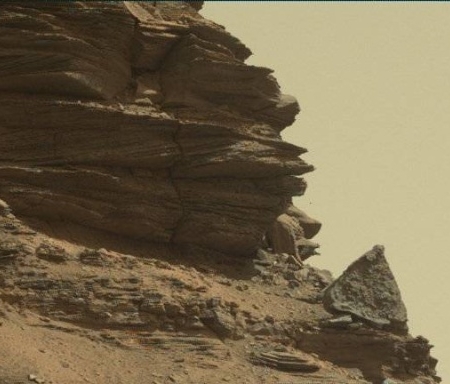
My pessimistic prediction that Curiosity’s science team would take the least risky route and thus not pass close to the butte with the balanced rock has fortunately turned out to be very wrong! They have moved Curiosity into the closest gap to get the best views of both the balanced rock as well as the butte behind it. The image on the right, cropped, was taken by the rover’s mast camera as Curiosity entered the gap between the buttes. It shows clearly that balanced rock broke off from the layers above and landed on its side.

The image below the fold shows the same butte after Curiosity had passed the balanced rock (inside red box).
» Read more

1 comment

The status of SLS for its first launch in 2018

Link here. The article gives an excellent and detailed overview of where construction of SLS presently sits, what the problems are that still remain, and what they have done to overcome them.

What struck me most however in reading the article was how long it takes them to do anything. For example, it appears they will assemble the rocket in the spring of 2018 for a December launch. In fact, the description of this assembly in this article partly explains to me why SLS will have the ungodly slow launch rate of at best once every two years.

In addition, the article describes how NASA has handled a number of engineering issues that have come up, and for each the approach seems to me to be more complicated than necessary. However, I am not an engineer and have never been part of this kind of work. Maybe everyone does it this way.

12 comments

The Backwards Brain Bicycle

An evening pause: This is show 133 of a series called Smarter Every Day which has some really entertaining and very educational videos. I especially like his video showing how the drill on Curiosity works. The video below however shows some actual experimentation done by the videographer himself, and is almost profound in it what reveals about the human learning process.

Hat tip Chris McLaughlin.

13 comments

A fine collection of Rosetta images

Comet 67P/C-G

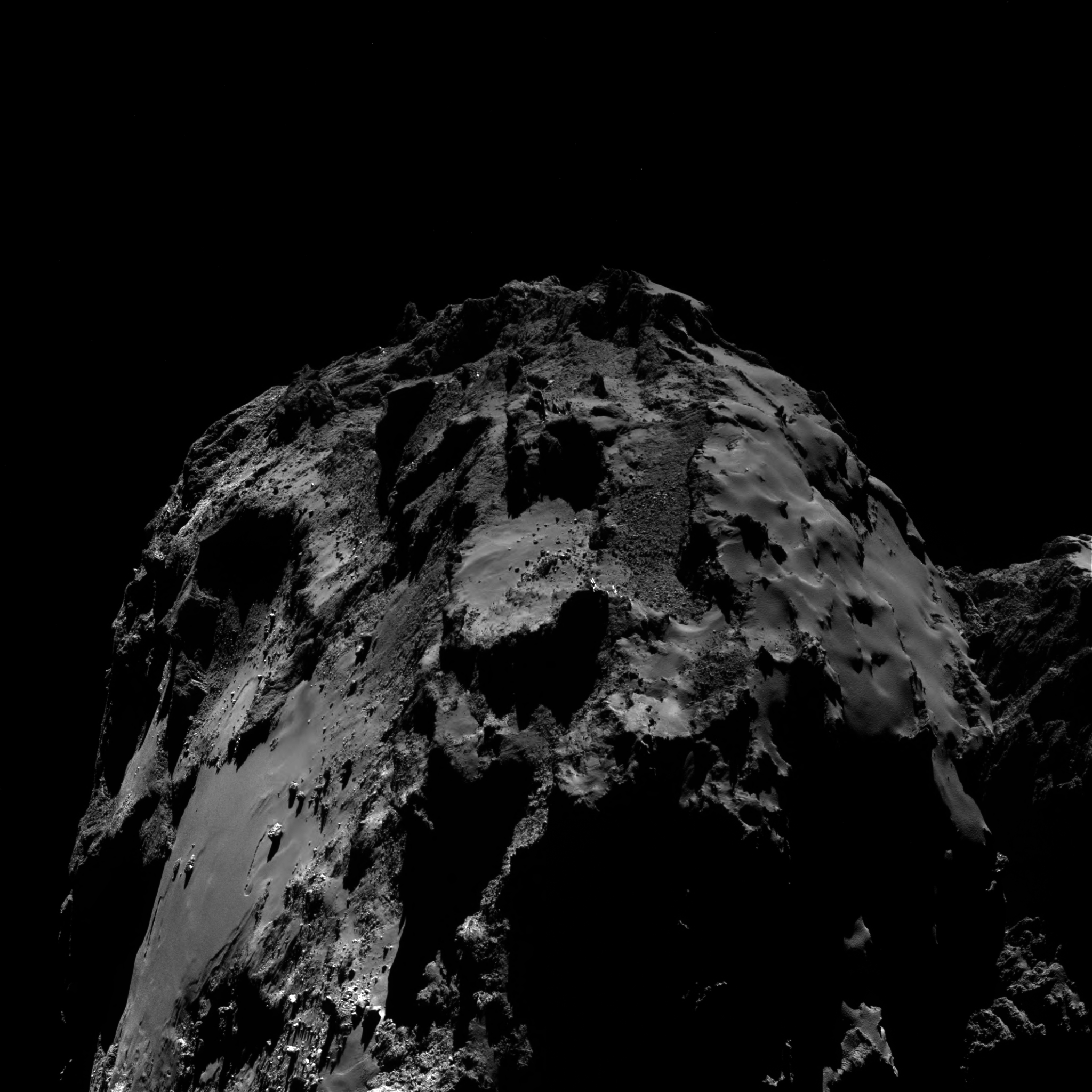
Many cool images! The Rosetta team has released a bunch of very nice images taken of Comet 67P/C-G during August when the spacecraft was flying in close. The image on the right, cropped and reduced in resolution to post here, shows the comet’s large lobe, with the narrow neck to the left. Make sure you check out the full resolution image. It was taken on August 10, 2016 from about 8 miles away, and has a resolution of less than four feet per pixel. If a person was standing there you could just see them!

What I find most fascinating is the incredible curvature of the comet’s surface. The smooth area on the left, dubbed Imhotep (images of which have been posted here previously), has several big boulders on its flat surface. If you stood there, the ground would be down and horizontal. Walk only a short distance and you quickly reach the curving horizon and that flat area would look like a steep slope dropping down behind you. Yet, the boulders do not roll down hill! Walk a short distance more and you begin to enter the neck region, with giant walls rising above you, until you start to walk up them and they become the floor!

5 comments
1 579 580 581 582 583 821