Sublimating ice in the Martian dry tropics?

Sublimated ice in the Martian dry tropics?
Click for original image.

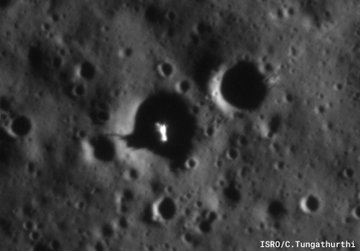
Cool image time! The picture to the right, cropped, reduced, and sharpened to post here, was taken on May 3, 2025 by the high resolution camera on Mars Reconnaissance Orbiter (MRO). Labeled merely as a “terrain sample,” it was likely snapped not as part of any specific research project but to fill a gap in the camera’s schedule so as to maintain the camera’s proper temperature.

When the MRO camera team does this, they try to pick features of interest at the time required, and I think succeed more often than not. In this case, they captured this one-mile-wide unnamed crater that appears to be filled with sublimating glacial debris. Similarly, the plateau surrounding the crater seems to also show signs that some sublimation is occurring of ice just below the surface, producing the areas that appear filled with pockmarks.

The location however suggests that if near surface ice here is sublimating away, it hints at a find of some significance.
» Read more

2 comments

Ground-based imagery now suggests China has completed a docking and undocking of two robotic servicing satellites

According to ground-based imagery by the commercial company S2A, China’s Shijian-21 and Shijian-25 robotic servicing satellites appear to have completed a docking and undocking on June 13 and June 14, 2025.

China’s Shijian-21 and Shijian-25 satellites had been moving toward each other in geosynchronous orbit, around 22,236 miles (35,786 kilometers) above the equator, Spacenews reported on June 6. And now the pair appear to have had a brief first encounter, according to observations from the ground.

Optical tracking by the space situational awareness firm s2a systems shows a close approach between the two on June 14, with the pair, at times, virtually unresolvable from the other. This suggests that Shijian-21 and Shijian-25 made at least a test-run close approach and may have even performed a docking and undocking test.

You can see video of the first apparent docking here.

Shijian-21 was launched in 2021, and was used to grab a defunct Chinese geosynchronous satellite and tug it to a graveyard orbit. Shijian-25 was launched in January 2025 to test robotic servicing of satellites. These maneuvers with Shijian-21 appear to be part of those tests.

2 comments

Monaco-based startup unveils its proposed European-built lunar rover

Capitalism in space: The Monaco-based startup Venturi Space, this week unveiled its own proposed European-built lunar rover, dubbed Mona Luna. and offered it to both the European Space Agency (ESA) and France’s CNES space agency.

Venturi has received some support from ESA for key technologies needed for the rover. The company is hoping to win support for a rover development project at ESA’s ministerial conference in late November, when member states will decide on funding for agency programs for the next three years. Antonio Delfino, Venturi’s director of space affairs] argued a rover like Mona Luna fit a gap in Europe’s exploration plans. Mona Lisa is designed to be delivered to the lunar surface on ESA’s Argonaut lander, which would launch on an Ariane 64.

The company has said it is willing to commit some of its own investment capital to develop the rover, should either ESA or CNES decide to buy it. Whether ESA or CNES agree to build this rover however will likely depend on whether either has a program to land on the Moon. At the moment the status of NASA’s Artemis program is unclear, and it was that program that Europe was relying on to get to the Moon.

1 comment

Starlink begins or expands service in three more countries

Starlink this week officially began service in both India and the African country of Guinea-Bissau, while expanding its service in the Ukraine to include phone-to-satellite texting.

In India the final licensing approval came through, and the service is now available to customers through two different Indian telecommunication platforms.

The deals consists of selling Starlink’s equipment through Jio and Airtel’s retail networks, while Jio will also offer customer service, installation, and activation support. It will emphasise on providing high-speed internet to businesses, healthcare centres, schools and remote communities across India, according to reports.

SpaceX also begain to offer its services in Guinea-Bissau, a former Portuguese colony located on Africa’s northwestern coast and the seventh African country to approve Starlink. Its license had been approved in April, but the service wasn’t available apparently until now.

Finally, regulators in the Ukraine have now approved the use of Starlink’s phone-to-satellite service by the Ukrainian telecommunications company Kyivstar. The program will at present be limited to texting and emergency alerts. This expands Starlink’s already extensive internet availability there.

In every case, Starlink will act to decentralize control of communications aware from the government, as its sells terminals to ordinary citizens.

3 comments

Russia launches classified military satellite using its Angara-5 rocket

Russia today successfully launched a classified military satellite, its Angara-5 rocket rocket lifting off from its Plesetsk spaceport in northeastern Russia.

This was the fifth flight of the Angara-5 rocket, the most powerful version in the Angara family of rockets that Russia first proposed three decades ago to replace its older rockets and has had an extremely slow development history. Its core stage and four strap-on boosters crashed in drop-zones across Russia,

On June 9, 2025, the administration of the Kolpashevo District in the Tomsk Region of Russia declared several communities at risk of debris impact during an Angara-5 launch scheduled around 06:00 Moscow Time on June 19, 2025. The danger area covered the Verkneketsky, Kolpashevsky, Kargasoksky and Parabelsky Districts and was located around 65 kilometers north-west of Lake Tresh. This particular area, located around 2,320 kilometers downrange from Plesetsk, would normally be used as a drop zone for the second stage of an Angara rocket heading to an orbit with an inclination 63.4 degrees toward the Equator.

The rocket’s first stage boosters were expected to fall in the Komi Republic around 850 kilometers downrange, while the third stage would splash down in the Pacific Ocean, east of the Philippines, where the Russian authorities also declared a danger zone.

The leaders in the 2025 launch race:

76 SpaceX
34 China
8 Rocket Lab
7 Russia

SpaceX still leads the rest of the world in successful launches, 76 to 56.

0 comments

Major explosion during preparations for static fire test of Starship prototype

The moment the explosion begins on this Starship prototype<

As engineers tonight were preparing for a standard static fire engine test at Boca Chica of the next Starship prototype, expected to fly on the tenth Starship/Superheavy test flight, the spacecraft suddenly exploded.

I have embedded video of the explosion below. The event occurred prior to the actual static fire test, while Starship’s tanks were being filled. The image to the right is a screen capture just as the explosion begins. The white cloud is the initial release from the explosion (not standard venting), with the red dot indicating the location where the event began. It appears very much to have started inside this Starship spacecraft, which SpaceX was preparing for the next test flight.

Fortunately, no injuries have been reported.

Obviously, this is going to delay somewhat that tenth test flight. SpaceX has more Starship prototypes ready to go, but the company must first figure out what went wrong in this case. It also appears there might be some damage to that test stand, which will also have to be rebuilt so that future static fire tests of upcoming Starships can take place.
» Read more

40 comments

France’s space agency agrees to let Spanish rocket startup PLD establish its own launch site at French Guiana

Though France’s space agency CNES had initially attempted to place many rules and restrictions on the commercial operations of new independent private rocket companies at its spaceport in French Guiana, it has now backed off those demands in agreeing to let the Spanish rocket startup PLD establish its own launch site there at the decommissioned launchpad used by France’s Diament rocket in the 1970s.

This new contract greenlights the implementation of the infrastructure project designed by PLD Space with technical support from CNES and grants legal use of land in the ELM-Diamant area, where the MIURA 5 Preparation Zone and Launch Zone will be located. Construction will begin with the start of the dry season in French Guiana, expected in the summer months of 2025.

In September 2024 CNES said it wished to standardize the launch site for the seven different European rocket startups (Avio, HyImpulse, Isar Aerospace, MaiaSpace, PLD Space, Rocket Factory Augsburg, and Latitude) it had approved to use it. At the time I sensed there was opposition from these companies to this policy, since each rocket was different and would not function with this standardized design.

At a minimum that policy apparently delayed PLD’s plans, as it originally hoped to start its launchpad construction in October 2024 and launch in 2025. That schedule went by the wayside.

It now appears PLD will proceed with development as it wishes, for its rocket, and the others will have to figure out how fit their rockets to that design. Or maybe CNES is going to open up further sites at French Guiana to avoid this conflict.

1 comment

Another company enters the military’s hypersonic test market

UP Aerospace today announced the successful launch of its suborbital small Spyder rocket, designed expressly for hypersonic flight testing.

The maiden flight took place at 7:00 AM MST at Launch Complex 36 [at White Sands Missile Range in New Mexico], marking a new era in hypersonic mission capabilities. The mission reached the threshold of hypersonic speeds similar to the UP Aerospace SpaceLoft rocket missions that have been operational for 20 years.

In the U.S. the military now can do hypersonic flight tests using this small rocket, Stratolaunch’s giant Roc plane and Talon-A flight vehicle, Rocket Lab’s Haste reconfiguration of its Electron rocket, and Varda’s orbital capsules on their return from space. In addition there is at least one other startup, Radian, that hopes to build a space plane for hypersonic testing as well.

I also expect this testing to result in some new technologies for both commercial aircraft as well as rockets.

2 comments

NASA/Axiom announce another four-day launch delay for Axiom’s fourth manned mission

NASA and Axiom today announced that they have rescheduled the launch of Axiom’s fourth manned mission to ISS, dubbed Ax-4, to June 22, 2025 in order to give Russian and American engineers more time to assess the leak repairs in the station’s Russian Zvezda module.

The press announcement provided little information, simply stating that:

The change in a targeted launch date provides NASA time to continue evaluating space station operations after recent repair work in the aft (back) most segment of the International Space Station’s Zvezda service module.

It would be nice if the agency would release some actual data. Earlier reports had suggested that the repairs had completely sealed the leaks and that the station was no longer losing air. The vagueness of today’s report suggests that the repairs might not have been as successful as hoped. It could also be engineers simply want more data for a longer period to prove the repairs have worked.

The lack of detailed information causes unnecessary speculation.

1 comment

SpaceX launches 28 Starlink satellites

The beat goes on! SpaceX successfully launched another 28 Starlink satellites early this morning, its Falcon 9 rocket lifting off from Cape Canaveral in Florida.

The first stage completed its fifth flight, landing on a drone ship in the Atlantic.

The leaders in the 2025 launch race:

76 SpaceX
34 China
8 Rocket Lab
6 Russia

SpaceX now leads the rest of the world in successful launches, 76 to 55.

0 comments

Mars will be mystery until we can walk its surface

A Martian mystery
Click for original image.

Today’s cool image illustrates starkly the limitations of orbital imagery. The picture to the right, rotated, cropped, reduced, and sharpened to post here, was taken on March 30, 2025 by the high resolution camera on Mars Reconnaissance Orbiter (MRO). It shows flow features inside a depression that strongly resemble glacial features, with the downhill grade roughly heading south.

Such features are seen in many places on Mars, almost always in the 30 to 60 degree mid-latitude bands in both the northern and southern hemispheres (see here, here, and here for just three examples. For many more simply search this website using “glacier” or “glacial feature” as search terms).

The problem is that this location is not within that 30 to 60 degree latitude band. In fact, at this location no near surface ice should exist at all.
» Read more

2 comments

Honda’s grasshopper rocket successfully completes vertical take-off and landing

Honda today successfully completed the first test of its own grasshopper prototype rocket, with the rocket reaching a height of 890 feet before landing vertically 56 seconds after launch.

I have embedded the video of the flight below.

Honda had announced this project back in 2021, but since then had published no updates of note. This flight indicates that project is real and is on going.

In 2021 the company said it was targeting the first orbital flights by 2030. Today’s update says it will be doing suborbital flights in 2029, which suggests the orbital flights will not occur in 2030.
» Read more

8 comments

Rocket Lab gets a quick launch contract from unnamed customer

Rocket Lab today announced it has been awarded a launch contract from an unnamed “confidential commercial customer” calling for two launches before the end of this year, with the first to occur only four days from today.

Launching from Rocket Lab Launch Complex 1 in New Zealand, the first dedicated mission on Electron – named “Symphony In The Stars” – will take place no earlier than June 20, 2025 to deploy a single spacecraft to a 650km circular Earth orbit. A second dedicated launch on Electron to meet those same mission requirements is scheduled for launch before the end of 2025.

That the customer name is classified suggests these are both military launches, and are designed to demonstrate Rocket Lab’s ability to launch something fast under short notice. The new contract also increases the chances that Rocket Lab will manage two dozen launches in 2025, a pace of twice a month.

0 comments

SpaceX launches 26 more Starlink satellites

SpaceX last night successfully placed 26 more Starlink satellites in orbit, its Falcon 9 rocket lifting off from Vandenberg in California.

The first stage completed its third flight, landing on a drone ship in the Pacific.

A comparison between this launch of SpaceX’s Starlink with Amazon’s scrubbed ULA launch of 27 Kuiper satellites yesterday is worth noting. This launch of 26 Starlink satellites was utterly routine, and just one of four in just the past week, all of which put 98 satellites into orbit. Thousands of such satellites have been launched since the first launch in 2018.

Amazon’s attempt to launch 27 Kuiper satellites was scrubbed, and would have only been the second launch total, separated by about six weeks. The constellation only has 27 satellites in orbit, and its launches are anything but routine, despite signing launch contracts with four different rocket companies. And yet, Amazon proposed Kuiper at almost the same time SpaceX proposed Starlink, in the mid-2010s.

I will let my readers draw their own conclusions from this comparison.

The leaders in the 2025 launch race:

75 SpaceX
34 China
8 Rocket Lab
6 Russia

SpaceX now leads the rest of the world in successful launches, 75 to 55.

2 comments

Spinlaunch signs deal to build its spin launch facility on island in Alaska

Spinlaunch prototype launcher

Spinlaunch has now confirmed that it has signed a deal to build its spin launch facility on Adak island in the far western extent of the Alaskan island chain.

The facility will be a scaled up version of its spin launch test facility in New Mexico, shown to the right, that was used for tests back in 2022, hurling payloads 35,000 feet into the sky up by spinning them up.

Since then the company changed its leadership and shifted focus to building a satellite constellation that will at least initially will be launched by conventional rockets. This new agreement, actually signed in October 2024 but kept secret until now, suggests that it has not yet abandoned its spin launch technology.
» Read more

7 comments

ULA scrubs 2nd Kuiper constellation launch due to technical issue

ULA today scrubbed its second Atlas-5 launch to place 27 more of Amazon’s Kuiper constellation satellites into orbit due to “an engineering observation of an elevated purge temperature within the booster engine.”

At the moment no new launch date has been scheduled.

So far Amazon has only placed 27 operational Kuiper satellites into orbit, on a single Atlas-5 launch in April. According to its FCC license, it must have 1,600 satellites in orbit by July 2026. Though it has contracts to launch these satellites 46 times on ULA rockets (8 on Atlas-5 and 36 on Vulcan), 27 times on Blue Origin’s New Glenn, 18 times on ArianeGroup’s Ariane-6, and 3 times on SpaceX’s Falcon-9, except for SpaceX all these companies have had problems getting off the ground.

Whether Amazon can meet the FAA licence requirement by next year is becoming increasingly questionable.

7 comments

China launches science satellite to study Earth’s electromagnetic fields

China today successfully launched a science satellite built in partnership with Italy and designed to study the interaction of the Earth’s atmosphere with its electromagnetic fields, its Long March 2D rocket lifting off from its Jiuquan spaceport in northwest China.

No word on where the rocket’s lower stages crashed inside China. As for the satellite:

With a designed lifespan of six years, the satellite is equipped with nine payloads, including an electric field detector co-developed by China and Italy, as well as a high-energy particle detector developed by Italy. It will carry out quasi-real-time monitoring of global electromagnetic fields, electromagnetic waves, the ionosphere and the neutral atmosphere, detecting electromagnetic anomalies caused by geological and human activities, as well as monitoring thunderstorm and lightning activity, according to CNSA.

The leaders in the 2025 launch race:

74 SpaceX
34 China
8 Rocket Lab
6 Russia

SpaceX still leads the rest of the world in successful launches, 74 to 55.

0 comments

Axiom manned flight to ISS rescheduled; NASA attempts to clarify ISS leak situation

In a NASA update today, it announced a new launch date of June 19, 2025 for Axiom’s fourth manned flight to ISS while also attempting to clarify ISS leak situation that caused this last and more extended delay.

On June 12, NASA and Axiom Space delayed the mission as the agency continued to work with Roscosmos to understand the most recent repair efforts to seal small leaks. The leaks, located in the aft (back) most segment of the International Space Station’s Zvezda service module, have been monitored by flight controllers for the past few years.

Following the most-recent repair, pressure in the transfer tunnel has been stable. Previously, pressure in this area would have dropped. This could indicate the small leaks have been sealed. Teams are also considering the stable pressure could be the result of a small amount of air flowing into the transfer tunnel across the hatch seal from the main part of space station. By changing pressure in the transfer tunnel and monitoring over time, teams are evaluating the condition of the transfer tunnel and the hatch seal between the space station and the back of Zvezda.

It appears, though NASA doesn’t say so directly, that the Russians did not wish to change the situation at ISS with another docking — even if it was a docking on the American half of the station — while it was evaluating these leak repairs. It now appears they have gotten enough data to allow NASA to set a new launch date later this week.

If the repairs have managed to stop the leaks this is excellent news. At the same time, it doesn’t reduce the risks of a catastrophic failure of Zvezda, since the existence of these numerous stress fractures in its hull suggest a chronic long term failure that can only worsen with time.

The sudden delay of Axiom’s AX-4 last week also indicates poor coordination between NASA and Roscosmos. It was as if NASA had no idea the repair work was occurring, either because it wasn’t paying attention to what the Russians were doing or because the Russians had kept this work secret until it was completed. In either case, this is not how such a partnership should operate.

8 comments

Brian Cox – The world’s biggest vacuum chamber

An evening pause: Watch another demonstration of Galileo’s Leaning Tower of Pisa experiment where he proved gravity worked the same on all objects regardless of weight.

May everyone have a great weekend.

Hat tip Doug Johnson.

2 comments

The mad mountains of Mars

The mad mountains of Mars
Click for original image.

Overview map
Click for interactive map

Cool image time! The picture above, cropped to post here, was taken on June 10, 2025 by the high resolution camera on the Mars rover Curiosity, and shows some of the stranger terrain found higher up the flanks of Mount Sharp in Gale Crater.

The blue dot on the overview map to the right marks Curiosity’s present position, where it is doing another drilling campaign into the first boxwork geology it has encountered. The white line marks its past travels, while the green dotted line its planned route.

The yellow lines indicate the area seen in the picture above. The wild mountain peaks on the horizon are part of the sulfate-bearing unit that appears very bright in the overview map. The material that makes up this terrain appears to be very easily eroded, based on its features as seen from orbit, as well as Curiosity’s distant view. Whether that erosion was wind, water, or ice, remains undetermined, and is the main question Curiosity will attempt to answer once it gets there, likely in a year or so.

Regardless, the landscape appears almost like it soft sand being washed away.

Where the rover will go next the science team has not yet decided. It will definitely continue uphill, but they do not yet know the route they will take through that sulfate-bearing unit.

3 comments
1 60 61 62 63 64 814